







 Watch Full Show

Guests
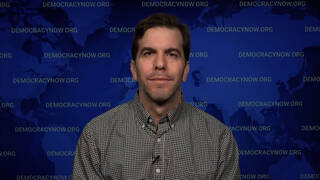
- Ali Kadivarfellow at the Radcliffe Institute for Advanced Study at Harvard University and an associate professor of sociology and international studies at Boston College.
As the U.S.-Israeli war on Iran enters its second month, President Donald Trump has said he wants “to take the oil” and seize Kharg Island, Iran’s key export hub in the Persian Gulf. President Trump’s comments come as 3,500 U.S. troops began arriving in the region on Friday, with The Washington Post reporting that the Pentagon is preparing for weeks of potential ground combat in Iran. According to a consortium of human rights groups in Iran, nearly 1,500 Iranian civilians, including at least 217 children, have been killed in U.S. and Israeli strikes. Iranian scholar Ali Kadivar says the increased targeting of residential areas, schools and hospitals in recent days shows that regime change is no longer the main goal, if it ever was. “These recent attacks on civilian infrastructure makes the war look more like a war on Iran as a nation-state,” says Kadivar, fellow at the Radcliffe Institute for Advanced Study at Harvard University and an associate professor at Boston College.
Transcript
AMY GOODMAN: This is Democracy Now!, democracynow.org. I’m Amy Goodman.
As the U.S. and Israeli war on Iran enters its second month, we also are joined by Ali Kadivar, a fellow at the Radcliffe Institute for Advanced Study at Harvard University, associate professor of sociology and international studies at Boston College. He grew up in Iran during the Iran-Iraq War, was active in the student movement at the University of Tehran.
We’re going to do this interview in two parts, Professor Kadivar. First, if you can talk about the significance of this moment as the U.S. and Israel moves into the second month of bombing Iran and Iran retaliating around the region?
ALI KADIVAR: So, Iran has gone through various wars, multiple wars, through its modern history. Any Iranian that has lived through 20th and 21st century has witnessed at least two significant wars in their lifetime. Many of these wars, even if you go back to 19th century, Iran and Russia war with Britain, then World War I, World War II, Iran-Iraq War, the June War with Israel and America, and this current war, many of the previous wars also lost — resulted in the lost territory. World War I resulted in famine and in plague. Many Iranians died.
So, these have been significant wars, and Iran is going through another war, which is — which has been an existential threat for the government. The head of the state, Ali Khamenei, was killed and removed on the first day of the war. Many officials of the Islamic Republic have been killed. Also, many residential buildings have been pounded and attacked. Schools have been bombed. Hospitals have been bombed. Over the last few days, there have been bombing and attacks on major factories, steel plants in Isfahan, in Khuzestan. And it looks like that if — maybe if the war was about the regime change, it is not anymore, or maybe never it was. These recent attacks on civilian infrastructure makes the war look like more a war on Iran as a nation-state.
AMY GOODMAN: I wanted to get your response, Professor Kadivar, to President Trump speaking on Sunday in Air Force One.
PRESIDENT DONALD TRUMP: But we’ve had regime change, if you look, already, because the one regime was decimated, destroyed. They’re all dead. The next regime is mostly dead. And the third regime, we’re dealing with different people than anybody’s dealt with before. It’s a whole different group of people.
AMY GOODMAN: Basically, President Trump is saying we’ve accomplished regime change because we killed the first group, the second group, and now the third group, we’re dealing with a whole different group of people. Your response to his definition of regime change?
ALI KADIVAR: I mean, he, of course, keeps changing his definitions and his goals. The leadership has changed in that sense. Yes, there has been some change within the Islamic Republic. But the institutions have not collapsed. Internal dynamics of Islamic Republic have functioned to replace new individuals for each positions.
And the killing and assassinations of leadership of Islamic Republic is not something new. Killing of the head of the state is new. This had not happened for a long time or in Islamic Republic. But up to the level of president, we have had senior leadership of Islamic Republic being assassinated in 1980s, and they have been replaced.
So, I don’t think the regime has changed, because these are the — the new leadership is not coming from outside the regime. In most cases, such as Mojtaba Khamenei, that is now the new leader, or Zolghadr, that became the secretary of the High Council for National Security, the new leadership have been even more hawkish than previous leadership. So, it is — in some way, it is true that the leadership has changed, and it has become more hard-line and hawkish.
AMY GOODMAN: We’re going to continue this discussion and post it online at democracynow.org, with professor Ali Kadivar, fellow at the Radcliffe Institute for Advanced Study at Harvard University, associate professor of sociology and international studies at Boston College.
Democracy Now! currently accepting applications for a development associate position to support our fundraising team. Learn more at democracynow.org. That does it for our show. I’m Amy Goodman. This is another edition of Democracy Now!





 Top
Top
Media Options