






 Watch Full Show

The rise of online prediction markets has allowed people to bet on virtually any news event. For a small group of traders, the war with Iran has been a windfall. A number of lucrative, well-timed bets related to the war totaling over $1 billion have raised alarm over people connected to the Trump administration possibly using inside information to profit.
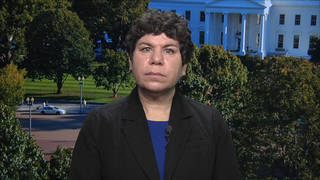
Amanda Fischer, policy director and chief operating officer for Better Markets, says it’s unclear how closely regulators are watching these online betting markets. The president’s son Donald Trump Jr. is also an adviser to the two leading prediction markets, Polymarket and Kalshi, raising further questions about conflicts of interest.
“There is a strict prohibition on offering gambling related to war, assassination, terrorism, gaming, activities that are illegal under state law or anything that’s contrary to the public interest. But the [Commodity Futures Trading Commission] under President Trump has completely retrenched from any enforcement of what kind of contracts are made available on these platforms,” says Fischer.
Related Story
 StoryApr 29, 2026“Political Disaster for Donald Trump”: Jeremy Scahill on Stalled U.S.-Iran Talks
Transcript
NERMEEN SHAIKH: We turn now to the dark world of online betting markets that allow bets on virtually any news event. For a small group of traders, the war with Iran has been a windfall. On the night of February 27th, 16 bets on the trading platform known as Polymarket made $100,000 each for accurately predicting when the U.S. would strike Iran. Soon after, one trader made over half a million dollars betting that Ayatollah Ali Khamenei would be toppled, moments before he was assassinated by Israeli forces.
The same surge was seen in oil futures trading, as well. Right before President Trump announced a temporary ceasefire with Iran on March 7th, traders bet $950 million that oil prices would drop, which they did. On the same day, 50 Polymarket accounts placed bets that the U.S. and Iran would reach a ceasefire, before Trump announced it on social media. Overall, traders have placed over a billion dollars in perfectly timed wagers relating to the Iran war.
A recent analysis by the BBC of online bets placed throughout President Trump’s second term found a consistent pattern of spikes just hours or sometimes minutes before a social media post or media statement from President Trump was made public. The timing of these bets and the huge windfalls they’ve created are raising concerns of possible insider trading.
Prediction markets and platforms like Polymarket and its biggest competitor, Kalshi, are governed by the Commodities Futures Trading Commission, or the CFTC. This means they can avoid state-level restrictions in place for traditional gambling and sports betting today. A growing number of states are trying to stop this, but the Trump administration has pushed back. Trump’s son Donald Trump Jr. has advisory roles in both Polymarket and Kalshi.
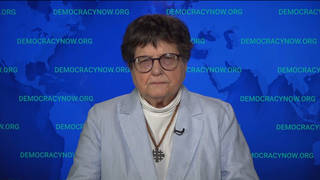
For more, we’re joined now from Washington, D.C., by Amanda Fischer, policy director and chief operating officer for Better Markets, an advocacy organization focusing on making financial markets fair and accountable. She was previously the chief of staff and senior counselor to the chair of the Securities and Exchange Commission, or SEC.
Welcome to Democracy Now!, Amanda Fischer. If you could just begin by laying out what has been happening in prediction markets, particularly since the Iran war began?
AMANDA FISCHER: Yes. Thank you for having me.
And, you know, these markets have actually existed for decades, and they have a good purpose and intent in that original design of the markets, and it’s to allow companies in real economy to manage their exposure to volatile commodities, like oil, and basically place bets that will pay out to them if the prices spike. But in recent years, and particularly since the inauguration of President Trump, we have seen an explosion of these event contracts available to retail users using apps, you know, on their phones, that allow them to bet on everything from frivolous things like celebrities and pop culture to what will happen to the price of bitcoin in the next 15 minutes to things as grave and serious as war and proxies for war.
And the real innovation that has taken place in the last 18 months or so is that the Commodity Futures Trading Commission, which is supposed to police what bets are available on these markets, and really narrow the focus to be on bets that help people in the real economy manage real commercial risks, they have stood down their enforcement and oversight. And now we see just, really, a proliferation in any number of gambling opportunities available to people in the United States and around the world.
NERMEEN SHAIKH: And could you explain, Amanda, how these prediction markets work? Most jurisdictions here do not require Polymarket users to disclose their names. Unlike the stock market, users are presented with a binary option, yes or no, so they’re actually competing against one another. And the fact that Polymarkets use cryptocurrency. If you could tell us what the implications of these things are in terms of regulating the industry?
AMANDA FISCHER: Yeah, it’s a great question. So, Polymarket is not yet licensed to operate in the United States, but they’re seeking to. But during the Biden administration, the CFTC, with the Department of Justice, found that Polymarket was offering their bets to U.S. traders without the appropriate licensing, and they had turned into a settlement and a consent order that required Polymarket to geoblock anyone signing in from the United States.
But since the Trump administration came in, there is really not a lot of clarity around if that prohibition is actually being enforced. And obviously, all of this aberrant trading activity around the Iran war raises questions on if people in the United States are placing these bets and profiting. And I think the president’s family’s involvement in Polymarket as advisers really heighten concerns that perhaps Polymarket is not abiding by the restrictions put in place in 2022. And further, they are seeking to expand in the United States and have licensing pending with the regulator, the Commodity Futures Trading Commission.
NERMEEN SHAIKH: Amanda, do we know when exactly did Trump’s family become involved in these prediction markets as advisers, including, of course, most prominently, Trump’s son?
AMANDA FISCHER: You know, similar to the president’s involvement in cryptocurrency, this all happened around the time of the election and the inauguration. And again, as you mentioned at the top of this segment, you know, his son is an adviser both to Polymarket and its competitor, Kalshi, which is highly irregular to be an adviser to two firms competing directly, head to head, in the market.
And it’s really no accident that just really weeks after the inauguration took place, the CFTC, the regulatory agency, stood down on a legal challenge to Kalshi offering bets on election outcomes, U.S. election outcomes. And then also the platforms exploded and started offering bets on sporting events, which have traditionally been regulated by state gambling commissions. And now we see a proliferation of bets related to activities that really ought to be prohibited under U.S. law. So, there is a strict prohibition on offering gambling related to war, assassination, terrorism, gaming, activities that are illegal under state law or anything that’s contrary to the public interest. But the CFTC under President Trump has completely retrenched from any enforcement of what kind of contracts are made available on these platforms.
NERMEEN SHAIKH: Well, let’s go to the beginning of the war on Iran. On the very day the U.S. and Israel launched attacks on Iran, numerous bets were made on prediction markets, drawing criticism from lawmakers. On Polymarket alone, half a billion dollars was traded over when the U.S. would bomb Iran. Democratic Senator Chris Murphy posted on X quote, “It’s insane this is legal. People around Trump are profiting off war and death. I’m introducing legislation ASAP to ban this.” Meanwhile, Senator Richard Blumenthal argued that prediction markets are, quote, “turning war into a casino game and creating a market for national security leaks.” So, Amanda, if you could comment on that and also, in particular, what effects prediction markets now have on real-world events? What kinds of incentives are created by profits?
AMANDA FISCHER: It’s a great question. And these instances of outsize profits around the announcement of major military actions raises a lot of concerns. It obviously erodes trust in our democracy, creates national security threats around the leakage of sensitive information. And, you know, law enforcement agencies in the United States should be looking into whether or not people in the United States were making these bets on offshore platforms, and looking to follow the money and trace it back. I, unfortunately, don’t have a lot of confidence that that is actually taking place. So, you know, it just introduces so much risk.
Think about — you know, there are frivolous things like if a streaker is going to run out during a soccer game, right? And then that obviously incents someone to go streak at the soccer game. But take that example and put it in a life-and-death situation around whether or not a strike hits a particular location in a global conflict. Not only does that encourage particular targets to be hit, but somebody also has to be the arbiter of whether or not the strike took place, because, as we know, news events can be ambiguous. It requires people to sort through and provide objective information on what happened. So, we already have one example of a journalist being harassed and stalked online because his reporting said that a strike did not happen, and people who had placed bets wanted him to change his journalism to say that it did happen, so that they could win out on their wager.
NERMEEN SHAIKH: And just to go back to a point that you made earlier, Amanda, the fact that Polymarket was founded here in the U.S., an American CEO, in fact, a very young man who went on to become the first self-made billionaire in the country — in the world, in fact. So, if it’s founded here in the U.S., why were U.S. customers barred from using it?
AMANDA FISCHER: Because in order to offer these types of wagers in the United States, you have to have the appropriate licensing from that agency, the CFTC, and Polymarket did not have that licensing. And also, I should really underscore that, again, these platforms were designed to offer opportunities for companies in the real economy to manage their exposure to corn price fluctuations, soybean price fluctuations, gas price fluctuations. It was not meant to be a retail betting app. So, the fact that they were —
NERMEEN SHAIKH: I’m afraid we’re going to have to —
AMANDA FISCHER: — offering these contracts — yeah.
NERMEEN SHAIKH: — leave it there.
AMANDA FISCHER: Thank you so much.
NERMEEN SHAIKH: Amanda Fischer, policy director and chief operating officer for Better Markets. She was previously the chief of staff and senior counselor to the chair of the SEC.
And that does it for today’s show. Amy Goodman will be back tomorrow broadcasting from Seattle. She’ll be speaking in Seattle tonight and tomorrow after the screenings of the new documentary about Democracy Now! called Steal This Story, Please!. Today, it’ll screen at SIFF Cinema Uptown at 4:15 and 7 p.m. and Friday at 7 p.m. Amy will then head to Portland, Oregon. I’m Nermeen Shaikh. Thanks so much for joining.



 Top
Top
Media Options