










 Watch Full Show

The United Arab Emirates announced Tuesday it would be leaving OPEC, the Organization of the Petroleum Exporting Countries, on May 1. The UAE has long disagreed with Saudi Arabia over oil production quotas and says it is leaving the group to focus on “national interests” and increase its production capacity.
“The fact that the UAE has pulled out means that this cartel will have less ability to be able to push up the price when it wants,” says Akshat Rathi, senior climate reporter at Bloomberg News. “We’ve already seen some of it not working, because there are all these other producers, like the U.S.A., but also places like Guyana, that are increasing their production a lot.”
Meanwhile, Rathi adds that as countries across the globe brace for the ripple effects of the energy shocks created by the U.S.-Israeli war on Iran, transitions to clean energy could be accelerated. “In the past, when countries were faced with this kind of energy shock, they had options that were quite limited,” says Rathi. But now countries can “try and deploy as much renewables so that they can build energy supply at home.”
Related Story
 StoryNov 29, 2023UAE Oil CEO Sultan Al Jaber Uses His Role as U.N. Climate Summit President to Push Fossil Fuel Deals
Transcript
AMY GOODMAN: This is Democracy Now!, democracynow.org, The War and Peace Report. I’m Amy Goodman, on the road to Rochester, New York, where I’ll be speaking at Monroe Community College today at noon.
We turn now to the long-term impact of the Iran war and the near closure of the Strait of Hormuz on energy systems nationwide — worldwide. On Tuesday, the United Arab Emirates, the UAE, announced it’s leaving OPEC, the Organization of Petroleum Exporting Countries, by the end of the week. The UAE has long disagreed with Saudi Arabia over oil production quotas and says it’s leaving the group to focus on national interests and increase its production capacity. The announcement came just as leaders of the six Gulf countries gathered in Saudi Arabia to discuss the regional crisis created by the war and the impact of Iran attacking their energy infrastructure.
As countries across the globe brace for the ripple effects of the energy shocks created by the war, European Commission President Ursula von der Leyen addressed the European Parliament earlier today. She warned the consequences of the current energy crisis could last for years.
URSULA VON DER LEYEN: So, the way forward is obvious. We must reduce our overdependency on imported fossil fuels, and we must boost our homegrown, affordable, clean energy supply, from renewables to nuclear, in full respect of technology neutrality.
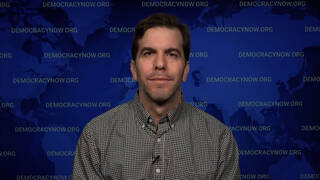
AMY GOODMAN: For more on the energy crisis and what the war has meant for the push to a clean energy transition, we’re joined now in London by Bloomberg senior climate reporter Akshat Rathi. He is the host of the Zero podcast, a newsletter on climate solutions, author of Climate Capitalism: Winning the Global Race to Zero Emissions.
Thanks so much for joining us. Start off by talking about the significance, Akshat, of UAE pulling out of OPEC.
AKSHAT RATHI: So, UAE is the third-largest producer of oil in that cartel. And it is a cartel. It increases production and decreases production to try and control the price, keep it high enough so that oil-exporting countries can balance their budgets and, you know, subsidize a lot of the lifestyle that is there in these oil-rich economies.
The fact that the UAE has pulled out means that this cartel will have less ability to be able to push up the price when it wants. And we’ve already seen some of it not working, because there are all these other producers, like the U.S.A., but also places like Guyana, that are increasing their production a lot. And that means the power that OPEC had had been weakening already, and this will be a big blow to them, purely if they are looking at just price control.
AMY GOODMAN: If you can talk about what all of this means for a transition away from fossil fuels? I mean, we’re speaking as that meeting in Santa Marta, Colombia, is taking place. Where is this all headed?
AKSHAT RATHI: So, we are currently living through what the International Energy Agency calls the biggest energy shock that the world has experienced. This is bigger than the 1970s dual oil shocks, that were there in '73 and ’79, in sheer volumes, but also as a share of total energy consumption, because it's not just oil, but also liquefied natural gas, that is getting blocked in the Strait of Hormuz.
And in the past, when countries were faced with this kind of energy shock, they had options that were quite limited. In the short term, they could try and pay more money, if they had more money, or they could try and reduce the use in some form by telling people to do less of something. But this time around, beyond those two options, there is a third or a fourth option that countries have, which is to try and deploy as much renewables so that they can build energy supply at home, because most countries have plenty of sun and the wind, and to deploy electric vehicles or electric infrastructure that would consume energy in the form of electricity, which is just a much more efficient way of consuming energy. So, for every unit of electricity you can go, if you can go a mile in an electric car, you can only go a third of the mile in a gasoline car. And so, that is what most countries are looking towards.
And this meeting in Santa Marta, that is the first meeting of countries — and it’s not all countries in the world; it’s the countries that want to transition away from fossil fuels, a few dozen, 50, 60 countries — they are meeting at this moment because they have found that the international framework for governance on climate, which is under the United Nations, isn’t addressing this key challenge, which is, countries that are, A, dependent on fossil fuel imports want to move away from fossil fuels, and then there are countries that are progressive and realize, yes, we are fossil fuel producers today, but we cannot be fossil fuel producers for long, and so we need to figure out how can we wean our economies off fossil fuel revenue and move toward a cleaner future, even if the world doesn’t care about climate change.
AMY GOODMAN: We just heard the European Commission president say that we have to reduce our dependency on imported fossil fuels. You’re always, as a climate reporter, looking at success stories, from Ethiopia to the Philippines. As we begin to wrap up, talk about the significance of what’s happening now, and if that is accelerating as a result, maybe an unintended consequence, of the U.S.-Israeli war on Iran.
AKSHAT RATHI: Well, we should note that when the 1970s oil crisis happened, and this was importing countries in North America and Europe, they turned to making themselves more efficient, trying to find cleaner sources, like nuclear, in their mix. But they were rich countries, and they could, at that time, invest in these technologies in a big way. This time around, if that was the path that the world had to take, developing countries would have really struggled.
But what is now happening, as you point out, in places like Ethiopia, you know, $1,000-per-capita income, one of the poorest countries, or the Philippines, this, you know, islanded nation with, like, really difficult terrains to work through, they are turning to clean energy sources because they are affordable and they are cheap. And sure, much of that comes from China, but most of the developing countries that are importing fossil fuels are importing economies anyway. So, rather than import fuel and fuel-burning devices, they’re like, “Well, we’ll just import electric vehicles and make the fuel ourselves by importing some of the renewables.” And so, this is the kind of move that we’ve not seen in the past, and most of the acceleration on the energy transition is likely to happen in developing countries that are really dependent on fossil fuel imports today.
AMY GOODMAN: On Monday, you tweeted climate change headlines from around the world, writing, “We might be in the middle of wars, but the climate crisis takes no break.” I mean, you’ve got the U.S. state of Georgia declaring a state of emergency after wildfires burned over 39,000 acres and destroyed more than 120 homes. In the Great Plains, intense drought is threatening winter wheat harvest. And, of course, as you talked about, in India, extreme heat right now.
AKSHAT RATHI: Well, the climate crisis does not take a break. It is a crisis that is caused by us putting out all these carbon emissions into the atmosphere, but then its impacts are run by the rules of physics and chemistry. So, even if our societies currently aren’t interested, aren’t willing to act on the climate crisis, that crisis continues to get worse.
You know, as a climate reporter, going into summer, it’s always an anxious time. People are thinking about holidays, but I’m thinking about extreme weather events that are going to go up a notch because the planet continues to get hotter. We are also looking at an El Niño formation, perhaps a super El Niño formation, which is this natural cycle that adds even more heat to the Northern Hemisphere during this period, which means extreme weather events that are being made worse by climate change could get even more extreme because a natural phenomenon adds on top.
So, I think, you know, as much as many countries, including the United States, can ignore this crisis for now, most countries do not have that comfort, and which is why the meeting at Santa Marta is so important, because the countries that are most vulnerable, island nations, they are there in Santa Marta trying to push for a legal framework to try and figure out how the world can transition away from fossil fuels. And it seems like a marginal conversation now, but it will show up again and again, because this meeting is also going to happen another year in Tuvalu, they’ve confirmed. So, next year’s meeting will look to try and get this instrument going, if it can.
AMY GOODMAN: Akshat Rathi, senior reporter for climate at Bloomberg and the host of the Zero podcast, author of Climate Capitalism: Winning the Global Race to Zero Emissions. Tune in on Thursday, when we’ll speak with journalist Bill McKibben about his new piece, “The Iran War Is Another Reason to Quit Oil.”
Coming up, “We Are Bombarding America’s Forests With Roundup,” a new investigation by Mother Jones, after this.
[break]
AMY GOODMAN: “Bad Monsanto” by the late folk musician Michael Hurley from our Democracy Now! studio.







 Top
Top
Media Options