










 Watch Full Show

The U.S. Supreme Court heard arguments Monday in a case that could determine whether thousands of cancer patients can keep suing the manufacturers of the popular weed killer glyphosate, known as Roundup. Critics of Roundup have long alleged a link between the herbicide and cancer. It was developed by Monsanto, which was bought by Bayer in 2018.
Mother Jones and the Center for Investigative Reporting recently released a major investigation by Nate Halverson that looks at how the U.S. Forest Service has been rapidly expanding its use of Roundup despite concerns about its safety. “The majority of glyphosate is still used in agriculture, but … we were able to show that the fastest-growing use is actually now for forestry,” says Halverson.
Related Story
 StoryNov 07, 2019“The Pollinators”: New Film Shows How Decline of Bee Colonies Could Mean Collapse of Food Chain
Transcript
AMY GOODMAN: This is Democracy Now!, democracynow.org. I’m Amy Goodman.
Justices at the U.S. Supreme Court heard arguments on Monday in a case that could determine whether thousands of cancer patients can keep suing the manufacturers of the popular weed killer glyphosate, or Roundup. The pesticide was developed by Monsanto, which was bought by Bayer in 2018. Critics of Roundup have long alleged a link between the herbicide and cancer. On Monday, justices appeared to be split on whether a federal law that regulates the sale and marketing of herbicides preempts state-level lawsuits against manufacturers. The case centers on whether the federal government or states should decide what warning labels should be put on herbicides.
The main plaintiff in the case is a Missouri man named John Durnell. He’s alleged two decades of exposure to the chemical caused him to develop blood cancer. A jury found Bayer had failed to warn him of the risks associated with Roundup, and awarded him $1.25 million in damages. The Trump administration, which has called Roundup safe, is siding with Bayer.
Meanwhile, Mother Jones and the Center for Investigative Reporting have just released a major investigation looking at how the U.S. Forest Service has been rapidly expanding its use of the herbicide despite concerns about Roundup’s safety. In a moment, we’ll be joined by investigative reporter Nate Halverson. But first, let’s turn to excerpts of a short documentary he made as part of the investigation he did with data reporter Melissa Lewis.
NATE HALVERSON: We found that over the past 20 years, the use of glyphosate has more than quadrupled in California forests. Check out this map that Melissa made. We only have these numbers on California because the state is crazy enough to make everyone report their pesticide use. And thank God they do, because no other state apparently does it. And so we have almost no clue what it looks like elsewhere — almost no clue.
I dug up this crazy long appendix to another crazy long EPA report. And guess what: It gives me an estimate for national use. And do you know where it estimated that 90% of forest spraying was happening? In Southern states. So, California is only a drop in the bucket. These Southern states are some of the biggest timber producers in the country, and companies are using it right after they log the land, spraying glyphosate everywhere to make way for the next generation of trees. The timber companies and the Forest Service are using Roundup in the woods to help trees grow back faster. And then one day they can cut them all down again, make more money and repeat the process. They are treating millions of acres of forest just like a row of corn.
AMY GOODMAN: An excerpt from a new short documentary by journalist Nate Halverson for Mother Jones, who’ll join us in a minute. But first another excerpt from the documentary.
NATE HALVERSON: For decades, Monsanto, the original maker of Roundup, has insisted the product is safe when used as directed. But in 2015, the World Health Organization released a landmark assessment saying glyphosate is “probably” carcinogenic. It sparked all those lawsuits.
REPORTER: The most popular weed killer in the world may cause cancer. That is the determination by the International Agency for Research on Cancer.
NATE HALVERSON: The optics were really bad. And PR catastrophes like this didn’t help.
PATRICK MOORE: You can drink a whole quart of it, and it won’t hurt you. It’s —
PAUL MOREIRA: You want to drink some? We have some here.
PATRICK MOORE: I’d be happy to, actually. Not – not really, but —
PAUL MOREIRA: Not really?
PATRICK MOORE: I know it wouldn’t hurt me.
PAUL MOREIRA: And if you say so, I have some glyphosate here.
PATRICK MOORE: No, no, I’m not stupid.
PAUL MOREIRA: Ah, OK, so, you —
PATRICK MOORE: No, but I know that —
PAUL MOREIRA: So, it’s dangerous, right?
PATRICK MOORE: I know — no, people try to commit suicide with it and fail fairly regularly.
PAUL MOREIRA: No, no, but let’s — let’s tell the truth.
PATRICK MOORE: It’s not dangerous to humans.
PAUL MOREIRA: It’s dangerous.
PATRICK MOORE: No, it’s not.
PAUL MOREIRA: Oh. So, are you ready to drink one glass of glyphosate?
PATRICK MOORE: No, I’m not an idiot.
NATE HALVERSON: Here’s where the safety debate and our investigation takes a turn, because Monsanto’s strategy went way beyond public relations. Monsanto was secretly behind some of the most influential scientific reports. It was padding the scientific studies in its favor.
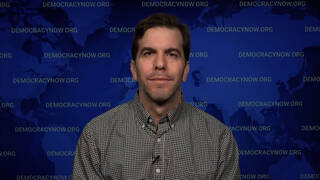
AMY GOODMAN: An excerpt from the short documentary by investigative journalist Nate Halverson, an Emmy Award-winning producer for Reveal. The video accompanies his new article for Mother Jones, headlined “We’re Bombarding America’s Forests With Roundup.” Nate Halverson joins us from San Francisco.
Hi, Nate. If you can start off by talking about the oral arguments the Supreme Court heard this week around Roundup, and then how that relates to this major investigation you’ve done for Mother Jones/Reveal?
NATE HALVERSON: Yeah, so, the Supreme Court, as you said, was hearing whether or not people will be able to sue in state courts, and — because, essentially, on the federal level, the EPA had previously come out and said that Roundup and glyphosate, the chemical behind Roundup, was safe. I think it’s worth noting that the 9th Circuit Court of Appeals actually overturned the EPA’s decision, noting that the EPA had failed in coming to this conclusion that it does not cause cancer, that by its own research, the majority of studies it looked at indicated it had caused non-Hodgkin’s lymphoma. So, even on the federal level, there’s a lot of uncertainty around the safety.
And in the state courts, I mean, some of the information you saw there in the documentary, we only have, like the internal emails from Monsanto employees talking about creating these fabricated or, as they say, ghostwritten studies — we only have that information now because people were able to sue in state courts. And in that very first lawsuit that came forward, which was here in the Bay Area, the jury determined that Monsanto had acted with, quote, “malice.” And part of that was because of their dummying up of the science, which a state appellate court upheld and said was very reasonable for the jury to have concluded.
AMY GOODMAN: So, if you can talk about Trump issuing an executive order deeming glyphosate critical to national security? He even invoked the Defense Production Act to bolster its domestic production?
NATE HALVERSON: Yeah, the Trump administration has, both in the first term, when some of these internal emails that came out in the lawsuit quoted a lobbyist saying the Trump administration was telling Monsanto that they had nothing to worry about from them, that they had Monsanto’s back around products like glyphosate, to now, of course, the executive order, which provides legal protection, and also his attempt to boost domestic production, to their intervention in the Supreme Court case — it’s a long list of the ways that the Trump administration has stepped forward to help glyphosate.
Of course, the majority of glyphosate is still used in agriculture, but it is, we found — by building this database of 5 million records with pesticide reports here in California, we were able to show that the fastest-growing use is actually now for forestry. And previous to Trump basically giving the shield laws to the manufacturers of glyphosate, you know, Bayer, he had issued a executive order to the — to increase timber production across national forests by 25%. And so, when you combine these two things, what you’re talking about is a rapid potential increase — well, we’ve seen it historically, but even going forward, a continued rapid increased use of Roundup and glyphosate in the forests of the United States.
AMY GOODMAN: I want to go back to another clip of your short documentary, released as part of your new investigation”:https://www.motherjones.com/politics/2026/04/roundup-glyphosate-spraying-forests-monsanto-science-retraction-cancer-health-concerns-maha-trump-executive-order-supreme-court-bayer-lawsuits/, “We’re Bombarding America’s Forests With Roundup.”
NATE HALVERSON: So, I wanted to talk to the Forest Service officials behind spraying glyphosate.
We’re looking for Ranger Nickerson.
I went to their outpost near my cabin in the little town of Chester, California, and I sat down with District Ranger Russell Nickerson, who oversees like half a million acres of Lassen National Forest. It was his decision to spray glyphosate here.
RUSSELL NICKERSON: So, I’m the decision-maker for the district, so for that land base.
NATE HALVERSON: Is it safe to use?
RUSSELL NICKERSON: I mean, really, if you want to talk more herbicide details, it’s probably our Washington office that you would talk to on that.
NATE HALVERSON: You know, there’s now been more than $10 billion in settlements and jury verdicts, you know, to people who got sick after being exposed to glyphosate. Does that raise concerns?
RUSSELL NICKERSON: Yeah, I mean, it does, from that level.
NATE HALVERSON: I asked him about U.S. surgeon general nominee, Dr. Casey Means.
You know, she said glyphosate, which is the most commonly used pesticide in the United States, has a direct relationship with non-Hodgkin lymphoma.
MEDIA LIAISON: Sorry, I’ll stop you right now.
NATE HALVERSON: Yeah.
MEDIA LIAISON: That’s something that — I mean, he can discuss things that are in the purview of the project.
NATE HALVERSON: Yeah.
MEDIA LIAISON: Right now it’s getting outside of, like — like, it’s not in his official capacity. So, if we can stick with the project and not so much what’s the tools that are being — that are potentially being used?
NATE HALVERSON: Yeah.
AMY GOODMAN: So, Nate Halverson, if you can talk about that scene and the interruption, and then also talk about the Trump administration’s interests in siding with Bayer, which has gone against the so-called MAHA agenda, “Make America healthy again”? MAHA wants crop chemicals reduced, if not banned entirely. What’s going on here?
NATE HALVERSON: Yeah. I mean, this was a fascinating moment, right? But this is — the person we were interviewing there is in charge of the spraying. You know, he runs half a million acres of national forest land. And so I just asked him point blank, “Is it safe to use?” And he can’t say, “Yes, it’s safe to use.”
And, you know, I pulled all of the inspection reports that the state has accrued. You know, they’re spraying hundreds of thousands of acres. So I pulled all of the reports for inspection. Only 11 times in the state of California had they actually gone out to see if they were appropriately spraying this; I mean, if the workers themselves were wearing the necessary protective equipment. And I found that — of those 11, I found photos of contractors, and foresters tell me these are predominantly Latino workers, Hispanic workers, coming up from Mexico and Central America, that you see them coming out of the forest covered in Roundup. And this is the same — when you have this skin contact, this is the same situation that resulted in all of these successful lawsuits against Monsanto, against Bayer. And these guys who are moving around, oftentimes contracted workers that don’t speak English, are covered in it. And so I also asked him about that, and he couldn’t say that that was safe.
And so, I think we have a real concern here, both for the communities around where this is being sprayed, but also for the people that are doing the spraying. And I think it’s also important to note that the EPA itself says that this adversely or harms 93% of endangered species. And we’re spraying across these incredibly environmentally sensitive areas. And of the 7% it doesn’t hurt, it’s like whales. It’s things that aren’t even in the forest.
So, I think MAHA movement has long — you know, since the MAHA movement formed, which was really formed out of other groups that had long advocated for some of these environmental issues —
AMY GOODMAN: We have 10 seconds.
NATE HALVERSON: — they really don’t — they don’t like Roundup. President Trump has come out in favor of Roundup. And so, I think you’re beginning to see a real schism between President Trump’s base.
AMY GOODMAN: Nate Halverson, Emmy Award-winning producer at Reveal and the Center for Investigative Reporting. We’ll link to your new piece, “We’re Bombarding America’s Forests With Roundup.”
That does it for our show. Today I’m headed to Rochester for a speech at Monroe Community College at noon. I hope folks come out. And then, on Friday, May 1st, I’ll be doing a fundraiser with the screening of Steal This Story, Please! at AFI Silver in Silver Spring for WHUT PBS — you can go to our website for more information — as well as a fundraiser for WPFW on May 2nd at noon at the same theater. I’m Amy Goodman. Thanks so much for joining us.





 Top
Top
Media Options