







 Watch Full Show

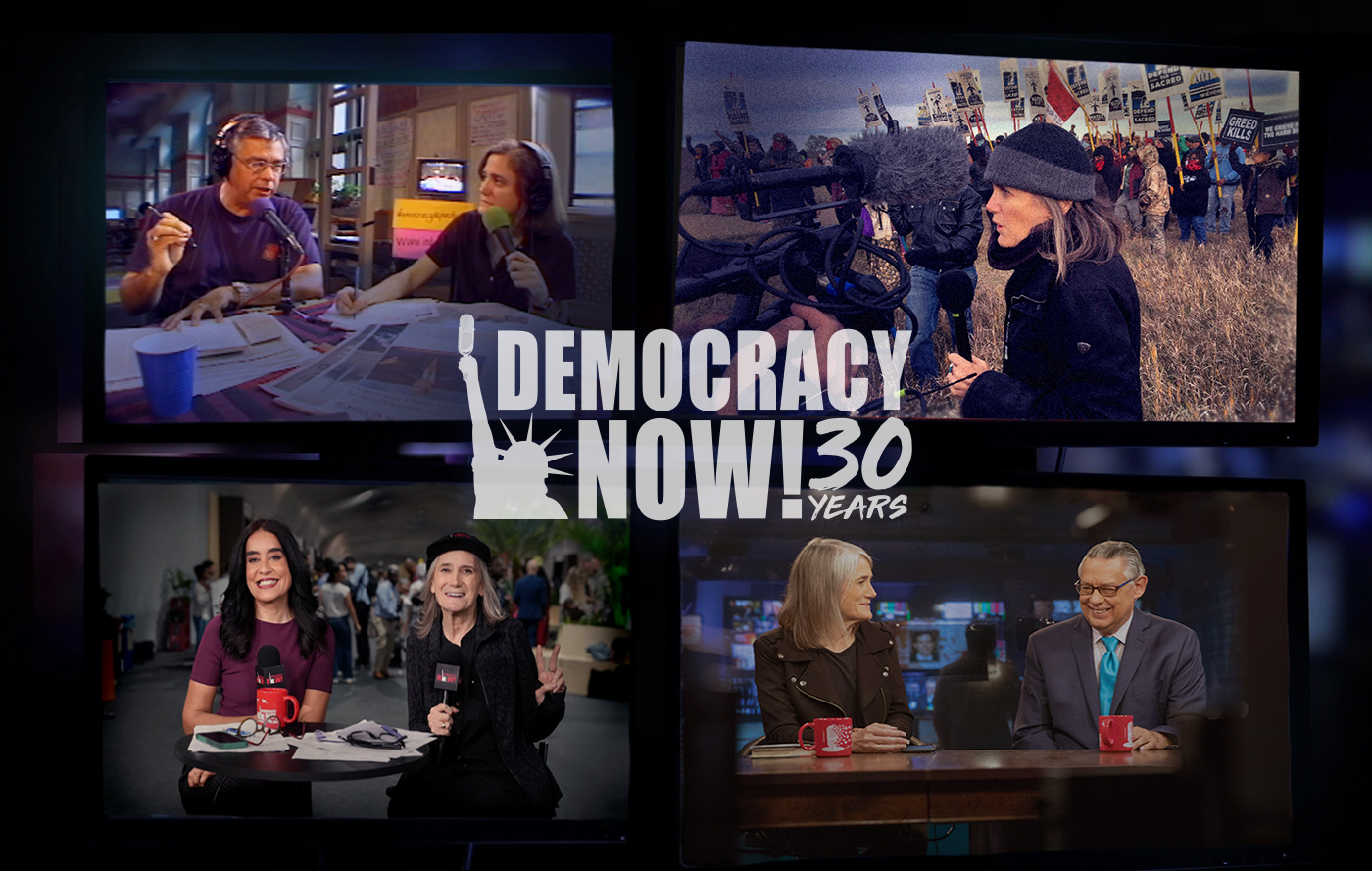
A special broadcast: Highlights from Democracy Now!’s 30th anniversary celebration at the historic Riverside Church, featuring Angela Davis, Patti Smith, Mosab Abu Toha, Michael Stipe, Hurray for the Riff Raff, Amy Goodman, Juan González, Nermeen Shaikh and a surprise appearance by Bruce Springsteen.
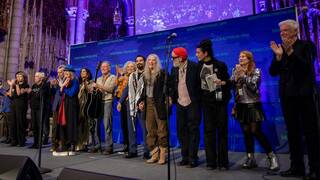
Watch our special Memorial Day broadcast featuring highlights from Democracy Now!’s 30th anniversary celebration at the historic Riverside Church on March 23, 2026. The night featured Angela Davis, Patti Smith, Mosab Abu Toha, Michael Stipe, Hurray for the Riff Raff and a surprise appearance by Bruce Springsteen.
Related Story
 StorySep 07, 2026Democracy Now! Marks 30 Years with Angela Davis, Bruce Springsteen, Patti Smith, Michael Stipe & More
Transcript
AMY GOODMAN: In late March, over 2,000 people packed into the historic Riverside Church in New York to celebrate the 30th anniversary of Democracy Now! Today, in this special, we bring you highlights from the evening. Let’s go back to that night.
AMY GOODMAN: It is our absolute honor to welcome you all here to Democracy Now!’s 30th anniversary. It is hard to contemplate a celebration at this time, amidst the U.S.-Israeli war on Iran and other armed conflicts, rising authoritarianism, power-hungry billionaires and the worsening climate catastrophe, but gatherings like this are essential, to remind us that the gathering storm, despite the forces of oppression that threaten us all on the planet, there is a force more powerful. And that is all of you gathered here tonight at Riverside Church, but in all over this country and around the world, of people joining together, organizing for peace and justice.
It was in this very sanctuary here in Riverside Church that Dr. Martin Luther King Jr. gave his famous speech “Beyond Vietnam: A Time to Break Silence” on April 4th, 1967, a year to the day before he was assassinated in Memphis. King called out in that speech “the greatest purveyor of violence in the world today: my own government,” he said. Dr. King warned, “When machines and computers, profit motives and property rights are considered more important than people, the giant triplets of racism, extreme materialism and militarism are incapable of being conquered.” How prescient he was. And, you know, at the time, King was attacked viciously and publicly for opposing the war. Life magazine accused him in an editorial of betraying the cause for which he has worked for so long, adding his speech was a “demagogic slander that sounded like a script for Radio Hanoi.” King, though, was undeterred, and his commitment to peace, despite enormous pressure to back off, should be a lesson for us all today.
Yes, tonight is a celebration, not only of 30 years of Democracy Now!, but of the resilience of people and movements we strive to cover in this country and around the world. This is such an honor to be here with you and to be with my colleagues, Juan González and Nermeen Shaikh and the whole family.
AMY GOODMAN: Let’s turn to an excerpt of the speech of Democracy Now!’s Juan González.
JUAN GONZÁLEZ: It has truly been a privilege and an honor to work with all these colleagues and to be welcomed into the homes of you, our audience, for so many years.
My modest contribution as a part-time host and secretary treasurer of the board of Pacifica all these years was to shed light not so much on the who, what, where and when of the news, but on the why and the how, the historical context and broader framework of social forces underlying those events.
All of our achievements, however, have always been bittersweet for me, for even as the show has thrived, and even as platforms for news and information, including progressive and independent ones, have proliferated, the American public’s consciousness has plummeted when it comes to the malevolent, destructive and barbaric role of U.S. imperialism, whether in its neoliberal or its fascist management form. In our contemporary world, morality, decency, the quest for peaceful resolution of conflict, empathy for the weak and the powerful are branded as weaknesses, while bombast, cruelty, patriarchy, the frenzy for obscene profits, hate, torture, outright fraud and lies are celebrated as signs of strength and power. Sadly, reporting the truth is important, but it is not sufficient to make a better world possible, especially when capitalism, with artificial intelligence and internet bots, has mastered, to previously unimagined levels, the mass production of disinformation and alternative realities. In the end, only organizing resistance of working-class and oppressed peoples of the world, strengthened by — yes, by revolutionary analysis, can bring about a better world.
AMY GOODMAN: I want to introduce no one more appropriate to perform after Juan González than Hurray for the Riff Raff with the Bronx-born Alynda Segarra. The band’s new album has just come out. It’s called Live Forever. This song, “Pa’lante,” was featured in the short New York Times documentary Takeover about the Young Lords, who took over Lincoln Hospital in 1970. “Pa’lante” means “onwards,” or, as Juan says, “Right on.”
HURRAY FOR THE RIFF RAFF: [performing “Pa’lante”]
Well, I just wanna go to work
And get back home, be something
I just wanna fall in line
And do my time, and be something
I just wanna prove my worth
On the planet Earth, and be something
I just wanna fall in love
And not ruin it, and feel something
Well, lately, don’t understand what I am
Treated as a fool
Not quite a woman or a man
Well, I don’t know
I guess I don’t understand the plan
Colonized, and hypnotized, be something
Sterilized, dehumanized, I’ll be something
They tell you take your pay
But stay out the way, go be something
They tell you do your best
Forget the rest, be something
Well, lately, it’s been mighty hard to see
Just searching for my lost humanity
I look for you, my friends
But do you look for me?
Lately I’m not too afraid to die
I wanna leave it all behind
I think about it sometimes
And lately all my time’s been movin’ slow
I don’t know where I’m gonna go
Just give me time, and I’ll know
Oh, any day now
Oh, any day now
I will come along
Oh, any day now
Oh, any day now
I will come along
Oh, I will come along
AMY GOODMAN: This is Hurray for the Riff Raff. We’ll be back.
HURRAY FOR THE RIFF RAFF: ¡Pa’lante!, my friends!
From El Barrio to Arecibo, ¡Pa’lante!
And from Marble Hill to the ghost of Emmett Till, ¡Pa’lante!
And to Juan, Miguel, Milagros, Manuel, ¡Pa’lante!
And to all who have to hide, we say, ¡Pa’lante!
And to all who lost your pride, ¡Pa’lante!
And to all trying to survive, ¡Pa’lante!
¡Pa’lante!
To the earth under our feet, ¡Pa’lante!
To resistance in the street, ¡Pa’lante!
To the children of the world, ¡Pa’lante!
To the poets of Palestine, ¡Pa’lante!
To the dream that can never die, ¡Pa’lante!
To all who came before, we say, ¡Pa’lante!
To all who came before, we say, ¡Pa’lante!
AMY GOODMAN: Hurray for the Riff Raff at Democracy Now!'s 30th anniversary celebration. This is Democracy Now!, democracynow.org. I'm Amy Goodman.
We turn now to the Pulitzer Prize-winning Palestinian writer and poet Mosab Abu Toha. He fled Gaza with his family in December 2023 after he was detained by Israeli forces for two days. He was close friends with the Palestinian poet Refaat Alareer, who was killed in an Israeli airstrike in 2023. This is Mosab Abu Toha speaking at Riverside Church.
MOSAB ABU TOHA: Thank you so much, Democracy Now! Thank you, Amy, Nermeen and Juan.
I mean, these are very heartbreaking moments. There is no language that can describe my feelings listening to my dear friend Refaat. He is somewhere else better than this ugly world that we are trying, all of us, to survive.
It was October 12th, 2023, when I had my interview with Amy. I was still in our house in Gaza. This house has been a heap of rubble since October 30th, 2023. Just two days after the interview I did with Amy on October 12th, Israel killed 30 members of my extended family, including my great-uncle, Khader Abu Toha, his wife, his children, the wives of his children, the grandchildren. The youngest was 4 years old. That same Khader was the only one in my family who was interested in doing the family tree. And I ended up doing his family tree after he was killed. And that’s something that I kept doing, unfortunately, to document the genocide that Israel perpetrated not only against Palestinians, but the Palestinian families. Israel has erased hundreds of families in Gaza, including some of my relatives, some of whom remain under the rubble even now.
“Under the Rubble.”
She slept on her bed,
never woke up again.
Her bed has become her grave,
a tomb beneath the ceiling of her room,
the ceiling a cenotaph.
No name, no year of birth,
no year of death, no epitaph.
Only blood and a smashed
picture frame in ruin
next to her.
In Jabalia camp, a mother collects her daughter’s
flesh in a piggy bank,
hoping to buy her a plot
on a river in a faraway land.
A group of mute people
were talking sign.
When a bomb fell,
they fell silent.
It rained again last night.
The new plant looked for
an umbrella in the garage.
The bombing got intense
and our house looked for
a shelter in the neighborhood.
I leave the door to my room open, so the words in my books,
the titles, and names of authors and publishers,
could flee when they hear the bombs.
I became homeless once but
the rubble of my city
covered the streets.
They could not find a stretcher
to carry your body. They put
you on a wooden door they found
under the rubble:
Your neighbors: a moving wall.
The scars on our children’s faces
will look for you.
Our children’s amputated legs
will run after you.
He left the house to buy some bread for his kids.
News of his death made it home,
but not the bread.
No bread.
Death sits to eat whoever remains of the kids.
No need for a table, no need for bread.
A father wakes up at night, sees
the random colors on the walls
drawn by his four-year-old daughter.
The colors are about four feet high.
Next year, they would be five.
But the painter has died
in an air strike.
There are no colors anymore.
There are no walls.
I changed the order of my books on the shelves.
Two days later, the war broke out.
Beware of changing the order of your books!
What are you thinking?
What thinking?
What you?
You?
Is there still you?
You there?
Where should people go? Should they
build a big ladder and go up?
But heaven has been blocked by the drones
and F-16s and the smoke of death.
My son asks me whether,
when we return to Gaza,
I could get him a puppy.
I say, “I promise, if we can find any.”
I ask my son if he wishes to become
a pilot when he grows up.
He says he won’t wish
to drop bombs on people and houses.
When we die, our souls leave our bodies,
take with them everything they loved
in our bedrooms: the perfume bottles,
the makeup, the necklaces, and the pens.
In Gaza, our bodies and rooms get crushed.
Nothing remains for the soul.
Even our souls,
they remain stuck under the rubble for weeks.
Now for years.
For Gaza, for Refaat Alareer, for all our loved ones, those who were killed, those who are surviving in the streets, in tents, for my three sisters who are in Gaza right now, for my beloved ones who remain under the rubble while we are speaking for a free Palestine.
[singing “Yamma Mweil El-Hawa”]
Thank you.
AMY GOODMAN: That was the Palestinian writer and poet Mosab Abu Toha, who just recently won a Pulitzer Prize for his essays in The New Yorker magazine.
This is Democracy Now! co-host Nermeen Shaikh speaking at Democracy Now!’s 30th anniversary celebration.
NERMEEN SHAIKH: We’re living, irrefutably — if perhaps, in some instances, not irreversibly — in a time of multiplying and accelerating crises. To name only the most obvious and the most proximate, the slow and now rapid transformation of this country into a more brutal, more unforgiving and more exclusionary polity and society, the scale of which, as we witness it, is literally unfathomable. The cruelty of the current administration is everywhere in evidence. It would take the remainder of this evening, and indeed well beyond it, to rehearse the litany of horrors to which we’re daily confronted.
What, then, is our orientation, our vision, as this administration continues unleashing its violence, both within and without the borders of this country? What possibilities exist as we report on what appears an imminent threat of world war, and crucially, of those suffering in its midst — of course, in Iran, but also elsewhere — or when we speak of the calamitous and ongoing lethal effects on the world’s very poorest of the staggering cuts in U.S. aid, or as we tell the stories of those brutalized while protesting ICE or the stories of the tens of millions enduring merciless wars, from Palestine to Ukraine to the DRC and Sudan, the latter African countries, to our collective shame, almost totally absent from the public sphere?
The only gesture, of course, the only gesture possible, of course, is resistance, a resistance whose source and agency must find expression in the media.
AMY GOODMAN: It is my honor to bring up on the stage Michael Stipe, the singer-songwriter, artist and activist, … and Aaron Dessner, Grammy Award-winning musician and producer, founding member of The National and a close collaborator with Taylor Swift. … They’re singing “No Time for Love Like Now.”
MICHAEL STIPE: Thank you, Amy. This evening feels like a clarion call, a voice, a voice of courage, of optimism and resilience and community in the face, in the midst of system collapse. We are honored to be here and to be a part of this community. Thank you.
MICHAEL STIPE and AARON DESSNER: [performing “No Time for Love Like Now”]
No time for breezy
No time for arguments
There’s no time for love like now
There’s no time in the bardo
No time in the in-between
No time for love like now
Where did this all begin to change?
The locked-down memories can’t sustain
This glistening, hanging free fall
I turned away from the glorious light
I turned my head and cried
Whatever waiting means in this new place
I am waiting for you
There’s no time for dancing
No time for undecideds
No time for love like now
There’s no time for honey
No time for psalms and thresholds
Whisper a sweet prayer sigh
Where did this all begin to change?
The locked-down memories can’t sustain
This glistening, hanging free fall
I turned away from the glorious light
I turned my head and cried
Whatever waiting means in this new place
I am waiting for you
Your voice is echoing love, love, love, love, love
I hear it far, far away
And I am waiting for you
Yes, I am waiting for you
Whatever waiting means in this new place
I am waiting for you
Yes, I am waiting for you
I am waiting for you
Thank you.
AMY GOODMAN: Right now, to say the least, we have a very, very special guest, Angela Davis. Angela, it is such an honor to be with you tonight.
ANGELA DAVIS: Well, congratulations, Amy, Nermeen and Juan, on the occasion of the 30th. Can you believe it? Thirtieth anniversary of Democracy Now! Without Democracy Now!, I do not know where we would be today. You know, I can remember when we felt unseen and unacknowledged, when we had no legitimate place or space in the established media. And so, before I say anything else, I just really want to say thank you on behalf of all of the progressive and radical movements in this country and the world.
AMY GOODMAN: Start where you grew up. Start in Birmingham, Alabama, and what it meant to grow up in Dynamite Hill. And then take us on a short trajectory of your remarkable life.
ANGELA DAVIS: Really? Well, you know, that was over 80 years ago.
OK, Amy, I was born in 1944 in Birmingham, Alabama, at a time when the government of the city and of the state were in — literally in the hands of the Ku Klux Klan. And I often point out that some of my earliest memories are of hearing the sound of dynamite, because when my family moved into that area, Black people were allowed to live on one side of the street, Center Street, which was the dividing one, but not on the other side. And one of the stories I never tire of telling is that, as kids, we knew that a Ku Klux Klan man, Klansman, lived right across the street from us, and we knew that we were not allowed to cross that street. Black people weren’t allowed to cross that street unless they worked for white people in the neighborhood. And so, you know, sometimes, instead of playing hide-and-go-seek or, you know, all of the other children’s games that we used to play, we used to dare each other to run across the street. And if you were really courageous, you would not only run across the street, you would run up the steps of the Klansman’s house and ring the doorbell and try to make it back across the street before they came to answer.
So, I mean, I say that because I know the theme of this evening is resistance. And as I look at — as I see Palestinian children throwing rocks at the Israeli military, I realize that, you know, in some communities, resistance is the only possibility of living a life of significance.
And what is so — what is so exciting about this moment is that we’ve struggled so long for Palestine solidarity to be a part of the largest social justice agenda in this country, and for so long it appeared as if Zionism was so powerful that we would never achieve that goal. And so, people who worked around issues of Palestine solidarity had to do it in a kind of marginalized fashion, not in connection with what we consider to be the main issues of social justice. But I can say now that I am really thankful that I’ve managed to live as long as I have, because I also see myself as a witness for all of those who struggle for Palestine, and Palestine in connection with feminism, Palestine in connection with the struggle against racism, Palestine in relation to our antiwar movements.
JUAN GONZÁLEZ: Angela, I’d like to ask you about those grand forms of resistance. We were politically formed during the same period of time, and you first came to national fame, or national or international notoriety, as a member of the Black Panther Party. And I’m wondering if you could share, especially for the young people here, what drew you to revolutionary struggle, to the Panther Party. And what kinds of lessons, good and bad, have you drawn from that experience that might help other folks who are organizing resistance and seeking to build a better world today?
ANGELA DAVIS: I think I’ve always been connected with some kind of collective. And I suppose I would say that is because it became clear that, despite the individualism that is promoted, and especially in relation to and by capitalism, that nothing that we do as individuals is ever going to really make a major difference. We always have to be connected with community.
And so, when the Black Panther Party was organizing in Los Angeles for the very first time, I was, as a matter of fact, teaching at UCLA, and I asked, “Well, how can I be of assistance? What can I do?” So I began to work with the political education program that John Huggins, Ericka Huggins’ husband at the time, was working on. So, John and I worked on political education for the Black Panther Party, until he was killed at UCLA. And, you know, it’s a long and very complicated story.
But the fact is that I think I’ve always felt more comfortable in environments where I could resist, where I could say no, and not be by myself saying no, being with others who recognize that we need — we need a different kind of world, a world without racism, a world without heteropatriarchy, a world without economic exploitation, a world without colonialism, a world without genocide. And the only way to do that is together.
AMY GOODMAN: I have the enormous pleasure to introduce our next guest. A special guest is coming later. This is also an extremely special guest, who I can name at this moment: Patti Smith, singer-songwriter, poet, author, widely known as the “grandmother of punk.” And we want to welcome Patti Smith, her daughter Jesse Smith and Tony Shanahan to the stage.
PATTI SMITH: On March 16th, 2003, Rachel Corrie, a young nonviolence activist, was protesting the Israeli demolition of homes in the Gaza Strip. Bulldozers had already destroyed surrounding houses in Rafah, where she was based. They targeted the family home of Professor Nasrallah, where she was staying. Corrie, wearing an orange vest, bullhorn in hand, called for them to cease. She stood on a raised mound in the path of an Israeli bulldozer. But it kept going. Her fellow activists cried out, and the Nasrallah children watched in horror as she was crushed to death. The loss of Corrie, a bright, altruistic force, just two years older than my own son, haunted me.
At the same time, on the first day of spring, it was obvious that all the marches, pleas and protests of millions of people worldwide were not going to halt the Bush administration’s plan to attack Baghdad.
That was 23 years ago, when Tony Shanahan and I wrote this song. We wrote it to comfort the family of Rachel Corrie and to send a small — a small message of hope to the Palestinian people.
PATTI SMITH, TONY SHANAHAN and JESSE SMITH: [performing “Peaceable Kingdom”]
Yesterday I saw you standing there
With your hands against the pane
Looking out the window at the rain
And I wanted to tell you
All your tears were not in vain
But I guess we both knew
We’d never be the same
Never be the same
Why must we hide all these feelings inside?
Lions and lambs shall abide
Maybe one day we’ll be strong enough
To build it back again
Build the peaceable kingdom
Back again
Build it back again
AMY GOODMAN: This is Patti Smith. We’ll be back in a minute.
PATTI SMITH, TONY SHANAHAN and JESSE SMITH: Why must we hide all these feelings inside?
Lions and lambs shall abide
Maybe one day we’ll be strong enough
To build it back again
Build the peaceable kingdom
Back again
Maybe one day we’ll be strong enough
We can build it back again
Build the peaceable kingdom
Build it back again
Build the peaceable kingdom
Build it back again
I was dreaming in my dreaming
of an aspect bright and fair
and my sleeping it was broken
but my dream it lingered near
in the form of shining valleys
where the pure air rarefied
and my senses newly opened
'cause I awakened to the cry
that the people have the power
to redeem the work of fools
upon the meek the graces shower
it's decreed the people rule
Thank you. Jesse Paris Smith, Tony Shanahan. Thank you.
AMY GOODMAN: That was Patti Smith performing at Democracy Now!'s 30th anniversary. Yes, this is Democracy Now!, democracynow.org. I'm Amy Goodman, as we go back now to the Riverside Church celebration.
AMY GOODMAN: We couldn’t think of a way to end tonight. But then I saw someone in the audience, and I realized this is how we give thanks. Let’s bring on “The Boss,” Bruce Springsteen!
BRUCE SPRINGSTEEN: Hello! Happy anniversary, Democracy Now! Happy anniversary, Amy. It’s so wonderful to be here. And happy birthday, Patti! You’re welcome.
Past winter, the federal troops brought death and terror to the streets of Minneapolis. They picked the wrong city, because the power and the solidarity of the people of Minneapolis was an inspiration to the entire country. Their strength and their commitment told us that this is still America, and the reactionary nightmare and the invasion of an American city will not stand. Their strength gave us hope. They gave us courage. And for those who gave their lives — Renee Good, mother of three, brutally murdered, Alex Pretti, VA nurse, executed, shot in the back by ICE in the street and left to die — their bravery, their sacrifice and their names will not be forgotten.
This is “Streets of Minneapolis.”
[singing] Through the winter’s ice and cold
Down Nicollet Avenue
A city aflame fought fire and ice
'Neath an occupier's boots
King Trump’s private army from the DHS
Guns belted to their coats
Came to Minneapolis to enforce the law
Or so their story goes
Against smoke and rubber bullets
By the dawn’s early light
Citizens stood for justice
Their voices ringin’ through the night
And there were bloody footprints
Where mercy should have stood
Two dead, left to die on snow-filled streets
Alex Pretti and Renee Good
Oh, our Minneapolis, I hear your voice
Singing through the bloody mist
We’ll take our stand for this land
And the stranger in our midst
Here in our home, they killed and roamed
In the winter of '26
We'll remember the names of those who died
On the streets of Minneapolis
Trump’s federal thugs beat up on
His face and his chest
Then we heard the gunshots
And Alex Pretti lay in the snow dead
Their claim was self-defense, sir
Just don’t believe your eyes
It’s our blood and bones
And these whistles and phones
Against Miller and Noem’s dirty lies
Oh, Minneapolis, I hear your voice
Crying through the bloody mist
We’ll remember the names of those who died
On the streets of Minneapolis
Now they say they’re here to uphold the law
But they trample on our rights
If your skin is black or brown, my friend
You’ll be questioned or deported on sight
And in our chants of ”ICE out now”
Our city’s heart and soul persists
Through broken glass and bloody tears
On the streets of Minneapolis
Oh, Minneapolis, I hear your voice
Singing through the bloody mist
Here in our home, they killed and roamed
In the winter of '26
We'll take our stand for this land
And the stranger in our midst
We’ll remember the names of those who died
On the streets of Minneapolis
We’ll remember the names of those who died
On the streets of Minneapolis
AMY GOODMAN: Well, we can’t end tonight without a joint rendition of the appeal someone made when Patti was singing, “People Have the Power,” with all the musicians on the stage, including Bruce. Folks, thank you so much for coming out and celebrating. We hope you all join in.
PATTI SMITH: Let’s do it.
PATTI SMITH, ET AL.: [performing “People Have the Power”]
I was dreaming in my dreaming
well, of an aspect bright and fair
and my sleeping it was broken
but my dream it lingered near
in the form of shining valleys
where the pure air rarefied
and my senses newly opened
'cause I awakened to the cry
that the people have the power
to redeem the work of fools
upon the meek the graces shower
it's decreed the people rule
People have the power — believe it
People have the power — make it so
People have the power
People have the power
Vengeful aspects became suspect
and bending low as if to hear
and the armies ceased advancing
because the people had their ear
and the shepherds and the soldiers
well, they lay beneath the stars
exchanging visions
and laying arms
to waste in the dust
in the form of shining valleys
where the pure air rarefied
and my senses newly opened
I awakened to the cry — come on
People have the power — believe it
People have the power — make it so
People have the power
People have the power
Where there were deserts
I saw fountains
and like cream the waters rise
and we strolled there together
with none to laugh or criticize
well, and the leopard
and the lamb
lay together truly bound
well, I was hoping in my hoping
to recall what I had found
I was dreaming in my dreaming
god knows a purer view
as I surrender into my sleeping
I commit my dream to you — come on
People have the power — to dream
People have the power — to vote
People have the power — to march
People have the power — to love
The power to dream, to rule
to wrestle the world from fools
it’s decreed the people rule
well, it’s decreed the people rule
Listen
I believe everything we dream
can come to pass through a union
we can turn the world around
we can turn the Earth’s revolution
we have the power
People have the power
The people have the power
The people have the power
The people have the power
Don’t forget it: Use your voice! Democracy now!
AMY GOODMAN: Patti Smith’s iconic iconic song, “People Have the Power,” performed by Patti herself, Bruce Springsteen, Michael Stipe, Aaron Dessner, Alynda Segarra, together at Democracy Now!'s 30th anniversary at Riverside Church. To see the full event, go to democracynow.org. And that does it for today's show. Special thanks to Julie Crosby, Charina Nadura and Mike Burke. I’m Amy Goodman. Thanks so much for joining us.



 Top
Top
Media Options