









 Watch Full Show

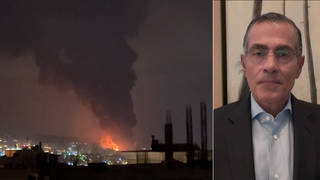
After the downing of an Apache helicopter near the Strait of Hormuz, the United States and Iran have begun trading missile and drone strikes in the most serious escalation of hostilities since the April ceasefire agreement. President Trump posted on social media Wednesday morning that Iran has taken “too long to negotiate a deal” and would now have to “pay the price!!!” For more, we speak to Mohammad Eslami at Tehran University, who says Trump’s “lies and broken promises” have shattered Iranians’ trust in a diplomatic solution. “Every night, there are lots of peoples chanting all around the street against Trump. And also, … unfortunately, many of them are chanting against negotiation with Donald Trump,” he says. “Right now they are asking the Iranian [forces] to retaliate.”
Related Story
 StoryJun 18, 2026Trump’s War on Iran Ends with a “Triumphant” Tehran and a Diminished U.S.: Vali Nasr
Transcript
AMY GOODMAN: This morning, President Trump posted on Truth Social that Iran has taken too long to negotiate a ceasefire deal and will now have to, quote-unquote, “pay the price.”
This comes as the U.S. military said it had completed strikes against Iran that were reportedly in response to the downing of a U.S. Apache helicopter near the Strait of Hormuz. Iranian state media is reporting around 20,000 Iranians have lost access to drinking water after two reservoirs were reportedly hit by U.S. strikes. Two U.S. officials told CNN the Apache helicopter was brought down by an Iranian drone, and said it was unclear whether the helicopter was intentionally targeted. An Apache helicopter costs between $52 [million] and over $100 million, while an Iranian Shahed drone costs roughly $35,000.
Iran said it launched regulatory strikes on U.S. targets in the region. This morning, Iran’s Revolutionary Guards said they had carried out missile and drone attacks on U.S. military bases in Jordan, Kuwait and Bahrain. This is Iran’s President Masoud Pezeshkian.
PRESIDENT MASOUD PEZESHKIAN: [translated] We must get out of this “no war, no peace” state. War is certainly not in the country’s interest, but if they think that by violating our dignity, our territory and our homeland, we will surrender or back down, then let them only dream about it. This is not something that we will back down from.
AMY GOODMAN: The social media post made by President Trump this morning said, quote, “Iran is all talk and no action. The Bully of the Middle East is DEAD!!!” in all caps. “They’ve taken too long to negotiate a deal that would have been great for them, now they will have to pay the price!!!” unquote.
For more, we go to the Iranian capital, Tehran, where we’re joined by Mohammad Eslami, research fellow at the University of Tehran. His latest piece, he co-authored for Responsible Statecraft. It’s headlined “The Persian Gulf is blowing up. These 3 obstacles explain why.”
Mohammad, thanks so much for being with us. If you could explain why? But start off by responding to President Trump saying Iran will now pay the price, after saying that they were days away, the U.S. and Iran, from reaching an agreement, which he has said dozens and dozens of times before.
MOHAMMAD ESLAMI: First of all, thank you so much for having me, Amy.
I should say that this war, which is a war of choice, a collaboration between Donald Trump and Bibi Netanyahu, is based on a series of miscalculations regarding the Iranian people, Iranian political system, Iranian economy and resilience, and also the role of the Americans in the regional order around the Persian Gulf. Right now Donald Trump is threatening Iranians, while he didn’t achieve none of his declared objectives during the war. The Iranian political system is intact. The Iranian nuclear program, which has lots of capabilities, according to NPT, Non-Proliferation Treaty, is continuing. The Iranian stockpile is in the hand of the Iranians. It is about 100 days that the Iranians closed the Strait of Hormuz, and the U.S. naval blockade cannot and couldn’t open the Strait of Hormuz. And right now Donald Trump is threatening again to bomb Iran. It is not — it is not a way that he can proceed.
Right now there are three challenges that they face during the negotiations between Iranians and Americans. First of all, Donald Trump is thinking about face saving in a war he cannot win and he cannot leave. He’s not thinking about the details of the negotiations. He’s thinking about his social media account, Truth Social, and other things.
The second point is, while the Americans are asking Iranians to act and to do irreversible actions, they cannot offer Iranians the same irreversible actions. Right now Donald Trump is out of his card. I mean, maximum pressure and the sanctions doesn’t work. A campaign of two — I mean, two military powers in the region and internationally didn’t work. A coercive diplomacy didn’t work. And right now he’s again threatening the Iranians. So, Iranians understood by — I mean, Donald Trump one and Donald Trump two, that — I mean, sanctions relief is not something irreversible from the American side, while the Americans are asking Iranians to do irreversible actions.
And the second — and the third point is about the regional order. Donald Trump sacrificed the interests of the American people. Donald Trump sacrificed the future of the so-called American allies around Persian Gulf, these Arab states — I mean, Arab states around Persian Gulf interests sacrificed by Donald Trump. The so-called, I mean, international order or regional order around Persian Gulf was based on American promises to defend these countries. But after this war, these Arab states understood that Donald Trump and the Americans will not defend them in any kind of circumstances. And right now the Strait of Hormuz is closed.
So, Donald Trump is asking Iranians to trust him, a most — one of the most corrupted persons, one of the most unreliable persons in the decades in international relations, a man who has betrayed the diplomacy two times. Last war, Iranians and Americans were in active negotiations, when Donald Trump and Bibi Netanyahu started this war against the Iranians. He asking Iranians to trust him and sign a useless memorandum of understanding and see what happens after 13 days or 16 days. Right now he’s putting pressure on the Iranians not to release the Iranian frozen assets. This is not working. And if he wants to start a new campaign against Iran, I don’t think that he can achieve none of his declared goals again.
AMY GOODMAN: The latest news we have, Mohammad, about a reservoir hit by the U.S. military, that 20,000 people are out of drinking water. I think it’s in southern Iran. Have you heard anything about this? And then, specifically to respond to this latest tweet of Donald Trump saying Iran will “pay the price.” I’m wondering the response in the streets, those who support the regime in Iran, and even those who don’t.
MOHAMMAD ESLAMI: You know, Donald Trump, for Iranians, is an iconic person who is famous for his lies and broken promises. Donald Trump started this war claiming that he’s going to do something for the interests of the Iranian people. After he understood that he cannot, I mean, have this kind of very quick success by attacking Iran and assassinating the Iranian leaders, he threatened all the Iranians. He said lots of appropriate words about Iranians, not only about the Islamic Republic. He said that he’s going to finish the Iranian civilization. I’m sure that he cannot — he does not know the meaning of this, the word “civilization,” because a civilization cannot be done and cannot be finished by bombing. So, right now by bombing the water facilities in Iranian cities, the Iranians understood, and they were understood during the war, that Donald Trump is not thinking for a minute about the future of the Iranian people.
Right now lots of cities, including Tehran, the capital city, every night, there are lots of peoples chanting all around the street against Trump. And also, I should say, that, unfortunately, many of them are chanting against negotiation with Donald Trump. And it is interesting that after lots of negotiations in Islamabad, in Qatar, and also lots of back-channel negotiations between Iranians and Americans, those ordinary people in Tehran’s streets saying that “We were right from the day one when we asked you not to negotiate with Donald Trump.” And right now they are asking the Iranian military — I mean, forces to retaliate what happened during the war.
AMY GOODMAN: Finally, I wanted to ask you, although it may sound strange, about the sports game, about World Cup. Mexico says that the Iranian soccer team can sleep there, because they haven’t been allowed to come into the United States except to play, though the Iranian World Cup players will now be allowed to enter the U.S. the day before matches. But I wanted to ask you about their pin, “165.” When they recently — “168.” When they recently played a game, they held the backpacks of — symbolizing the Iranian girls who were killed in southern Iran, in Minab. That number 168 is referring to the children that were killed at the girls’ school there with a U.S. Tomahawk missile. Is this being paid attention to at the same time, Mohammad?
MOHAMMAD ESLAMI: First of all, regarding the soccer and football, soccer and football is a symbol of dignity for the Iranian ordinary people. Donald Trump administration, by these disrespectful actions against the Iranian team, is uncovering their intentions regarding the Iranian people. It’s not about the Iranian political system.
And talking about Minab, and I should also add what happened in Lamerd, they have tested new bombs with the Iranian, I mean, civilians and victims, Iranian victims in Minab, the girls in Minab, and also the civilians in Lamerd. It is a very, very sad story. Lots of years, we should talk about what happened in Minab. Those girls and those boys, that kids in Minab, were not among these political calculations. The American — I mean, Trump administration killed all of them intentionally. This is how we think about what happened in Minab. We don’t think that what happened in Minab is unintentionally an accident. It was not an accident, because the American military is the most powerful military in the human history, and they have intentionally killed them, yeah.
AMY GOODMAN: We have to leave it there, but, of course, we’re going to continue to follow what happens in Iran and between the U.S., Iran and Israel. Mohammad Eslami, research fellow at the University of Tehran, we’ll link to your latest piece in Responsible Statecraft headlined “The Persian Gulf is blowing up. These 3 obstacles explain why.”
When we come back, as fans watch Game 4 of the NBA playoffs at Madison Square Garden, they, too, are being watched. We’ll talk to Wired contributing editor Noah Shachtman. His latest piece, “The Shocking Secrets of Madison Square Garden’s Surveillance Machine.” Stay with us.
[break]
AMY GOODMAN: “Hi-Fly” by the late legendary pianist and composer Randy Weston. To see him playing and our interview, go to democracynow.org.




 Top
Top
Media Options