








 Watch Full Show

The FIFA World Cup kicks off today with two games in Mexico. This will be the biggest World Cup in history, with teams from 48 countries playing over 100 games in 16 host cities across Canada, Mexico and the United States. With a new FIFA pricing system in place, tickets are significantly more expensive for this World Cup than for previous tournaments. And Trump’s harsh immigration policies are having another chilling effect on the games. Out of the 39 countries under either a full or partial U.S. travel ban, four — Iran, Haiti, Côte d’Ivoire and Senegal — are expected to play in the World Cup. Players from the latter three countries received visa exemptions, while the Iranian team must train in Tijuana, Mexico.
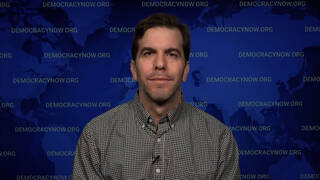
“This World Cup is shaping up to be one of extreme exclusion,” says author and former professional soccer player Jules Boykoff. “Working-class fans basically have no chance of buying a ticket to these games … and you have people who have chosen not to come to the United States because they fear getting scooped up by Immigration and Customs Enforcement.”
More from this Interview
Transcript
NERMEEN SHAIKH: This is Democracy Now! I’m Nermeen Shaikh in New York, with Amy Goodman in Sheffield, England.
The FIFA Men’s World Cup kicks off today with two games in Mexico. Mexico plays South Africa in Mexico City, and South Korea takes on the Czech Republic in Guadalajara. This will be the biggest World Cup in history, with teams from 48 countries playing over a hundred games in 16 host cities across three countries — Canada, Mexico and the United States. This is also the first time a host nation is at war with a participating country, the United States and Iran.
AMY GOODMAN: Policies from the Trump administration, as well as the football federation FIFA, are making the people’s game more inaccessible than ever. There’s already the most expensive World Cup in history, this is. And Trump’s harsh immigration policies are having a chilling effect on the games. There are 39 countries that are under either a full or partial travel ban, four of which — Iran; Haiti; Côte d’Ivoire, the Ivory Coast; and Senegal — are expected to play in the World Cup.
Earlier this week, New York City Mayor Zohran Mamdani commented on the mounting barriers faced by the World Cup fans and soccer players from countries facing Trump’s travel ban and visa restrictions.
MAYOR ZOHRAN MAMDANI: The World Cup is supposed to be a celebration of the world as a whole. And some of the decisions that we’ve seen been taken by the federal administration, be it the denial of visas for journalists from certain countries or the rejection of a visa for a coach of a team, as well as single-day visas for specific foreign national teams, this is anathema to what this tournament is supposed to be about. If we cannot even allow the players, the teams and the journalists covering those teams to come into this city and this country, then it begs a larger question about our commitment to the spirit of this tournament.
NERMEEN SHAIKH: On Wednesday, President Trump described the 2026 World Cup as the, quote, “most successful World Cup they’ve had.” He was later questioned by a journalist over the visa restrictions.
REPORTER: Some people are afraid that it’s going to be harder and harder to get visas to come from outside. Can you reassure them —
PRESIDENT DONALD TRUMP: We’ll, we’re going to — we’re working on it very closely to make sure the right people come into our country.
AMY GOODMAN: Among those affected are at least 15 officials and support staff for the Iranian team, forcing the team to train in Tijuana, Mexico, instead of in the U.S., and the Somali referee Omar Artan, who was denied entry into the United States. He was going to be the first Somali referee to officiate in a World Cup game. But there’s this breaking news: Canada has invited him to referee in Canada for the World Cup.
For more on all of this, we’ll be joined by three guests. As thousands of protesters are expected to disrupt the opening game of the World Cup in Mexico City, we’ll be joined there by José Luis Granados Ceja of Drop Site News. And amidst rising fears of administration raids in cities hosting the World Cup, we’ll be joined from Philadelphia by Nelini Stamp of the Working Families Party and Our Copa. But first to Paris, France, where we’re joined by Jules Boykoff, author of Red Card: The 2026 World Cup, Sportswashing, and the FIFA Greed Machine, as well as Kicking, a memoir about his former life as a professional soccer player. He represented the U.S. on the men’s U-23 national soccer team in international competition.
Jules, welcome back to Democracy Now! Why don’t you just introduce us to this first day of the game and the contradictions we see between the people’s game and the massive sums people have to pay for tickets, the fact that it’s the first time that a host country is at war with a participating country, and the restrictions the U.S. has put on Iran, ICE? Lay it out for us.
JULES BOYKOFF: The 2026 World Cup arrives wrapped in a paradox. On one hand, there will be more teams participating than ever before, 48 countries from around the world. On the other hand, this World Cup is shaping up to be one of extreme exclusion. Working-class fans basically have no chance of buying a ticket to these games because of the exorbitant prices. You’ve got people from countries like Iran, Senegal, Côte d’Ivoire, Haiti, who have absolutely zero chance of getting a visa for this tournament. And you have people who have chosen not to come to the United States because they fear getting scooped up by Immigration and Customs Enforcement.
So, this is a tournament that’s supposed to bring the world together, but instead, what we’re seeing in the lead-up to this game is that you have a tournament of fear, you have a World Cup of exclusion, and you have a World Cup of chaos. And the two main chaos agents to be aware of here are, one, President Donald Trump of the United States — he has made it absolutely clear that this World Cup is key to his political legacy, and he’s used sports to his political advantage more than any president in recent history. The second culprit that’s injecting chaos here is FIFA and its president, Gianni Infantino. FIFA has cranked up the prices for this, essentially putting it out of the reach of many ticket buyers, trying to squeegee as much money as possible out of world soccer fans around the world. And essentially, FIFA is treating Canada, Mexico and the United States like its own private cash machine. And this has placed a real pall over this event, that is supposed to be festive and happy. And it’s also made this the most politically combustible World Cup in recent memory, and that’s really saying something.
NERMEEN SHAIKH: And, Jules, this is the first World Cup to be held in the U.S. in 32 years. If you could explain how World Cup host countries are selected? And in this case, there are three. And also, the fact of this ticket pricing, which is really, truly, as you said, exorbitant, who sets the prices of the tickets?
JULES BOYKOFF: OK, so, for starters, to get the World Cup, you have to put forth a bid. And you can access the bid that the United States, Canada and Mexico put forth. And when you read it, it’s all rainbows and unicorns and free transportation to people at these matches in the United States. Obviously, much has changed since then. And that’s kind of an ingrained problem with these events, is that these bids come, arrive with all sorts of promises that aren’t actually delivered.
In terms of the prices for tickets, there’s two markets to be aware of. The first one is controlled by FIFA entirely. And they’re using something called dynamic pricing to assign value to these tickets. “Dynamic” kind of sounds nice, right? It’s not nice if you’re buying a ticket to the World Cup. That means they’re trying to extract the maximum that they can out of the ticket buyer. And that’s why you’re seeing, for the World Cup final, tickets in the range of like $11,000, whereas only four years earlier the highest-price ticket for the final in Qatar was $1,600. On the secondary market, so when somebody buys a ticket and resells it, in the United States, there’s no limit what they can charge. And FIFA loves this, because FIFA snatches 15% from the seller and 15% from the buyer for every ticket sold. So, I saw a ticket online recently going for $11 million. Now I’m not saying they’re going to sell that for that price, but if they did, FIFA would walk away with some $3.5 million for one ticket alone. And so, if you think about the ticket pricing, it’s a really good example of the FIFA greed machine in action.
AMY GOODMAN: Jules, also, if you can talk about the Iran team having to stay in Mexico? And then — in Tijuana, that’s where they’re training. President Sheinbaum has said that they can sleep there. And what deal was worked out with the United States, who said they can’t stay in the United States? And also, this Somali referee, the significance of him coming into Miami and being turned back? He ends up back in Mogadishu. And now the latest news: Canada says, “Oh, you can ref up here.”
JULES BOYKOFF: Yes, absolutely. Let’s start with Omar Abdulkadir Artan, who was, in fact, excluded by the United States. And this was really a shame, because it’s too bad that the people didn’t step up in this moment, other referees, and say, “We’re not going to referee matches unless our colleague is included.” This is an award-winning referee who won the men’s award for the entire continent of Africa. I would love for FIFA to have a stronger spine when it comes to these matters and stand up for this referee, because this is a horrific situation that we’re dealing with. In terms of Iran — and by the way, if you have soccer fans cheering for a referee when they come back home, that’s really saying something, I think.
But then you have Iran right now, and this is just an epic fail on the part of the Trump administration, a strategic blunder in a major way. And here’s what I mean by that. President Trump should be opening his arms wide to the players from Iran, because if you look at the recent history of Iran playing in international matches, you’ll see that those Iranian players have taken the opportunity to do things that are critiques of their government at home. So, for example, the last World Cup in Qatar, you had Team Melli, as they’re known, the Iranian team, not sing the national anthem in their opening match, thereby signaling to activists back home that they were on their side. More recently, the women’s national team from Iran traveled to Australia, where two of them claimed political asylum — again, sending a message to people back home. And so, this is a major own goal for the Trump administration, in addition to just being very much against the spirit of what this event is supposed to be.



 Top
Top
Media Options