










 Watch Full Show

Guests
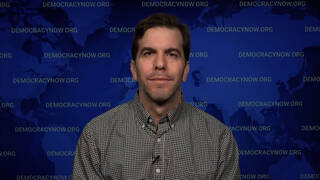
- Ori GoldbergIsraeli political analyst and scholar.
The United States and Iran are set to formally sign an agreement Friday to end military hostilities, reopen the Strait of Hormuz and begin negotiations on a long-term peace accord between the two countries.
According to terms of the memorandum of understanding obtained by CNN and other media outlets, there is to be “an immediate and permanent end to the war on all fronts, including Lebanon.” The leaked text also promises sanctions relief for Iran and access to the country’s frozen assets held abroad, as well as a $300 billion fund for reconstruction and development. The memo reiterates Iran’s long-held position that it will never produce nuclear weapons, with the fate of its nuclear program delayed until further negotiations.
Israel has vowed to ignore the U.S.-Iran agreement and maintain its occupation of southern Lebanon, with many Israeli leaders and commentators expressing outrage about the apparent terms of the deal for being too conciliatory to Iran. President Trump, meanwhile, has expressed criticism of Israel’s actions in Lebanon.
“Trump’s had enough,” says Israeli political analyst Ori Goldberg, speaking to Democracy Now! from Tel Aviv. “He hasn’t had enough because he cares about the Palestinians or about Lebanon. He’s had enough of Netanyahu’s disrespect. He’s had enough of the notion that it’s actually Netanyahu who’s calling the shots.”
Related Story
 StoryJun 15, 2026Will Israel Blow Up Trump’s Deal? Jeremy Scahill on Iran Talks, Strait of Hormuz, Nukes & More
Transcript
AMY GOODMAN: This is Democracy Now!, democracynow.org, The War and Peace Report. I’m Amy Goodman. We’re broadcasting from Belfast in the North of Ireland.
The G7 summit continues in Évian-les-Bains, in the Alps in France, France, with world leaders praising President Trump’s so-called strong leadership amidst his tentative peace agreement with Iran. But questions linger about what’s actually in the deal, before the United States and Iran are scheduled to sign the MOU, the memorandum of understanding, in Switzerland on Friday. While the text of the U.S.-Iran deal has not been made public, CNN says it’s obtained the full 14-point agreement. The first point calls for a, quote, “immediate and permanent end to the war on all fronts, including Lebanon,” unquote. Iran has accused Israel of violating the ceasefire in Lebanon at least 84 times in the days after Tehran reached the tentative deal to end the U.S. war. Iran’s Foreign Minister Abbas Araghchi spoke from Tehran Tuesday.
ABBAS ARAGHCHI: [translated] The end of the war also includes the end of occupation. Without the withdrawal of Israeli forces from the territories they have occupied in the war, a full end to the war has not been achieved. And any military attack by the Zionist regime on Lebanon from now on, as well as the continued occupation of Lebanese territories from now on, will, in our view, be considered a violation of the memorandum of understanding.
AMY GOODMAN: Iranian officials warned of a harsh response if Israel continues to escalate, after Israeli forces killed another four people in Lebanon. President Trump has criticized Israeli Prime Minister Benjamin Netanyahu, saying the Israeli leader “has to be more responsible” in Lebanon.
Following news of the proposed U.S.-Iran deal, far-right Israeli National Security Minister Itamar Ben-Gvir said on social media, quote, “Trump’s agreement does not bind us. Israel is not subject to the United States, and we are an independent and sovereign nation! … My position is clear: We are not partners to this agreement [with Iran] that does not ensure our security, and it does not bind us in any way,” Ben-Gvir said.
Meanwhile, Prime Minister Netanyahu has threatened Israeli forces will continue to occupy southern Lebanon in defiance of any ceasefire deal.
For more on Israel’s response, we go to Israel, to Tel Aviv, where we’re joined by Ori Goldberg, Israeli political analyst and scholar, has written extensively on Iran and Israel.
Ori, thanks for joining us again. Can you respond to what Ben-Gvir and Netanyahu are saying, and what this deal, that you — as far as you understand it, is all about between the U.S. and Iran?
ORI GOLDBERG: Well, first of all, I think the most important aspect of the deal is what it’s not about. And it’s not about Israel. In that sense, both Ben-Gvir and Netanyahu are right, but to their own detriment, not as proof of their achievements. Israel was not included in the discussions. Israel asked to see an advanced draft of the MOU and was denied. This is an agreement between the United States and Iran, and it’s based on Trump’s interests and the Islamic Republic’s interests. Israel is not a part of it.
Does that mean that Israel is not bound by it? Ben-Gvir is a dyed-in-the-wool populist. All he wants to do is set things on fire and sit back and enjoy the flames, and stick it to Israel’s Palestinian citizens, as well as Israel’s Palestinian objects, as frequently as possible. Any statements from him are not worth the paper that they’re published on, if they’re still published on paper.
As far as Netanyahu is concerned, he is the leader of the country, but he has not completely detached himself from the United States. He can’t afford to do that, because he knows the truth: Israel can’t do this alone. Israel cannot operate in Lebanon alone, if it has — if it has invoked the ire of the world, and specifically Washington, towards it. The EU is just looking eagerly for an opportunity to sanction Israel, to review the articles of association with Israel, to show Trump that, for once, they’re speaking the same language as he is.
And I don’t think Israel really has one significant ally left, which is, of course, Israel’s doing, because it has consistently and emphatically burned all of its bridges over the past year or so. So, I really do think that the most important aspect of this agreement, other than American-Iranian cooperation, is that Israel is not seen as a regional axis, as a force for stabilization, or simply as an entity that must be recognized, no matter what. Israel is just not in the game.
AMY GOODMAN: So, the assessment by Trump that Netanyahu showed no judgment in ordering a strike on Beirut has been seized upon by Netanyahu’s political rivals, also media commentators, ahead of the election that’s scheduled in Israel for October. What’s the current political landscape in Israel? And as Netanyahu faces this growing friction with Trump and Israel’s most powerful military ally, of course, the United States, can you talk about the pressure he’s facing within his own Likud party and where he stands? Is this shifting the Israeli population?
ORI GOLDBERG: To the best of my understanding, the answer would be a resounding no. It’s not shifting Israel’s population. It’s actually — I think this is an interesting bit of the conundrum that you described — it’s actually making Netanyahu and his policies seem even more inevitable, because when his rivals criticize him, regardless whether they do it from the left or from the right, the only criticism that they have is “You weren’t strong enough. You didn’t do enough to secure Israel’s future. You didn’t do enough to calm Israelis in the north,” which means create a strip of land that is completely empty of Lebanese, not just of Hezbollah. And when Israeli politicians are saying this, what they’re actually saying is that Netanyahu’s basic assumption — only war, and hopefully forever war, makes Israel safe — that assumption is correct. So, actually, this is not bad for Netanyahu.
As his rivals struggle to put forth some kind of alternative position, the only alternative they can offer, or seem to be willing to offer, is an alternative that says, “We would have done it better.” What would they have done better? They would have managed the war better. They would have been stronger. They would have been able to create better cooperation with Trump. They would not have been so disrespectful.
But all of this goes to Netanyahu’s management capabilities, not to the principle at stake. When it comes to the principle at stake, there’s a broad, broad consensus in Israeli Jewish society, and you can define it in various ways. One would be Jewish blood is worth more than non-Jewish blood, in this case. Another would be the ultimate jackpot is complete. This is a term coined by Ehud Barak, our former prime minister. Complete freedom of action for Israel, where Israel can do whatever it wants, attack whomever it wants, for as long as it wants, and suffer none of the consequences, most Israelis still believe that this is the way to go. Israelis are not supportive of any kind of a resolution, especially not with the Palestinians. Israelis think of the Lebanese state as weak, as unable to control Hezbollah. People who live in the north — _Haaretz_ just published a story yesterday. It’s been very quiet over the past two days in Israel’s north, and all of the residents that they interviewed said, “The quiet scares us more than when the action is on.”
So, Israelis don’t feel secure, and nobody has offered or even said that peace will make them more secure, that some kind of agreed-upon solution, diplomatic in orientation, would make them more secure. The only option that is still there, active and viable, as far as the great majority of Jewish Israelis are concerned, is war. So, in that sense, Netanyahu comes out on top, because he’s been the one who’s been fighting the war the whole time. And should it come to an election, I would think that that is what he would say. He would say, “All of these people are saying that maybe mistakes were made, maybe I’m not good enough or capable enough. But, ultimately, you all know that I’m right.” And since none of his competitors have ever ventured any kind of opinion suggesting otherwise, Israelis would simply nod and vote for Netanyahu.
AMY GOODMAN: Finally, I want to ask you, Ori Goldberg, about Israeli Defense Minister Israel Katz saying Israeli troops will stay indefinitely in Lebanon and the Gaza Strip. Can you talk about Israel’s treatment of Lebanon and Gaza?
ORI GOLDBERG: Israel is trying to do to Lebanon what it has been doing to Gaza for nearly three years now, or at least to the part of Lebanon that is in close proximity to Israel. It’s trying to destroy it, raze it to the ground, leave nothing standing, and thereby provide security for the Israeli north. I don’t think Israel is gearing up towards an invasion of Lebanon. I’m sure that there are people on the hard Israeli right who would rejoice at such an invasion, but my understanding, from both military and political circles, is that this is not the plan that’s being considered.
As far as Gaza goes, Israel seems to be perpetrating a new status quo, where Palestinians don’t get enough food, where the humane conditions are deteriorating. Palestinians are open to disease. They’re open to vermin. Palestinians are dying by the dozens every day, not just from Israeli bombings, but from Israeli-induced chaos, because they’re still living in the rubble, basically, without Israel allowing them any kind of systematic reconstruction.
But I do want to stress that Israel is doing this — or, the fact that Israel is doing this is, in my mind, a proof of Israel’s weakness. All Israel can do is destroy, destroy or harm or kill. Now, a lot of blood will be shed by Israel, a lot of blood that should not have been shed, because the world was too lenient, because the world wanted to give Israel some freedom of action, some leeway.
But again, to the best of my understanding, Trump’s had enough. He hasn’t had enough because he cares about the Palestinians or about Lebanon. He’s had enough of Netanyahu’s disrespect. He’s had enough of the notion that it’s actually Netanyahu who’s calling the shots. He’s very sensitive to the conspiracy theories, that are rife, suggesting that Netanyahu is blackmailing him through some sort of covert Epstein finding or, I don’t know, whatever else he has on him, or simply denying him money from the Adelson family, or whatever. Trump has had enough. He feels that he is not just within his rights, but within a general comfort zone, to berate Netanyahu. And I think he’s right. I think the EU agrees with him. I think China agrees with him. I don’t think there’s anybody in the world who sees Netanyahu as a trusted leader.
Last thing I want to say about our defense minister, he’s a hollow trumpet. He echoes his master’s voice. He’s not responsible for any kind of serious initiative. While he has some authority, he really does not call the shots on either policy or even day-to-day action. He’s — pardon the use of the expression — a blowhard.
AMY GOODMAN: Ori Goldberg, I want to thank you for being with us, Israeli political analyst, scholar in Tel Aviv, written extensively on Iran and Israel.
Coming up, Journacide: The War on Truth. We’ll be joined by filmmaker Seán Murray to talk about his film on the targeting of journalists in Lebanon and more, joining us here in Belfast, in the North of Ireland. Stay with us.
[break]
AMY GOODMAN: “Farewell to My Love” by Patrick Campbell-Lyons.






 Top
Top
Media Options