









 Watch Full Show

Guests
- Paul Hessburgformer senior research ecologist at the U.S. Forest Service and professor of fire and landscape ecology at the University of Washington.
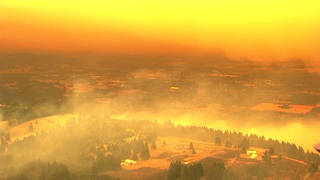
The Pacific Northwest is facing its worst fire season in more than 30 years. Scientists say drought, extreme heat and climate change are making wildfire seasons longer, more frequent and more destructive across the western United States.
“The homes, the communities, they’re just not simply prepared for fire,” says Paul Hessburg, former senior research ecologist at the U.S. Forest Service and professor of fire and landscape ecology at the University of Washington. Hessburg walks us through the history of the region, from the controlled fires practiced by Indigenous peoples before European settlement to present-day ecologically unsound factors including “accidental ignitions, dense forests, the wrong kinds of fuels on the ground [and] rapidly changing climate.”
Related Story
 StorySep 14, 2020“These Are Climate Fires”: Oregon Firefighter Ecologist Says Devastating Blazes Are a Wake-Up Call
Transcript
NERMEEN SHAIKH: We begin today with the wildfires sweeping across the Pacific Northwest, which is facing its worst fire season in more than 30 years due to climate change. In Washington state, firefighting crews continue to battle fires that have destroyed more than 700 homes and structures in the Spokane area. Nearly 65,000 people have been evacuated from Spokane County. Authorities have arrested one man on suspicion of arson in connection to one of the three blazes that have devastated the area.
This is resident Kami Fehlig, who evacuated with her husband and children before wind-driven flames engulfed her family home.
KAMI FEHLIG: Well, you know, we didn’t expect it to jump the river, but we knew the winds were high. And about 30 minutes before it jumped the river, my husband and I were seeing how bad it was, and we told the kids, “We don’t want to scare you, but we think you should start preparing to grab some things.” And I grabbed my wedding album. I grabbed the kids’ baby books. I grabbed pet supplies and that evacuation thing that had the photos electronically on, you know, memory sticks and all that stuff, put that in the cars. And within a few minutes, the power went out, and it was go now, go now.
AMY GOODMAN: The National Interagency Fire Center reports there are at least 99 uncontained large fires currently burning across the country. Fifty of them are in the Washington/Oregon area.
Meanwhile, the U.S. Forest Service says it plans to close 57 of 77 research facilities nationwide. Our next guest spent 42 years working at the Wenatchee Forestry Sciences Laboratory in Washington state, one of two facilities in Washington marked for closure. Paul Hessburg is senior research ecologist emeritus at the U.S. Forest Service. He’s also a professor of fire and landscape ecology at the University of Washington. Today he’s joining us from North Carolina.
Professor Hessburg, thanks so much for being with us. If you can start off by talking about just the scope of the fires — more than 60,000 people evacuated, hundreds of homes burned to the ground? Explain what’s happening here as these research facilities, as these fire labs are closed in Washington, where you worked, and across the country.
PAUL HESSBURG: Thanks for having me on the program, Amy.
What’s going on has developed over many decades, and we’re seeing the fruit of a lack of action to curb, essentially, a mounting situation. Across the West, the mountain snowpack was 30 to 50% of what it normally is. And if you think about it, forests grow in the interior where the snowpack is, and so if snow is in short supply, forests are in short supply. They dry early. They’re available to burn early. When you couple that with the fact that hot, dry, windy weather is increasing under climate change, forests are denser now, there’s a constellation of things that are coming together to sort of set the dining room table for more frequent and more severe fires.
And when you think about it, people are moving into those environments right now, and the homes, the communities, they’re just not simply prepared for fire. And the short answer is, throughout the West and the East, these are fire environments, and we haven’t lived and prepared as though they are.
NERMEEN SHAIKH: And could you explain, Professor Hessburg? You’ve talked in your research on forests and fires about the fact that today’s forests look nothing like what they looked like a hundred years ago. You said a little bit about that now, but if you could elaborate? Why is that the case? And what are the impacts on the likelihood of wildfires being more intense and far-reaching?
PAUL HESSBURG: That’s a great question, Nermeen. Thanks for asking that.
So, go back in the Wayback Machine 200 years ago, and what you would have seen, especially in the Spokane area, is there would be a large number of Indigenous people, tribes, family groups, that were basically cultivating the landscape with fire. In the Spokane area, the Spokane Tribe, the Colvilles, the Coeur d’Alene, the Columbia Plateau tribes and the Kalispel tribes were all interacting, intermarrying, culturally burning the landscape for food and material resources.
After the gold rush in the West, you see that Indigenous people are marshaled onto reservations. Eighty to 90% of those tribal groups were killed by introduced European diseases. Population numbers were down, and fires started to be excluded from those woods. Our Indigenous people learned that in order to live safely and securely and providently on the landscape, they needed to burn it regularly.
So, in the case of the Spokane area, open pine forests became dense, layered pine forests. Instead of having grassy fuels on the ground, there’s a lot of dead wood on the ground. Bark beetles are killing trees. Those trees are falling over. They’re now becoming fuel. So, when you get ignitions, either arson ignitions or lightning ignitions, the table is set for fires that can spread fast and burn severely. The Spokane area is no different. People are tucking into those woods in various kinds of developments, and the developments aren’t ready for fire, and fire is coming to them.
NERMEEN SHAIKH: So, if you could elaborate also, Professor Hessburg, on the fact that you’ve said about 85% of wildfires are caused by human carelessness? I mean, in this case, one man has been charged with intentionally igniting the largest of the three wildfires. If you could talk about that and whether there’s been any change historically in the occurrence of this?
PAUL HESSBURG: Another great question. Human-caused fires are actually on the rise in the United States, and they’re changing the ecology of fire across the country. Arson ignitions are on the rise in some years, but they’re not the big story. The big story is cigarette butts out the window. They’re unattended campfires. They’re people pulling over by the side of the road with very hot catalytical converters. And catalytic converters have the — they’re so hot that when they pull over and sit over dry grass, that grass will begin to burn. And if there’s a puff of wind, it’ll spread beyond the road. So many fires start against roads and trails, and very often they’re just through human carelessness or accidentally, unwittingly starting fires.
AMY GOODMAN: But, Paul, they wouldn’t have the same effect if it weren’t for climate change, right? The heating of the planet. And that’s where we want to end this discussion, with everything from the fires across Washington and Oregon to what we’re seeing throughout Europe right now, some of the hottest days they have ever experienced and the massive fires there, as well. If you can talk about what has happened with this intensification of the heat?
PAUL HESSBURG: So, the short answer is that there’s increasing incidents of hot, dry, windy days. And so, the climate is warming. It’s getting moodier. We get deeper droughts, which we’re in right now in the West. And we have pluvials, the opposite of droughts. So, we’re getting hot and dry and windy weather. We’re putting out 95%, 97% of all fires that burn under moderate fire weather, and so the landscape is burning under the worst 2 or 3% of weather conditions. And that’s why we’re seeing most of the fires are big and hot.
So, this constellation of accidental ignitions, dense forests, the wrong kinds of fuels on the ground, rapidly changing climate and people tucking into the woods has set the table for really difficult circumstances going forward. And we need to start acting like we live in a fire climate and have our homes and our residences ready to go for the coming fires.
AMY GOODMAN: Paul Hessburg, senior research ecologist emeritus at the U.S. Forest Service, also professor of fire and landscape ecology at the University of Washington.
This is Democracy Now!, democracynow.org. Coming up, AI risk expert David Krueger. Stay with us.
[break]
AMY GOODMAN: Zeshan B, “A Change Is Gonna Come.”




 Top
Top
Media Options