








 Watch Full Show

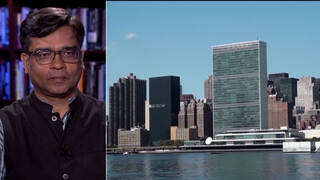
World leaders are returning home from the annual G7 summit, having failed to address issues such as income inequality, climate change and territorial conflict, while entertaining the wealthy executives of the artificial intelligence and fossil fuel industries. Oxfam International Executive Director Amitabh Behar calls the G7 “a club of the super-rich super-elites” and slams the summit’s focus on business, and business as usual, at the expense of humanitarian efforts and improving the lives of “the common people.”
Related Story
 StorySep 18, 2026“We Are the 99%”: 15 Years Later, Occupy Wall Street’s Impact Is Still Being Felt
Transcript
AMY GOODMAN: This is Democracy Now!, democracynow.org. I’m Amy Goodman, with Nermeen Shaikh.
NERMEEN SHAIKH: The G7 summit has wrapped up in the French Alps. On the summit’s final day, the heads of the world’s leading AI companies joined G7 leaders for a working lunch to discuss artificial intelligence. Attendees included the CEOs of OpenAI, Anthropic and Google DeepMind. Just days earlier, the U.S. had ordered Anthropic to disable access to its most advanced AI models from foreign nationals, citing national security concerns. Their attendance at the G7 also signaled the growing geopolitical power of the world’s wealthiest individuals.
Ahead of the summit, an estimated 20,000 people protested the G7 in Geneva. One sign read, “Your enemies don’t arrive by boat. They arrive by private jet. No G7!!!” This is Pippa Saugy, who attended the protest.
PIPPA SAUGY: [translated] The G7, for me, is a meeting of the rich to further illustrate how the rich can get richer while the poor are left behind. And I think we women need to protest against these rich people even more. Even though there are two women at the G7, it’s still very much about representing the patriarchy. So, there you have it.
AMY GOODMAN: For more, we’re joined now by the executive director of Oxfam International, Amitabh Behar. He is joining us from New Delhi.
Thank you so much for being with us from India. If you can talk about the outcome of this G7 summit and also the significance of what you feel is the deal was made to secure Trump’s presence, both in its process and its outcome?
AMITABH BEHAR: Thank you.
I think we need to put this in context, what is really the context in which the G7 was meeting. And as your previous speaker said, it is pretty much a club of the super-rich super-elites. But the context was, essentially, rising food prices, rising fuel prices and rising fertilizer prices. Most poor people, ordinary people are not being able to ensure food on their table at this moment. And that is when you have this super club, elite club meeting.
And what do they come up with? You know, it’s essentially like asking the people who have started the fire to kind of put it off. That’s not going to happen. And at this moment, what we have seen in terms of the outcome, it does not address the fundamental question that the world faces. And these are questions of international law. This is about ensuring human rights, human dignity for everyone. This is about fighting inequality.
And I’m glad that you asked me about the agenda, as in what the compromises in terms of the agenda that were needed to ensure the participation of President Trump. You have already seen issues like climate and gender go out of the window, and you are then really doing a conversation which is about the self-interest of the G7.
NERMEEN SHAIKH: And, Amitabh, could you talk about this in the context of these massive cuts in humanitarian assistance, of course, the largest cuts here in the U.S., but also from the EU? OECD countries now contribute 23% less aid than they did in 2025, led by the U.S. a year earlier. The U.S. has cut almost 60% of its aid.
AMITABH BEHAR: So, you know, last year, we have seen almost $48 billion of all the aid getting cut, and this is the biggest cut that we have seen. And this has really meant that you actually have communities where people are dying. The direct impact is very, very visible. You’re seeing public services crumble. You’re seeing countries go under the debt burden further.
But this is happening when — and I think that’s really the irony of the current economic model. On the one hand, you see these countries doing these massive cuts, which impacts the common, ordinary, poor people across the world. On the other hand, you’re looking at a conflict. And let me just give you a couple of numbers. Just since the war started, 48 of the energy billionaires from the G7 countries have actually added $23.5 billion to their equity, which is pretty much $300 million being added every day. You have had six oil companies almost being projected to crack a profit of more than $152 billion this year.
So, that’s what is happening. On the one hand, you create an economic system which essentially redistributes, sucks up wealth from the common, ordinary people, from the middle classes, and concentrates it at the top. On the other hand, you have these G7 countries dramatically and devastatingly cutting humanitarian aid, and the impact is visible.
NERMEEN SHAIKH: So, could you say — I mean, Oxfam has been calling for international action like that which occurred during the COVID-19 pandemic, as well as following the full-scale Russian invasion of Ukraine. Explain the steps that were taken then and what’s happened now in the wake of the U.S.-Israeli war on Iran. And also, the fact that there were a number of countries that were invited as guest observers, including India, but also South Korea, Brazil, Kenya and Egypt — what were they doing there?
AMITABH BEHAR: I think that’s really a question for us to ask the global leaders. I must say that the communities, the voices that you had from the streets on Geneva, are not unique to Geneva. These protests are happening across the world, and these people are asking those tough questions of their leadership.
But at the moment, you’re seeing this pretty much a Wall Street consensus, where they all come together to talk of self-interest. And what do you really see in terms of the outcome? You see some pittance going to Gaza at this moment. Yes, it’s good that we are talking of increased humanitarian aid, but does Gaza really need humanitarian aid alone? It is about not humanitarian aid. This is about reconstruction. This is about human dignity. This is about ensuring safety of people, food, water to everyone. That’s what we need. Look at the Ebola outcome. I would say it was positive. We welcome it, that you have now international coordination being discussed. That’s important. You also are looking at new resources deemed to be new resources, but, essentially, this is just bringing back some of the money that’s been cut.
So, at this moment, I feel that there’s a complete, complete disjunction between the global leaders, who are essentially moving towards an economic system which is then getting captured by these super-rich super-billionaires, who then twist the policies in their own favor, while the real questions of the common people, which is about inflation, which is about the cost of food, which is about a dignified livelihood, all those questions are not even in, in terms of the main agenda.
AMY GOODMAN: Amitabh Behar, we want to thank you for being with us, Oxfam International executive director, speaking to us from New Delhi, India.



 Top
Top
Media Options