

Guests
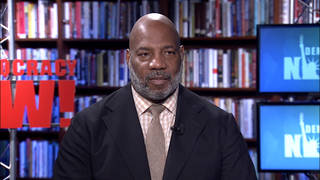
- Jeff Ballingerhead of Press for Change, a group that has been focusing on Nike’s activities in Indonesia.
- Charles Kernaghandirector of the National Labor Committee in New York.
- Medea Benjaminco-director of Global Exchange, a human rights advocacy group based in San Francisco.
Tape of New Jersey Republican Congressmember Chris Smith, chair of the Subcommittee on International Operations and Human Rights. Smith describes his bill on child labor.
Transcript
AMY GOODMAN: I wanted to ask you all what you think of the legislation that is being introduced by New Jersey conservative Republican Chris Smith around child labor. This is what he had to say the other day, just before his hearing in Congress on the issue.
REP. CHRIS SMITH: It would prohibit the importation of child-exploited-made goods. It would condition our foreign aid, except for humanitarian aid, as to whether or not that country has or is enforcing its child labor laws. It would also condition our aid to the multinational and multilateral lending organizations to whether or not they indeed are promoting child labor or trying to stop its abuse. And finally, it would — it would increase significantly our money going to the International Program on the Elimination of Child Labor. I just would say parenthetically, Germany has provided $65 million to this important organization, a group that was organized under the ILO. We have provided a paltry $3.6 million. We’re trying to increase that amount of money, so that these countries can have a strategy for mitigating this abuse.
AMY GOODMAN: And that was New Jersey Congressmember Chris Smith, who’s introduced this legislation against child labor, Jeff Ballinger of Press for Change, what
do you think of it?
JEFF BALLINGER: Well, my reaction is that child labor is — we have to deal with child labor, of course. It’s a big problem. But why do children work? Children work because their parents can’t make enough money to support them. And unless you deal with this issue, for people to say sweatshops are better than no shops, and a wage, even if it’s below the subsistence level, is better than nothing, this is ridiculous. What are these people saying, when so much money is being thrown around by these corporations?
AMY GOODMAN: Well, the other proposal is the “no sweat” label. Now, we just have a few minutes, but maybe if you could describe what this proposal is and what you think of it, Charlie Kernaghan?
CHARLES KERNAGHAN: Well, I think this is a very interesting direction to move in. And it goes back to the idea that you can buy tuna fish that has “dolphin-free.” You know, it’s not going to lead to the slaughter of dolphins. If we can guarantee consumers that they can have tuna fish which is dolphin-free, we should be able to guarantee to people, who want this knowledge, that you’re not purchasing a product made by a child or by an exploited woman or by someone being paid starvation wages, like Jeff just mentioned, working under armed guards. We should be moving in that direction. And I think that’s quite hopeful. And we get calls all day long from consumers: “Who should we trust? Who shouldn’t we trust?” This is the future,
AMY GOODMAN: And also, Charlie Kernaghan, today you’ve released a video on labor in Haiti. Is that right?
CHARLES KERNAGHAN: Yes, it focuses on the Walt Disney Corporation, which, through licensing agreements, is producing in five factories in Haiti, paying the workers 28 cents an hour, workers who, if they dare to speak up, they’re dumped on the street. We wanted to bring a worker from Haiti to the United States. We couldn’t do it, because the woman told us, “While I’m in the United States speaking, my child might be accidentally killed and hit by a car.” So, this is why we did the video, since we couldn’t bring a worker.
AMY GOODMAN: It’s obviously critical to continue to bring this information out. Let’s get phone numbers from each of you, if people are interested in getting in touch with you. Charlie, if people want to get the video or information from the National Labor Committee, your number?
CHARLES KERNAGHAN: Terrific. It’s in New York, 212 area code, and the number is 242-0986.
AMY GOODMAN: Again?
CHARLES KERNAGHAN: 242-0986.
AMY GOODMAN: That’s the 212 area code. Jeff Ballinger, Press for Change.
JEFF BALLINGER: I’m asking people to call the youth and labor group Frontlash at 800-833-3250.
AMY GOODMAN: That’s 800-833-3250. Medea Benjamin, Global Exchange?
MEDEA BENJAMIN: 415-255-7296. We’re based in San Francisco.
AMY GOODMAN: That’s 415-255-7296. I want to thank you all very much for joining us, Charlie Kernaghan of the National Labor Committee, Jeff Ballinger of Press for Change and Medea Benjamin from Global Exchange. You’ve been listening to Democracy Now!, produced by Julie Drizin, with help from Erica Martinez and Pat Greenfield. Kenneth Mason has been our engineer. Thanks to Verna Avery-Brown and Bill Wax. I’m Amy Goodman. Tomorrow, we look at Atlanta.


Media Options