





 Watch Full Show

Topics
Guests
- Antony LoewensteinAustralian German independent journalist based in Sydney, member of the advisory committee of the Jewish Council of Australia.
At least 15 people were fatally shot during a Hanukkah celebration at Sydney’s famed Bondi Beach this Saturday, and at least another 42 people were injured, marking Australia’s worst mass shooting in nearly three decades. Victims included a 10-year-old girl, two rabbis and a Holocaust survivor who died while shielding his wife from bullets.
After Israeli Prime Minister Netanyahu blamed Australia’s recognition of a Palestinian state for the shooting, Antony Loewenstein, member of the Jewish Council of Australia, says the shooting is “being weaponized by the worst people imaginable to support incredibly draconian policies.”
Related Story
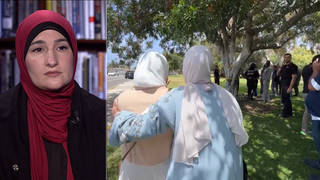
 StoryMay 19, 20263 Killed in Devastating San Diego Mosque Shooting: Linda Sarsour on Rising Anti-Muslim Hate & More
Transcript
AMY GOODMAN: Australia is vowing to enact stricter gun laws after a father and son fatally shot 15 people at a Hanukkah celebration in Sydney’s famed Bondi Beach. At least 42 others were injured in Australia’s worst mass shooting in nearly three decades, since the 1996 Port Arthur massacre. Victims included a 10-year old girl, two rabbis and a Holocaust survivor who died while shielding his wife from bullets.
This is the Australian Prime Minister Anthony Albanese.
PRIME MINISTER ANTHONY ALBANESE: What we saw yesterday was an act of pure evil, an act of antisemitism, an act of terrorism on our shores, in an iconic Australian location, Bondi Beach, that is associated with joy, associated with families gathering, associated with celebrations, and it is forever tarnished by what has occurred last evening. This was an attack deliberately targeted at the Jewish community on the first day of Hanukkah, which, of course, should be a joyous celebration. And the Jewish community are hurting today. Today all Australians wrap our arms around them and say, “We stand with you. We will do whatever is necessary to stamp out antisemitism. It is a scourge, and we will eradicate it together.”
AMY GOODMAN: Police say the massacre was carried out by a 50-year-old father and his 24-year-old son. The father, Sajid Akram, was shot dead by police. The son, Naveed Akram, was arrested after being tackled by a fruit vendor named Ahmed al-Ahmed. Video shows Ahmed tackling the gunman, then grabbing his gun and pointing it at the gunman. Ahmed was hospitalized after suffering bullet wounds to his arm and hand. Ahmed is an Australian citizen who immigrated from Syria in 2006. His father spoke via a translator to ABC, the Australian Broadcasting Corporation, earlier today.
MOHAMED FATEH AL-AHMED: [translated] He noticed one of the armed men at a distance from him, hiding behind a tree. My son is a hero. He served with the police and in the Central Security Forces, and he has the impulse to protect people. When he saw people laying on the ground and the blood everywhere, immediately his conscience and his soul compelled him to pounce on one of the terrorists and to rid him of his weapon. At the same moment, the armed man’s other friend was on the bridge, whoever he is. I feel pride and honor because my son is a hero of Australia.
AMY GOODMAN: Ahmed al-Ahmed is being widely hailed as a hero who saved many lives. Residents of Sydney praised his actions.
GARRATH STYLES: You’d like to hope that you would react the same way if you had the chance. I don’t know if I’m as strong as he is. He was incredibly strong and very brave and managed to take the gun off the guy, which is incredible.
AARON ASHTON: Yeah, I think he’s a national hero, for sure, probably a international hero. A lot of people around the world wouldn’t have done that. A lot of people would have run away from the gunfire. He ran towards it. So, [inaudible] probably saved a lot of lives.
AMY GOODMAN: We go now to Sydney, Australia, where we’re joined by Antony Loewenstein, an Australian German independent journalist based in Sydney, a member of the advisory committee of the Jewish Council of Australia and author of the best-selling book, The Palestine Laboratory: How Israel Exports the Technology of Occupation Around the World. Antony is the subject of the 2024 documentary film Not in My Name, which was broadcast on Australia’s ABC TV and Al Jazeera English. The documentary focuses on Jewish dissent and Antony’s critical journalism on Israel-Palestine.
Antony, first of all, condolences on what has taken place on Bondi Beach in Sydney. Can you take us through what happened?
ANTONY LOEWENSTEIN: Thank you for having me, Amy, and thank you for those condolences.
Look, I was not in Bondi myself. I was about half an hour away last night. I was celebrating Hanukkah at my home with my family. I’m not religious, but it’s become, I guess, almost a cultural annual celebration with my family.
There were two gunmen. I found out very quickly what was going on. It wasn’t, obviously, entirely clear initially, the extent of the carnage. We now know some more details. There’s so much we still don’t know about this horrific attack. It was clearly directed at the Jewish community. There was a public Hanukkah event on Bondi. For those who don’t know — a lot of people know Bondi. It’s an internationally famous beach. It’s a very open place, lots of tourists, lots of Australians. It’s obviously summer here, so it’s obviously warm. And we have — it was light. So, it gets dark here quite late, being summer. And it was a celebration.
Now, this horrific attack was not just terrorism, but it was directed at a Jewish community that has been, frankly, split for the last years around Israel-Palestine, which I know we’ll get to in a minute. Now, there’s no indication yet why this attack happened, the motives. There’s some evidence and indication that these two killers were associated with ISIS, or certainly radical Islamists, that traveled to the Philippines recently to potentially associate with some kind of Islamist groups. It’s not 100% confirmed yet. But, in short, I’m feeling sad and anger, actually, a lot of anger, because it’s already being weaponized by the worst people imaginable to support incredibly draconian policies.
AMY GOODMAN: I wanted to turn to the Israeli Prime Minister Benjamin Netanyahu. He was speaking in Dimona on Sunday, accusing the Australian government of promoting antisemitism.
PRIME MINISTER BENJAMIN NETANYAHU: On August 17th, about four months ago, I sent Prime Minister Albanese of Australia a letter in which I gave him warning that the Australian government’s policy was promoting and encouraging antisemitism in Australia. I wrote, “Your call for a Palestinian state pours fuel on the antisemitic fire. It rewards Hamas terrorism. It emboldens those who menace Australian Jews and encourages the Jew hatred now stalking your streets.”
AMY GOODMAN: So, that’s the Israeli prime minister weighing in. Antony Loewenstein, if you can respond and talk about the position of the Australian government? Albanese certainly came out quickly.
ANTONY LOEWENSTEIN: I mean, what a disgraceful human being — I’m talking about Netanyahu here. You know, within a few hours of this attack last night, Amy, a number of Israeli government ministers, Netanyahu, the foreign minister there, the minister for diaspora affairs and many others, essentially wrote posts on social media suggesting that the Australian government recognized Palestine a few months ago, which is true, that somehow that was causing the terrorist attack, the fact that Australia has allowed, so the argument goes, pro-Palestine protest. This kind of connection is absolutely disgraceful.
The idea that the Israeli government, a government that has overseen a genocide and mass slaughter for over two years in Gaza, is the moral arbiter of anything is farcical. And what’s so worrying is that so much of the Australian media, many in the, I’d say, more pro-Israel Jewish community somehow looks to Israel, Netanyahu as a moral guide. The Australian government is, generally speaking, pretty pro-Israel. We have still been — I’ve been doing a lot of reporting on this, a lot of weapons parts to the F-35 fighter jet that Israel’s been using over Gaza. This idea somehow that the Australian government is anti-Israel is absurd. And we live in a very flawed democracy, but a democracy where people are allowed to peacefully protest. And there’s been huge amounts of protest by Jews and Christians and Muslims and others, like in most Western countries, in the last two-plus years. So, to have the Israeli government, an utterly morally moribund government, talk about accountability is really the height of chutzpah, and that’s being polite.
AMY GOODMAN: Antony Loewenstein, talk about the Jewish Council of Australia, that you are a member of.
ANTONY LOEWENSTEIN: The Jewish Council founded after October 7, and it’s basically made up of progressive Jews, young and old, who did not feel represented by the so-called mainstream Jewish organizations here. It’s sort of similar, in a way, to what you’ve seen in the U.S. over the last years, and really before October 7, which has been almost a civil war of sorts within the Jewish community, between a very, I would say, hard-line, pro-occupation, pro-Israeli government, certainly pro-Gaza war, and many other young Jews, increasingly young Jews, who feel so disillusioned and disgusted by that blind support. So the Jewish Council was founded, and it’s really become a vital alternative voice to represent Jews and others, but principally Jews, who don’t share those politics, that regard the blind support that many in the pro-Israel community advocate towards the Israeli government is not just unhealthy but endangering all of us.
Now, we don’t know, obviously, enough details about last night’s horrific attack, but it’s clear that — and I’ve thought this and said this for years, Amy — that what the Israeli government is doing in Palestine, Gaza, the West Bank and beyond endangers everybody, Jews particularly, but others, as well, that nothing justifies antisemitic attacks or violence — nothing does, including last night — but the idea somehow that a Jewish state, created under the guise of protecting Jews, actually now creates massive danger for Jews around the world is, to me, undeniable. It’s more unsafe. It’s more unsafe to be a Jew in Israel than, arguably, anywhere else in the world.
Now, I’m not denying at all antisemitism. It’s real, as in real antisemitism, attacks against Jews or synagogues, or last night’s attack in Bondi, and it’s increasing and worsening in vast parts of the world, and that worries me deeply as a human and a Jew. But we cannot disregard the fact that Israeli government actions play a part in that. And too often, sadly, those voices are ignored in the community here, so, therefore, the Jewish Council was vital.
AMY GOODMAN: Antony, can you talk about the bystander — I think he was a fruit vendor — Ahmed al-Ahmed, and how —
ANTONY LOEWENSTEIN: Yeah.
AMY GOODMAN: — he stopped what could have been a far deadlier attack? I mean, his bravery was just astounding.
ANTONY LOEWENSTEIN: Amazing. A lot of people may have seen this footage on social media, and I’d encourage them to see it if they don’t — if they haven’t, is that he essentially went towards one of the gunmen to try to disarm him, I guess. He apparently is an Australian citizen. He comes from Syria, was born in Syria. He essentially fought the gunman relatively quickly, got the gun off him, then pointed the gun at the gunman, did not shoot, and then put the gun down, almost putting his hands up to suggest that he was not a threat himself. There’s no doubt he saved huge amounts of lives.
And what’s been so, you know, heartening, when there has been so much growing — and this, again, was happening long before last night’s attack, Amy, shamefully, like it is in many Western countries — growing anti-Islam sentiment, growing anti-immigration sentiment, anti-Muslim sentiment, to have a Muslim man stand up and be brave. Now, I know that that’s what any — a lot of humans would do, but to see a Muslim do that and to be recognized for that, I think, is important, to realize that Muslims are a major part of Australian society. We’re 27 million population here. It’s a relatively small country, the same size as the U.S. geographically, but a very small population. There’s about 800,000 Muslims and about 120,000 Jews. And there’s been a number of Palestinians from Gaza who have been brought to Australia since October 7, around 3,000. And there’s been growing calls by the Murdoch press and others to not allow these people in. Some of these people are my friends from Gaza. They’re remarkable people. They’re no threat to anybody. So, to have a Muslim man, this incredible gentleman who basically fought against this horrific terrorist, it really is inspiring and, I think, shows the world that any community is made up of a diversity, and that includes Muslims, Jews, atheists, whoever it may be.
AMY GOODMAN: I wanted to end by talking about this deadliest attack since Australia’s 1996 Port Arthur massacre, when a gunman opened fire in the Tasmanian tourist village of Port Arthur, killing 35 men, women and children, injuring 23 more. After the shooting, Australia moved to overhaul its gun laws. I mean, it was some of the most liberal gun laws in the world, a country of Crocodile Dundees, but then, within a number of days, outlawing automatic and semiautomatic rifles. About a decade ago, I spoke to Rebecca Peters, who led the movement to change the gun laws.
REBECCA PETERS: So, the principal change was that — the ban on semiautomatic weapons, rifles and shotguns, assault weapons. And that was accompanied by a huge buyback. And in the initial buyback of those weapons, almost 700,000 guns were collected and destroyed. There were several further iterations over the years, and now almost a million — over a million guns have been collected and destroyed in Australia. But also, the thing is that sometimes countries will make a little tweak in their laws, but if you don’t, you have to take a comprehensive approach. It doesn’t — if you just ban one type of weapon or if you just ban one category of person, if you don’t do something about the overall supply, then basically it’s very unlikely that your gun laws will succeed. So this was a comprehensive reform related to the importation, the sale, the possession, the conditions in which people could have guns, storage, all that kind of thing that can — the situations in which guns could be withdrawn.
AMY GOODMAN: If you can respond to Rebecca Peters and talk about what happened in Australia, how it changed? And what does this mean for Australia now, Antony?
ANTONY LOEWENSTEIN: There’s no — there’s no doubt, after that Port Arthur massacre, that horrific attack, as you said, Amy, in 1996, there was radical change on gun laws, pushed by then-Conservative Prime Minister John Howard. And that was enacted relatively quickly. There was some pushback, but, in general, the vast majority of Australians supported it.
Now, before this Bondi attack last night, there’s been some reporting in the last few years that some of the restrictions that were put in place have been loosened, that they’re being not properly enforced. There’s been a proliferation of guns. Now, whether that had any connection to last night’s attack, we don’t know yet. But it’s worth saying that today, less than one day after the attack, Anthony Albanese, the prime minister, spoke to all the states and has already proposed some pretty strong and necessary gun reforms. Now, there are voices, as there always are, against that, but it’s nothing like what you see in the U.S. So, to push through any serious or decent gun reform laws seem close to impossible in the U.S., even under a Democratic president often. So, I think there’s a very, very good chance that you’ll see some shifts here in Australia in the coming months, backed by the vast majority of Australians.
Now, Australians, understandably, and as I am, are shocked by this case of mass violence. Australia has a long history of colonial violence and violence against minorities, and continues to have violence against Indigenous populations. But the sign of mass violence, of this kind of attack last night, is almost unheard of in Australia, as you said, for decades. And I think that’ll push huge amounts of Australians to support necessary gun laws. Now, the idea, I think, of Australia becoming, sadly, alongside other nations that have seen this kind of mass killing, violence, is shameful. It’s shameful for me as an Australian, and it’s shameful that this sort of thing could happen in the first place, which is why you need effective gun laws now. There’s no other option.
AMY GOODMAN: Antony Loewenstein, I want to thank you for being with us, Australian German independent journalist based in Sydney, a member of the advisory committee of the Jewish Council of Australia, author of the best-selling book, The Palestine Laboratory: How Israel Exports the Technology of Occupation Around the World, speaking to us from Sydney, Australia, where the mass shooting took place on Bondi Beach.
Later in the show, we’ll look at Saturday’s mass shooting at Brown University in Providence. We’ll speak to Brown sophomore Mia Tretta. This shooting, though, was not her first. In 2019, she was a freshman in a Santa Clarita, California, high school when a gunman came in and shot her in the stomach. He killed her best friend. Mia has dedicated her life to preventing gun violence. But first, we talk about the reimprisoning of the Nobel Peace laureate Narges Mohammadi. Stay with us.



 Top
Top
Media Options