













 Watch Full Show

Lights on 24/7. Overflowing toilets and lack of access to showers. Solitary confinement in a 2×2-foot box. These are some of the torturous conditions documented in a new report from Amnesty International investigating human rights violations at two ICE detention centers in Florida: the Krome North Service Processing Center and the Everglades Detention Facility, dubbed “Alligator Alcatraz” by Trump and his supporters. Florida Governor Ron DeSantis is denying the report’s findings, calling them fabricated and politically motivated. We speak to the report’s lead researcher, Amy Fischer, about the “intentional development within immigration detention that is aiming to make it increasingly cruel, increasingly abusive, so that people are forced to give up their immigration claims [because] the conditions are so cruel that they can’t handle it anymore.”
Related Story
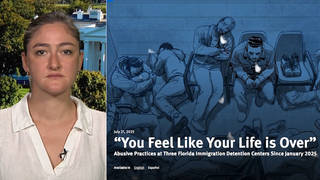
 StoryJul 22, 2025“You Feel Like Your Life Is Over”: HRW Report Exposes Abuses in Trump’s Immigration Jails in Florida
Transcript
AMY GOODMAN: This is Democracy Now!, democracynow.org. I’m Amy Goodman.
We look now at how Amnesty International says immigrants held at the ICE jail in Florida dubbed “Alligator Alcatraz” were shackled inside a two-foot-high metal cage and left outside without water for up to a day at a time. In a new report, they also detail unsanitary conditions, lights on 24 hours a day, poor-quality food and water and lack of privacy. The report is titled “Torture and Enforced Disappearances in the Sunshine State: Human Rights Violations at 'Alligator Alcatraz' and Krome in Florida.”
We’re joined now by the lead researcher, Amy Fischer, director of refugee and migrant rights at Amnesty International USA.
Amy, thanks for being with us. Thanks for joining us from Bentonville. Can you describe what you found?
AMY FISCHER: Sure. So, myself and colleagues from Amnesty International went to Florida in September, and we were able to have a tour of the Krome detention facility, and we were also able to speak to a number of individuals detained inside, who had also been detained inside of “Alligator Alcatraz.” And really, what we heard about both facilities were harrowing stories of human rights violations, cruel conditions, abuse and, in some cases, treatment that amounts to torture under international law.
AMY GOODMAN: So, explain — can you describe situations you found at what the Republicans have dubbed Alligator Alcatraz?
AMY FISCHER: Of course. So, what we found and heard about Alligator Alcatraz is that people are housed in cages that hold about 30 people, and there’s about three toilets per cage. The weather, the environment is very severe.
And one of the things that we heard that was so concerning was the use of something called “the box,” which was described to us as the type of cage that you put lions in at the zoo. And people are placed in this box as a form of punishment. It is a two-by-two-foot box where people are shackled at their wrists and at their feet and chained to the ground in the hot Florida sun for hours upon hours at a time, without food, without water, as a form of punishment. We heard that there was an incident in which somebody in one of the cages was having a medical emergency, and other people inside were calling for help for this individual, and those that were seeking help were placed in the box as a form of punishment. And after hearing about this, Amnesty made the determination that putting people in the box and the use of this box amounts to torture under international law.
AMY GOODMAN: So, what can be done? What are you demanding, Amy Fischer?
AMY FISCHER: We are calling for the shutdown of Alligator Alcatraz, as well as Krome, as well as any other cruel detention center across the United States. What we are really seeing is an intentional development within immigration detention that is aiming to make it increasingly cruel, increasingly abusive, so that people are forced to give up their immigration claims, give up their asylum claims, because the conditions are so cruel that they can’t handle it anymore. And what we know is that there are alternatives to immigration detention that are cheaper, that respect human rights and actually lift up all communities. And so, what we need to do is shut down these facilities and instead invest in an immigration system that works for all of us.
AMY GOODMAN: I wanted to go to a vigil outside of Alligator Alcatraz. Sonia Bichara spoke about the conditions that her fiancé, Rafael Collado, faced inside the jail.
SONIA BICHARA: [translated] He has been there for a month and three days, and he has told me that the conditions inside are deplorable. The food is terrible. They keep the lights on all the time to keep them awake. They say they are tired of seeing each other’s faces. They are given five minutes to eat and only a small cup of water with their meal. If they stand up, they are beaten. … They turn the identifications around so they can’t see the names. Some tell them the time. Others don’t, because they don’t know what time it is. They only know when they call home. My fiancé asks me what time it is, what day it is today. And it breaks my heart when he asks me that question.
AMY GOODMAN: In response to the Amnesty report, Republican Governor Ron DeSantis of Florida issued a statement that read, quote, “This 'report' is nothing more than a politically motivated attack. None of these fabrications are true. In fact, running these allegations without any evidence whatsoever could jeopardize the safety and security of our staff and those being housed at Alligator Alcatraz.” Amy Fischer, your response?
AMY FISCHER: First of all, if the governor would like to see some evidence, I encourage him and his office to read the report, where that evidence is presented. But more than anything, if Governor DeSantis is really concerned about the care and safety of those in custody, then he should shut down Alligator Alcatraz and allow these people to return to their communities, where they belong.
AMY GOODMAN: Amy Fischer, I want to thank you so much for being with us and ask one last question about Krome. I remember years ago when people were marching on Krome because of Haitians who were fleeing violence in Haiti were being placed there and the conditions that they faced. If you can briefly summarize what you found there?
AMY FISCHER: What we found at Krome was very similar to what other people have been reporting for years, horrific conditions. You know, one of the things that most impacted me at the time in Krome is that we were speaking to somebody in solitary confinement who was showing us an injured hand through the slot on the door, and an ICE agent slammed the metal flap of the solitary confinement door on this man’s injured hand and then punched it repeatedly. And that was such a show of force, a show of violence, and it happened in front of human rights monitors. And so, we know the conditions are horrible, and when we see that type of activity in front of human rights monitors, we can only imagine the type of cruelty that is going on on a day-to-day basis behind closed doors.
AMY GOODMAN: I want to thank you so much for being with us, Amy. Amy Fischer, lead researcher on the new Amnesty International report, “Torture and Enforced Disappearances in the Sunshine State.” We’ll link to it at democracynow.org. Thanks for joining us from Bentonville, Arkansas.






 Top
Top
Media Options