









 Watch Full Show

Topics
Guests
- Judith Enckformer regional administrator at the Environmental Protection Agency and president of Beyond Plastics.
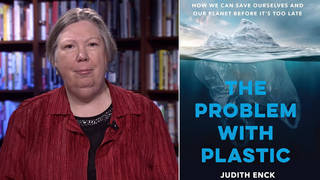
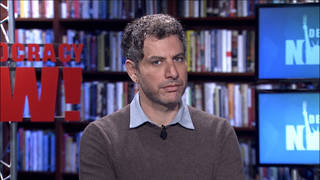
We speak with former EPA regional administrator Judith Enck about her new book, The Problem with Plastic: How We Can Save Ourselves and Our Planet Before It’s Too Late.
“Scientists have found microplastics in our blood, our kidneys, our lungs,” says Enck. “They’ve been found in heart arteries, and if it’s attached to plaque, you have an increased risk of heart attack, stroke, premature death.” Enck says plastic is a “political” issue shaped by the powerful “chemical, fossil fuel, plastics industry — and consumer brands.”
Transcript
AMY GOODMAN: This is Democracy Now!, democracynow.org, The War and Peace Report. I’m Amy Goodman.
The Problem with Plastic: How We Can Save Ourselves and Our Planet Before It’s Too Late, that’s the title of a new book by Judith Enck, former regional administrator for the Environmental Protection Agency, now president of Beyond Plastics, joining us to talk about pollution in the environment, our bodies, as well, and moving beyond plastics. Her book’s release comes as the United Nations’ efforts to negotiate a legally binding global treaty on plastic pollution have slowed, and plastics were low on the agenda at the COP30 U.N. climate summit in Brazil. Next week, the seventh session of the U.N. Environment Assembly is set to begin in Nairobi, Kenya, with the theme “Advancing sustainable solutions for a resilient planet.”
Judith Enck, welcome back to Democracy Now! It’s great to have you with us.
JUDITH ENCK: Thanks.
AMY GOODMAN: So, the title is The Problem with Plastic. Explain what it is.
JUDITH ENCK: So many problems. It should have been plural. Plastics is a climate change issue, because it’s made from fossil fuels and 16,000 different chemicals. It’s a health issue, because plastics, little pieces of microplastics, have been found in many parts of our bodies. This is an environmental justice issue, because plastics are produced in primarily low-income communities of color, places like Cancer Alley in Louisiana. It’s also a consumer deception issue, because the industry has been telling us we can recycle plastic, which is not true.
And finally, the issue that really drew me to this is we’re turning our ocean into a watery landfill, with so much plastic getting into the ocean. It’s about two giant garbage trucks every minute is dumped into the ocean. And, you know, the ocean is 71% of the world’s surface and a major protein source for many of us around the world.
AMY GOODMAN: So, what happens then to the plastic dumped in the ocean?
JUDITH ENCK: It gets exposed to sunlight. Then the wave action is almost like a paper cutter. So, one plastic water bottle, for instance, becomes hundreds or thousands of little pieces of microplastic, which are eaten by fish, marine life, and it is really an ocean emergency.
AMY GOODMAN: Chemicals found in plastics have been associated with cancer, nervous system damage, hormone disruption, fertility issues. Explain the issues.
JUDITH ENCK: Sixteen thousand different chemicals are used to make plastic, including PFAS chemicals, the forever chemicals. And every plastic product has a different chemical combination, so it’s hard to say precisely this plastic food wrapper, for instance, is linked to this health outcome. But we know that many of these chemicals, as you say, cause cancer. They’re reproductive toxins. And my big concern is the plastic packaging that touches our food and our beverage, especially if it’s ever heated.
AMY GOODMAN: OK. So, that goes to the issue of microwave. You say don’t microwave in plastic. But how many plastic containers say “microwave safe”?
JUDITH ENCK: Yeah, it shouldn’t. You should not put any food containers in the microwave, because the chemicals very likely are leaching into your food. You can kind of taste it, right? And definitely don’t use black plastic, because that’s from recycled electronic waste. So, this is so —
AMY GOODMAN: Wait a second.
JUDITH ENCK: Yeah.
AMY GOODMAN: Just the color, the plastic, the color of it, means it’s recycled electronic waste?
JUDITH ENCK: Very likely. If you have like a black plastic takeout container, when you get home, take it right out of the container and put it on your plate. I really try to avoid black plastic. There have been good studies on this. But any kind of plastic, you want to avoid heating.
AMY GOODMAN: What about putting it in your dishwasher?
JUDITH ENCK: Not a great idea, particularly if you’re using it for food.
AMY GOODMAN: Because?
JUDITH ENCK: Because the chemicals will leach, because it’s exposed to heat.
AMY GOODMAN: Can you talk about microplastics?
JUDITH ENCK: Microplastics are five millimeters or less, teeny, tiny pieces of plastic. Scientists have found microplastics in our blood, our kidneys, our lungs. They’ve been found in heart arteries, and if it’s attached to plaque, you have an increased risk of heart attack, stroke, premature death. Unfortunately, it’s crossed the blood-brain barrier and has been linked to Alzheimer’s and other neurological diseases recently. We need these studies repeated. We also know that microplastics have been found in the human placenta and breast milk, so our babies are being born pre-polluted. And when I talked to legislators that are male, I mentioned that it’s also been found in testicles, and they start to pay attention.
AMY GOODMAN: You know, we just came from the U.N. climate summit, the climate summit in the Amazon, in Brazil. There was a lot of activism there, but very little around plastics.
JUDITH ENCK: Yeah, you know, plastics traditionally were made from chemicals in oil, now from chemicals and waste product of fracking, ethane. So plastics is very much a climate issue. We did a report looking at production, use and disposal of plastics. The greenhouse gas emissions are the equivalent of about 116 coal-fired power plants.
There’s a separate U.N. process going on with plastics, but, unfortunately, because of the positions of the United States and Saudi Arabia, that process did not reach a conclusion, but it is ongoing.
AMY GOODMAN: So, if you can talk about who’s lobbying for plastics, and what you think needs to be done? Because your book has the word Saving Ourselves and the Planet Before It’s Too Late.
JUDITH ENCK: Yeah, we chose those words purposefully. So, this is a political science issue, not a science issue. So, we’re up against Exxon, Shell, Amazon, Dow Chemical, the American Chemistry Council. You show up even at a city council meeting, and these guys from Washington come flying in with their expensive suits, saying why we shouldn’t, for instance, ban plastic bags. In Albany, we’re working on a comprehensive packaging reduction law. We were outnumbered by corporate lobbyists four to one, still came very close to passing a packaging reduction bill. So, when you’re working on plastics, you’re going up against the chemical, fossil fuel, plastics industry — and consumer brands.
But progress is being made. All across the country, people are paying attention to the issue. And I want to emphasize that about half of all plastics have been manufactured worldwide in the last 18 years. So this is relatively new. I actually remember 18 years ago. So, I am hopeful that if people work not just to reduce plastic in their own lives, but get into the political arena, work on new laws, new regulations to reduce plastic, it’s in our own self-interest. This is not an ideological issue. In fact, when there’s polling on plastic, there’s bipartisan support to reduce plastic production. We just need to get more people in the arena saying we don’t want babies, for instance, born with microplastics while they’re in the placenta and then consuming breast milk.
AMY GOODMAN: Judith Enck, you were a regional administrator of the EPA. Talk about Trump’s attacks on the EPA and regulations. ProPublica has a new piece out today, “Under Former Chemical Industry Insiders, Trump EPA Nearly Doubles Amount of Formaldehyde Considered Safe to Inhale.”
JUDITH ENCK: This is the worst EPA has ever been. They are no longer protecting the environment. They are no longer protecting public health. You have people from the chemical industry at EPA making policy. Lee Zeldin, the head of the EPA, is the worst EPA administrator in the history of the agency. It’s going to take decades to rebuild. Places like Cancer Alley, where plastic is produced in Texas, people are being poisoned every day, and the EPA is doing nothing to protect health. It’s really a national embarrassment and something where the states need to step in, and we haven’t seen that yet.
AMY GOODMAN: The California attorney general has sued ExxonMobil for its recycling claims?
JUDITH ENCK: Yeah, Attorney General Rob Bonta sued ExxonMobil for not telling the truth about plastics recycling in September of 2024. The plastics industry tells us, “Don’t worry about all the plastics you’re using. Just put it in the recycling bin.” But plastics recycling has been an abysmal failure. People should keep recycling paper, metal, glass, cardboard. But the plastic recycling rate is only 5 to 6% nationwide, because plastics are made from so many different chemicals, different colors, different plastic polymers, that they cannot be recycled together, unlike other material.
AMY GOODMAN: Talk about the policies more around — that make a difference, from single-use plastic bans — and explain what that is — bottle bills, extended producer responsibility laws to reuse and refill systems.
JUDITH ENCK: So, our book, The Problem with Plastic, has model bills that people can work on at the local or state level. We are alert enough not to be trying this at the national level. All we’re doing in Washington is playing whack-a-mole, trying to beat back bad things. But communities can ban plastic bags. You can have policies called Skip the Stuff, so when you get takeout food, you don’t automatically get the plastic utensils and the straws; you have to ask for it.
The bottle bill is the first bill I ever worked on, as a college student with NYPIRG. It puts a refundable deposit on soda and beer and water bottles. You bring it back. And that’s the only recycling success story with plastics, is the plastic bottles do get recycled.
But the major policy reform we need is called extended producer responsibility, where companies that produce all this plastic need to take some responsibility. We have a model bill that takes it further and requires, for instance, that all single-use packaging be reduced by 50% over 10 years, and that the most toxic chemicals used in plastics, like PFAS chemicals, lead, cadmium, formaldehyde, not be allowed to be used in packaging.
AMY GOODMAN: I want to end with where you started: your dedication. You write, “By design, low-income people and communities of color bear the burden of plastics. The destructive web of plastics gathers in their neighborhoods, rivers, air, and bodies. We dedicate this book to those living in the shadow of plastics facilities in Louisiana, Texas, Appalachia, and elsewhere in the sincere belief that they should live in a world beyond plastics — and that such a world is within our reach.” Final 20 seconds.
JUDITH ENCK: Thank you, Amy. I mean, the environmental justice issues are quite severe. People are getting sick living near these plastic production facilities. Johns Hopkins did a study saying the cancer rate in Cancer Alley is seven times the national average. So, even if you don’t live in those communities, by reducing plastic and getting laws to reduce plastic, we’re helping our sisters and brothers in Cancer Alley in Texas and Appalachia.
AMY GOODMAN: Judith Enck, I want to thank you for being with us, former EPA regional administrator, president of Beyond Plastics. Her new book is The Problem with Plastic: How We Can Save Ourselves and Our Planet Before It’s Too Late.
And that does it for our show. I’m Amy Goodman. This is another edition of Democracy Now!




 Top
Top
Media Options