











 Watch Full Show

President Donald Trump says he will be personally involved in the potential sale of Warner Bros. Discovery, with two enormous buyout offers on the table that risk further exacerbating U.S. media concentration. Netflix announced an $83 billion deal last week to buy Warner Bros. Discovery, which would give the tech giant control of the Warner Bros. movie studio and rival streaming service HBO Max. Paramount Skydance then launched a hostile takeover bid worth $108 billion that would create a Hollywood behemoth and bring CBS News and CNN under the same roof, in addition to a host of other media properties. Paramount Skydance is controlled by the pro-Trump billionaires Larry Ellison and his son David; the takeover offer is also backed financially by Trump’s son-in-law Jared Kushner, as well as the sovereign wealth funds of Saudi Arabia, Abu Dhabi and Qatar. Media critics and anti-monopoly advocates have warned that both offers for Warner Bros. should be rejected by federal regulators, though the Trump administration has largely ended aggressive antitrust enforcement.
“We have these giant companies trying to take control of even more of what we watch, see, hear and read every day,” says Craig Aaron, the co-CEO of Free Press and Free Press Action, two media reform organizations. He calls the media giants’ efforts to woo Trump “a Mafia-type situation” and warns that previous media mega-mergers have been “disastrous” for workers, consumers and the businesses themselves.
Related Story
 StoryMay 05, 2026“Assault on the First Amendment”: Dem. FCC Commissioner on Megamergers & Trump Targeting Kimmel, ABC
Transcript
AMY GOODMAN: Paramount has launched a hostile bid to take over Warner Bros. Discovery, just days after Netflix announced an $83 billion deal to acquire Warner’s studio and streaming assets, including HBO Max. Paramount’s largest shareholder is Larry Ellison, one of the world’s richest men and a close ally of President Trump. Paramount is attempting to fund the takeover of the Warner Bros. Discovery company with funding from sovereign wealth funds from Saudi Arabia, Abu Dhabi and Qatar, as well as Affinity Partners, the private equity fund led by Jared Kushner, Trump’s son-in-law.
Critics of media consolidation have warned against both Netflix’s offer and Paramount’s hostile bid. Actor and activist Jane Fonda, who recently relaunched her father’s free speech organization from the 1940s called the Committee for the First Amendment, published an op-ed in The Ankler last week headlined “The WBD Deal Puts Hollywood, and Democracy, at Risk.” She writes further consolidation will mean, quote, “fewer jobs, fewer opportunities to sell work, fewer creative risks, fewer news sources and far less diversity in the stories Americans get to hear. … And when only a handful of mega-companies control the entire pipeline, they gain the power to steamroll every guild — SAG-AFTRA, the WGA, the PGA, the DGA, IATSE, everyone — making it harder for workers to bargain, harder to stand up for themselves and harder to make a living at all.” The words of Jane Fonda.
The future of Warner Bros. may rest in part in the hands of federal regulators who must approve any merger. On Sunday night, prior to Paramount’s hostile bid, President Trump said a Netflix-Warner merger, quote, “could be a problem.”
PRESIDENT DONALD TRUMP: They have a very big market share. And when they have Warner Bros., you know, that share goes up a lot. So, I don’t know. That’s going to be for some economists to tell, and also — and I’ll be involved in that decision, too. … But it is a big market share. There’s no question about that. It could be a problem.
AMY GOODMAN: On Monday, after Paramount announced its hostile bid, President Trump was asked about the competing bids for Warner Bros., including the involvement of his son-in-law, Jared Kushner.
PRESIDENT DONALD TRUMP: I know — I know the companies very well. I know what they’re doing. But I have to see. I have to see what percentage of market they have. We have to see the Netflix percentage of market, Paramount, the percentage of market. I mean, none of them are particularly great friends of mine. You know, I just — I want to — I want to do what’s right. It’s so — it’s so very important to do what’s right.
REPORTER: The Paramount deal is supported by Jared Kushner, Mr. President. Would that impact your decision?
PRESIDENT DONALD TRUMP: If Paramount is? No, I don’t know. I haven’t — I’ve never spoken with him.
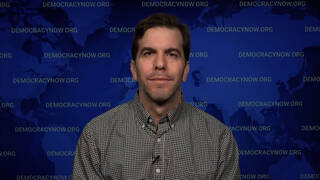
AMY GOODMAN: We’re joined now by Craig Aaron, the co-CEO of Free Press and Free Press Action, two media reform organizations — not to be confused with Bari Weiss’s The Free Press, which is now owned by Paramount. Craig’s most recent article is headlined “Stop the Merger Madness.” Free Press has also just published a new report headlined “Chokehold: Donald Trump’s War on Free Speech & the Need for Systemic Resistance.”
Craig Aaron, welcome back to Democracy Now! If you can respond to all that has happened in just a matter of days? There was enormous criticism of Netflix’s bid, and now, of course, you have this hostile bid by none other than President Trump’s son-in-law. Can you talk about all of this?
CRAIG AARON: Absolutely. Good to be with you, Amy and Juan.
This is really a damned-if-you-do, damned-if-you-don’t situation, where we have these giant companies taking — trying to take control of even more of what we watch, see, hear and read every day. So, Netflix, of course, if they could get this deal done, would dominate online streaming. Paramount itself has a huge streaming business and, of course, is a major movie studio. So, this is another situation where we’re talking about giant companies merging, spending billions and billions of dollars, all the lawyers and bankers getting rich.
But you don’t have to look very far in the past to understand that media consolidation after media consolidation deal are disastrous for the workers in these industries. They’re disastrous for the audience, who see prices go up and choices go down.
And pretty much every time, they’re disastrous for the businesses, as well. This is the third giant merger in recent time just to involve Warner Bros. You’ll go back to AOL Time Warner. We’ve had AT&T and Time Warner — all of these deals collapsing, falling apart, costing thousands and thousands of jobs, Warner Bros. Discovery itself the product of failed mergers.
And now we’re being told we need more concentration, more consolidation. And we have to be asking ourselves: Who does this serve? It seems to serve these executives. Maybe it serves Donald Trump. He seems very interested in competition for his favor, not very interested in actual competition when it comes to media, when it comes to entertainment.
JUAN GONZÁLEZ: And, Craig, you mentioned Trump. This spectacle of the president saying he will be involved in the decision —
CRAIG AARON: Unbelievable.
JUAN GONZÁLEZ: — on this merger one way or the other. Forget about the fact that his son-in-law is a participant, obviously, in one of the bids. How frequently have presidents in the past directly involved themselves in these kinds of merger decisions where the FCC is involved?
CRAIG AARON: Well, you know, certainly these are political fights, and so the White House might have a stake. They might have an interest in the outcome. But the idea that the president would be announcing that he’s personally going to be involved, the idea that someone as close to the president as a member of his own family could be poised to benefit from a decision of the administration, this would be completely unthinkable. And even the way this whole decision is being made really does look like, you know, a Mafia-type situation, not anything that is recognizable in terms of policymaking.
Paramount and the Ellisons’ entire argument for why they should be the company that wins this bidding war essentially boils down to “Donald Trump likes us better.” And they’ve been very clear in trying to win over Trump. That’s why Jared Kushner is involved. They’re trying to win over Trump. They’re saying, “We want to control CNN. We’re going to make CNN better for you. Look what we’ve done at CBS, where we’ve muted 60 Minutes, where we’ve put Bari Weiss in charge of the news operation.” This is their entire package and selling point to the administration, is that if they go with Paramount Skydance, then that’s going to be good for Trump, because these media executives understand, unfortunately, that’s how you get things done in the Trump era, is you appeal to the ego of Trump, you flatter Trump, and you try to line Trump’s pockets or the pockets of those closest to him. That’s how business gets done in the Trump era.
JUAN GONZÁLEZ: And what are the next steps here? What agencies do have to have oversight? And you mentioned Paramount, but isn’t the head — the chief legal officer of Paramount, wasn’t he the head of the Antitrust Division of the Justice Department during Trump’s first term?
CRAIG AARON: That’s right, Juan. The revolving door is spinning. So, Makan Delrahim, who was the top antitrust enforcer under the first Trump administration, now, of course, he’s Paramount’s top lawyer trying to work the system to get approval for their hostile takeover, if it’s announced.
So, there are a lot of things that are going to happen in the weeks ahead. I would remind folks that every time a merger is announced, all the companies involved want to treat it like it’s a done deal, like it’s about to be finished. That is not the case. That’s just PR and spin. We’re looking at at least a year of evaluating this deal, and that’s not even including the fact that there are multiple suitors here trying to appeal to the Warner Bros. board, and now directly to their shareholders, in a hostile takeover.
But whatever deal Warner Bros. pursues, probably by the end of this month, by December 22nd, that would have to go before the Justice Department. That is going to be, I believe, who will review this deal at the federal level. Of course, the Justice Department is also not what it used to be even when Delrahim was there. You know, it has become an arm of the — a direct arm of the Trump administration, pursuing the Trump administration’s political goals. But if they actually follow the law, of course, they would have to scrutinize this deal. And really, looking at the basics there, there’s no way a deal like this should even be considered.
Now, it’s not just the Justice Department that will look here. State attorneys general could have a role that’s very important. If you’re the attorney general of California or New York, you should have a lot of interest in what is going to happen to this huge industry that is such a big part of your state. And this is a big enough deal that European regulators and others around the world are also going to be scrutinizing it, because it is such a ginormous, multibillion-dollar deal between these huge companies, that, you know, really will reshape the entertainment industry as we know it.
JUAN GONZÁLEZ: And I wanted to ask you about another merger under consideration, this one by the FCC. That’s of Nexstar, the country’s largest owner of TV stations, with a competitor, TEGNA. Tell us — Nexstar is pretty well known as a very conservative company, isn’t it?
CRAIG AARON: That’s right, and especially during the Trump administration. Nexstar has been collecting hundreds of television stations across the country in this wave of media consolidation. They are now going to the Federal Communications Commission and asking them to waive laws, to actually overturn explicit instructions from Congress that limit the amount of television stations — the size of the audience one television chain can reach. They’re trying to get that thrown out so they can take over TEGNA.
And they’ve done that, again, by appealing to the Trump administration, by promising to crack down on critical journalism and by doing things like taking Jimmy Kimmel off the air. This was one of the companies, along with Sinclair Broadcasting, another very partisan broadcaster, that when the FCC chairman went on a podcast and started complaining about jokes Jimmy Kimmel was making about Charlie Kirk, it was Nexstar rushing to immediately yank him, pull him off the air, while having this multibillion-dollar deal before the FCC. So, again, we have the media executives seeing that the way to get ahead in the Trump administration is appeal to Trump.
We have the Trump administration abusing its power, really shaking down these companies, demanding loyalty, demanding they erase and eliminate their diversity and equity programs, and demanding that, in some cases, they pay off the administration through specious lawsuits, or maybe it’s they offer big movie contracts to the president’s wife or do favors for his son-in-law’s equity firm. This is the way the Trump administration has been working. This is what they’re pursuing to try to do a takeover of the media and make sure the mainstream, dominant media is really only there to serve Trump.
And you can see that in all of these deals. You know, over the weekend, Trump expressed skepticism of Netflix, but then, when 60 Minutes interviewed Marjorie Taylor Greene, well, maybe he doesn’t like CBS and Paramount so much anymore. This is the game they’re playing. It’s all about control and dominance and one narrative. And unfortunately, media executives in broadcast, in cable, in Hollywood, instead of fighting back against this infringement on free speech and freedom, have simply capitulated, hoping it will get their deals done.
AMY GOODMAN: Craig Aaron, I want to thank you for being with us, co-CEO of Free Press and Free Press Action. We’ll link to your new report titled “Chokehold: Donald Trump’s War on Free Speech & the Need for Systemic Resistance.” His new article is headlined “Stop the Merger Madness.” We’ll link to it at democracynow.org.
Next up, outcry is growing after the Trump administration drops free admission to national parks on the only two federal holidays honoring Black history: Juneteenth and Martin Luther King Day. Instead, the parks will be free on Donald Trump’s birthday. Stay with us.




 Top
Top
Media Options