








 Watch Full Show

The FBI raided the home of Washington Post reporter Hannah Natanson this week and seized her electronic devices, part of a leak probe into a government contractor accused of mishandling classified government materials. Natanson has reported extensively on the Trump administration’s changes to the federal bureaucracy, including mass layoffs of government workers. This comes amid a broader pattern of attacks on the media, including lawsuits, funding cuts, and increasing media and technology consolidation.
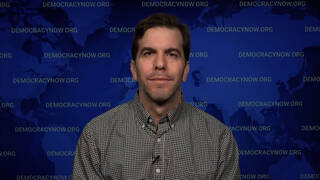
“It’s hard not to see [the FBI raid] as an effort to intimidate not just journalists, but the sources that would communicate with them,” says Jameel Jaffer, director of the Knight First Amendment Institute at Columbia University. “It’s a terrible time for press freedom. … We need the press to inform the public about the government’s actions and decisions and to help us hold government officials to account.”
Related Story
 StorySep 11, 2026Forever War: How 9/11 Unleashed U.S. Violence on Civilians Abroad & Attacks on Rights at Home
Transcript
NERMEEN SHAIKH: On Wednesday, the FBI raided the Alexandria, Virginia, home of a 29-year-old Washington Post reporter, Hannah Natanson, who covers the Trump administration’s reshaping of the government and its effects. The president of the Reporters Committee for Freedom of the Press called the raid a, quote, “tremendous escalation in the administration’s intrusion into the independence of the press.”
FBI agents searched Natanson’s home and seized a phone, a Garmin watch, her personal computer and one owned by the Post. Agents reportedly told Natanson the raid was related to their investigation of a government contractor and Navy veteran named Aurelio Perez-Lugones, who’s accused of illegally retaining classified government materials. He was reportedly messaging the reporter at the time of his arrest last Thursday.
AMY GOODMAN: Just last month, Hannah Natanson wrote a piece headlined “I am The Post’s 'federal government whisperer.' It’s been brutal,” unquote. She said her reporting had led to more than a thousand new sources who were current or former federal workers, quote, “who wanted to tell me how President Donald Trump was rewriting their workplace policies, firing their colleagues or transforming their agency’s missions,” unquote. Natanson was also part of a Washington Post team that won the 2022 Pulitzer Prize for Public Service for their coverage of the January 6th Capitol insurrection.
Readers of The Washington Post coverage of Wednesday’s raid on the reporter’s home left thousands of comments noting the paper’s owner, Amazon founder Jeff Bezos, had so far not commented on the raid.
For more, we’re joined in our New York studio by Jameel Jaffer, director of the Knight First Amendment Institute at Columbia University, previously deputy legal director at the ACLU.
Welcome back to Democracy Now!, Jameel.
JAMEEL JAFFER: Thanks, Amy.
AMY GOODMAN: Why don’t you explain to us what you understand happened on Wednesday morning, when the FBI raided the home of a reporter?
JAMEEL JAFFER: Yeah, I mean, this is a reporter who’s been covering the federal government, talking to government employees, publishing stories about her conversations with government employees. And her home was raided by the FBI. It’s a very unusual thing, extremely rare in this country that the FBI raids the home of a reporter or raids a newsroom — thankfully, very rare, in our recent history, at least. But that’s what they did in this case. And they seized her electronic devices, including two laptops, one of which was issued by the Post, and a cellphone, as well.
And not at all obvious to me why this search was necessary at all. They had already searched the home of this contractor a week before and obtained, apparently, evidence that he was sharing classified information, so they already had that evidence against him. They filed a criminal complaint against him. And a week later, they execute this search of a journalist’s home. And we don’t yet have the affidavit in support of the search, so we don’t know what they told the court to justify this search, but it’s hard not to see it as an effort to intimidate not just journalists, but the sources that would communicate with them.
NERMEEN SHAIKH: So, Jameel, could you explain what kind of legal authorization is typically required for this kind of search, in particular —
JAMEEL JAFFER: Yeah.
NERMEEN SHAIKH: — of a journalist’s home?
JAMEEL JAFFER: Yeah. So, it’s a very complicated legal landscape, mainly because the Supreme Court issued this decision in 1972, which is, to put it generously, very cryptic. Nobody understands what that decision really means. But, you know, essentially, the court said, “We’re not going to extend constitutional — special constitutional protection to journalists with respect to their sources. You know, we’re not going to let journalists refuse to testify, for example, before a grand jury when they’re subpoenaed for their sources.” But in the same decision, the court said, “Obviously, there are constitutional implications to some of these requests, and we’re going to be very careful that the government doesn’t cross constitutional lines.” So, it’s a cryptic opinion. There’s a concurrence by Justice Powell that people have taken to be the controlling opinion of the court, but the result is that there’s this very messy judicial landscape.
Congress has been asked over and over again, urged over and over again by press freedom organizations, including the Knight Institute, to pass legislation that would give reporters clearer protection against compelled process, so not just subpoenas, but also court orders and search warrants, of the kind that was, you know, at issue in this particular search, but Congress has failed to do that. And in the meantime, the only protections that journalists have are the ones that the Justice Department wants to — or, the main protections that journalists have are the ones that the Justice Department wants to provide. And the Biden administration had provided, had strengthened the rules protecting journalists in very important ways, but the attorney general, the current attorney general, Pam Bondi, weakened those rules last year. Press freedom advocates knew that the weakening of those rules would result in a kind of stepping up of investigations of the press and their sources. And this search, I think, is a sign that we were right to worry.
AMY GOODMAN: I mean, it’s really serious, when you look at — she’s not even the actual target?
JAMEEL JAFFER: That’s right.
AMY GOODMAN: They’re saying?
JAMEEL JAFFER: Yeah.
AMY GOODMAN: They get the information. You can’t help forget here that she is a winner of the Pulitzer Prize. She was part of the team that investigated what President Trump doesn’t want to talk about, which is the January 6th insurrection.
JAMEEL JAFFER: Yeah, yeah. Well, so, I think that one of the really worrying things here is that, presumably, they justified this search to the judge by saying this relates to this contractor who was sharing classified information, was taking classified information home unlawfully and then sharing it. And that’s how they justified the search to the judge. But this reporter has all kinds of information, all kinds of communications with sources that have nothing to do with classified information, right? All these communications with current government employees, for example, including conversations that are not national security-protected — they don’t touch on national security issues at all. And now the government has possession of all of those communications, and we don’t know whether any protections have been put in place to segregate those communications or whether the Justice Department is just sifting through them right now.
NERMEEN SHAIKH: And what kind of recourse, if any, legal recourse, does the reporter, Hannah Natanson, or, indeed, The Washington Post have, in light of what’s happened?
AMY GOODMAN: And let’s not forget its — the owner, Jeff Bezos, quite close to President Trump.
JAMEEL JAFFER: Yeah, I mean, it’s quite striking that, at least to my knowledge — and I think you said this in the intro, as well — that Jeff Bezos hasn’t said anything about this search. I mean, this is a huge attack on not just press freedom, but his — you know, his outlet, The Washington Post, and that he hasn’t come to the defense of the newspaper or the journalist is pretty striking.
NERMEEN SHAIKH: And what about the fact — what about the Post itself? It can’t do anything, the managing editor —
JAMEEL JAFFER: Well, no, I think that the Post can do something. I mean, there was a strong statement from the executive editor, and the Post could go to court and, at the very least, demand that the judge impose restrictions on what the government can review here, ensure that the only information that the government has access to is information relating to the search of the contractor, at the very least. And, you know, maybe they could challenge the search in broader ways, as well. I’m sure that they’re thinking that through now. I hope that they, you know, will go to court.
AMY GOODMAN: And quite terrifying, the fact that she is known as “the government whisperer,” that thousands of workers —
JAMEEL JAFFER: Yeah.
AMY GOODMAN: — have turned to her, they will know who those workers are.
JAMEEL JAFFER: Yeah, I think that that’s why it’s hard not to see this as an effort to intimidate the press.
AMY GOODMAN: We want to ask you about another issue. The House Oversight Committee is facing growing criticism for voting to subpoena the prominent investigative reporter Seth Harp after he posted publicly available information about a Delta Force commander who reportedly played a role in the recent abduction of the Venezuelan president, Nicolás Maduro, and his wife. Harp is the author of the book The Fort Bragg Cartel: Drug Trafficking and Murder in the Special Forces. On Monday, 20 press freedom and First Amendment groups, including the ACLU and Reporters Without Borders, called on the House committee to rescind the subpoena, saying Harp’s reporting is, quote, “fully and squarely within the protections of the First Amendment.” Your response, Jameel?
JAMEEL JAFFER: Yeah, I mean, my organization didn’t sign that letter, but I agree 100% with what the ACLU and other organizations wrote. I mean, this is plainly First Amendment-protected activity. You can publish information that is already publicly available. And the fact that the government says that this information is classified doesn’t actually change the calculus, because the First Amendment protects the right of news organizations and journalists to publish government secrets. So, I think that this is, you know, yet another effort, this time by Congress, not the Justice Department, to intimidate the press, to deter the press from doing work that all of us need the press to do.
AMY GOODMAN: So, you’re racing out of here to catch a plane to go to Boston. You’re dealing with the AAUP case that challenges the Trump administration’s policy of detaining and deporting international students and professors who participate in pro-Palestine protests. Can you explain where this case stands now?
JAMEEL JAFFER: Yeah, so, you know, this is, as you say, a case in which we’re challenging this policy of targeting student protesters. And we had a trial over the summer before Judge Young, William Young, in Boston, after which he issued a 168-page opinion, scathing opinion, holding that the government’s policy of targeting these foreign students on the basis of their pro-Palestinian activism was unconstitutional. So, he’s said that already, but he hasn’t yet given us a remedy for the violations that he’s identified. So, today’s hearing is about, essentially, what can the court do about the constitutional violations that he’s already recognized. So it’s a really important hearing. It’s this afternoon in Boston.
NERMEEN SHAIKH: And can you talk — next week marks the one-year anniversary of Trump having been in office — the attacks on the press that have happened in the last year?
JAMEEL JAFFER: Yeah, I mean, it’s — you know, it’s a terrible time for press freedom. And the important thing about that is that we need the press to inform the public about the government’s actions and decisions and to help us hold government officials to account. But the Trump administration is, you know, engaged in a kind of all-out assault on press freedom. You see it in so many different ways, like, at the ground level, just the kinds of abuses that you see ICE agents and other federal officials engaged in, other federal agents engaged in, you know, against reporters, but all the way up to the consolidation of control over some of the nation’s largest media organizations, including CBS and, possibly soon, TikTok and CNN, as well.
AMY GOODMAN: Speaking of CBS, this is the new CBS News anchor Tony Dokoupil closing out Tuesday night’s broadcast with a salute to Secretary of State Marco Rubio.
TONY DOKOUPIL: For Rubio’s hometown fans, which are many around here in Miami, it is a sign of how Florida, once an American punchline, has become a leader on the world stage. Marco Rubio, we salute you. You’re the ultimate Florida man.
AMY GOODMAN: That was how — I think that was his first CBS newscast that he was hosting as the main host. So, I wanted to go now to the Golden Globes, the comedian, the host, Nikki Glaser, who mocked CBS News during her opening monologue.
NIKKI GLASER: And the award for most editing goes to CBS News. Yes, CBS News, America’s newest place to see BS news.
AMY GOODMAN: The Golden Globes ceremony aired on CBS and streamed on Paramount+. But let’s not forget CBS pulled that story on CECOT, on the Venezuelan prisoners —
JAMEEL JAFFER: Yeah.
AMY GOODMAN: — the U.S. —
JAMEEL JAFFER: Yeah.
AMY GOODMAN: — men who were sent to Venezuela and put at the maximum-security prison in El Salvador.
JAMEEL JAFFER: Yeah, I mean, you know, it’s funny and, you know, sort of comical, what’s happening at CBS, but it’s also tragic, because we need — we need the press to cover this stuff seriously. We need the press to hold government officials to account. And when some of the most powerful news organizations in the country aren’t doing that, it makes our democracy much weaker.
AMY GOODMAN: Jameel Jaffer, we thank you so much for being with us, director of the Knight First Amendment Institute at Columbia University.
Coming up, the acclaimed Iranian filmmaker Jafar Panahi in our studio. Stay with us.
[break]
AMY GOODMAN: “I Keep Faith” by Billy Bragg, performing in our Democracy Now! studio.




 Top
Top
Media Options