








 Watch Full Show

Guests
- Mohammad Eslamiresearch fellow at the University of Tehran.
- Zeynab Malakoutisenior fellow at the Global Peace Institute and research affiliate at the Middle East Institute, National University of Singapore.
We speak with two Iranian scholars ahead of an 8 p.m. ET deadline set by President Donald Trump for Iran to reopen the Strait of Hormuz or face destruction of all its power plants, bridges and other civilian infrastructure. Twelve hours ahead of the deadline, the president posted on social media, “A whole civilization will die tonight, never to be brought back again. I don’t want that to happen, but it probably will.”
Iran has blocked most maritime traffic through the Strait of Hormuz since the start of the U.S.-Israeli war, leading to a sharp increase in oil and gas prices around the world. Mohammad Eslami, a research fellow at the University of Tehran, and Zeynab Malakouti, a senior fellow at the Global Peace Institute at the National University of Singapore, say Iran is likely to maintain long-term control over the strait even after the fighting stops.
“While Donald Trump and the U.S. Army and the Israeli army are focused on the battle, Iranians are thinking about the war,” says Eslami, adding that Iran has prepared for “at least three months of war,” while rising oil prices will make it increasingly difficult for the U.S. to sustain the fighting.
“Iran sees the Strait of Hormuz as a longer-term strategic lever, especially for the postwar period,” adds Malakouti, speaking from Shanghai.
Related Story
 StoryMar 26, 2026Crude Capitalism: Trump’s War on Iran Disrupts Global Systems, from Agriculture to Oil to Shipping
Transcript
AMY GOODMAN: President Trump has renewed his threats to attack Iran’s civilian infrastructure, warning that every power plant and every major bridge in Iran could be destroyed if the Strait of Hormuz is not fully reopened by 8 p.m. Eastern time tonight. Speaking to reporters Monday at the White House, Trump shrugged off questions about threats to civilians, saying, “Very little is off limits.” He also said Iran — a country of more than 90 million people — could be, quote, “taken out in one night.”
PRESIDENT DONALD TRUMP: They have 'til tomorrow. … Now, we'll see what happens. I can tell you they’re negotiating, we think, in good faith. We’re going to find out. We’re getting the help of some incredible countries that want this to be ended, because it affects them also. A lot of people are affected by this. But we’re giving them — we’re giving them 'til tomorrow 8:00 Eastern time, and after that, they're going to have no bridges, they’re going to have no power plants. … Very little is off limits.
REPORTER: Are there certain kinds of civilian targets, though? I’m thinking schools or hospitals —
PRESIDENT DONALD TRUMP: I don’t want to tell you that you.
REPORTER: — that you would say is off —
PRESIDENT DONALD TRUMP: I don’t want to tell you that. We’re going to have a — we have — we have a plan, because of the power of our military, where every bridge in Iran will be decimated by 12:00 tomorrow night, where every power plant in Iran will be out of business, burning, exploding and never to be used again. … We have to have a deal that’s acceptable to me, and part of that deal is going to be we want free traffic of oil and everything else.
AMY GOODMAN: A spokesperson for Iran’s Foreign Ministry condemned the Trump administration’s approach to negotiations.
ESMAEIL BAGHAEI: [translated] Negotiation in no way involves an ultimatum, a crime or a threat to commit war crimes. The Islamic Republic of Iran and the Iranian nation have very, very bitter experiences of negotiating with America, and we did not gain these experiences lightly to simply ignore them.
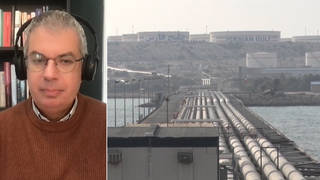
AMY GOODMAN: For more, we’re joined by two guests. In Shanghai, China, we’re joined by Zeynab Malakouti, senior fellow at the Global Peace Institute and research affiliate at the Middle East Institute, National University of Singapore. She previously served as director of the Human Rights Department at the UNESCO Chair for Human Rights, Peace and Democracy in Iran. And in Tehran, Iran, we’re joined by Mohammad Eslami, research fellow at the University of Tehran and co-author of The Second Europe, a study of Iranian nuclear — Iranian-European nuclear negotiations. He was also the editor-in-chief of Khorasan Diplomatic Magazine and traveled regularly with Iranian negotiators during the Iran nuclear deal talks. They’ve just co-authored a piece together for Responsible Statecraft headlined “Hormuz is not a tool to end the war but how Iran wins the aftermath.”
We welcome you both to Democracy Now! Mohammad Eslami, you’re in Tehran, the capital of Iran. First of all, can you just talk about how the war is unfolding on the ground in Tehran?
MOHAMMAD ESLAMI: First of all, thank you so much, Amy, for having me in your program. I’m a follower of your program, Democracy Now!, from years.
Here in Tehran, the people are waiting for Trump’s reaction to his own deadline, and they’re not thinking this deadline has a kind of powerness of President Trump, but considering his inappropriate rhetoric, talking about this deadline, they are thinking that it’s a kind of — it’s a message of weakness from him. So, the Iranian — the ordinary persons or ordinary people, they are understanding what’s going on in terms of the war, but it’s not in a way that they think that the government should stop the war, because they know that after the war, another war will come again.
And the question here in Iran which every person is talking is, all this operation — if all this operation is against the Islamic Republic, but — or is it about the Iranian people and Iran as a country? And it is interesting that Donald Trump himself continuously said that he’s talking about Iran and Iranians; he’s not talking about the Islamic Republic. He tell — I’m sorry to say that, but recently, when they asked him about bombing infrastructure all around Iran, I’m sorry to say that, but he said that they are animals. So, people here are talking about Trump and Bibi Netanyahu, and everyone knows that right now it’s not about Islamic Republic, it’s about Iran as a very powerful country in the region.
JUAN GONZÁLEZ: And, Mohammad, you said, quote, that Trump “appears to assume that Tehran is using the strait as a bargaining chip in exchange for a ceasefire or even sanctions relief,” but that that assumption is mistaken. How so?
MOHAMMAD ESLAMI: Very interesting question, because from the Iranian point of view, after Trump started the war on Iran, they recalculated about the Strait of Hormuz. And it is interesting to say that they discovered that it is a kind of historical mistake for them not to control the Strait of Hormuz. So, they’re not thinking about the Strait of Hormuz as a card to have a ceasefire or to stop the war. They know that the war has two dimensions. One is a tactical dimension, and the second one is about the strategy. The tactical dimension is the battle, and the strategy is the war. So, while the Donald Trump and the U.S. Army and the Israelis’ army are focused on the battle, Iranians are thinking about the war.
So, one of the points that Iranians are thinking about is about deterrence. In the previous 12-day war and in the current war, the Iranian officials understood that their missile program is important. They are targeting the U.S. bases. They are targeting Israel. But it’s not enough. So they should have something more in terms of deterrence. So, one of the things about deterrence, and which the Iranian officials think they should rebuild after the war, is the deterrence, which is the Strait of Hormuz. But it is not only about the deterrence. It is also about a card to reestablish their relations with other countries out of the regime of the sanction — regime of sanctions, unilateral sanctions by United States and the U.N. sanctions, that is, again after the snapback.
So, the Iranians are thinking about the Stait of Hormuz in a strategic way, and they want to have a constructive role in global economy, rather than a destructive role. And the Strait of Hormuz, for them, is required to have the bilateral relations with European countries, with also the regional countries, with East Asian countries. And they are thinking about this, as I told you. It is not about the Islamic Republic. It’s not about defending the Islamic Republic. They think that it was a historical mistake for them. I’m sure that Zeynab will explain more, but, legally speaking, it is their right to control the Strait of Hormuz.
JUAN GONZÁLEZ: And I wanted to ask you about Trump’s threat to bomb Iran back to the Stone Age. It seems to me that throughout this conflict, President Trump has not really grasped the size and power of Iran and has consistently overestimated the power of the United States to do what it wants. I’m wondering your thoughts about that.
MOHAMMAD ESLAMI: Yeah, you know that President Trump doesn’t have any plan for this operation. Who has the plan? Bibi Netanyahu has a plan for this operation. Well, what’s the plan? What’s the problem with Bibi Netanyahu? Netanyahu is the prime minister of a country with 10 million persons, but the persons and the population of Tehran, in night — I’m not talking about in the morning — the population of Tehran in night is more than 10 million persons. So it’s the question of scale. They cannot understand a big country, a big economy, a big society of the Iran, so they thought that by killing the Iranian supreme leader, by killing the high-ranking negotiators, by bombing the infrastructure, by bombing the bridges, as they’re talking about, they can push Iranians to surrender. But it’s not the way that they wanted, and it’s the problem of scale. And the matter of the scale is what they cannot understand and they didn’t have in their previous calculations.
AMY GOODMAN: Mohammad Eslami, you’re right there in Tehran.
MOHAMMAD ESLAMI: Yeah.
AMY GOODMAN: At 8:06 Eastern this morning, 12 hours before Trump’s deadline, he just wrote, “A whole civilization will die tonight, never to be brought back again. I don’t want that to happen,” Trump writes on Truth Social, “but,” he says, “it probably will.” Your response?
MOHAMMAD ESLAMI: I think there are two scenarios. The first one is Trump bluffing and bluffing and lying again and again and again. We should wait, because this is not the first time that he’s declaring a deadline. So, the second scenario is he is promising, I mean, having the operation and ordering the operation the same as he said.
But from the Iranian point of view, if Trump is going to do this, it means that he’s going to make lots of problem for the global economy. And I’m telling you that the Iranian officials have a plan of at least three months of war, at least three months of war, and they are calculating about the oil prices. They are calculating about lots of indexes globally and also United States domestically. They are, I mean, monitoring every happenings inside the United States, and also, as I told you, globally. They are in contact with European countries and other markets, East Asian market, for example, in oil and gas.
So, the Iranians are waiting for Trump. Trump will bomb Iran. He cannot — he cannot achieve their goals by bombing power plants and bridges, because the country is much more bigger than his understanding. So, yes, there is a scenario in Tehran, but everybody is waiting for him. Even people are waiting for him. That’s it, nothing more.
AMY GOODMAN: I want to bring Zeynab Malakouti into the conversation. She’s in Shanghai, China. She’s part of — she teaches at the National University of Singapore. We also have this breaking news, that the U.S. military conducted strikes on military targets on Iran’s Kharg Island, the Axios news outlet reported today. You have a piece, together with Mohammad Eslami, called “Hormuz is not a tool to end the war but how Iran wins the aftermath.” If you can explain exactly what you mean? Kharg Island, by the way, is not in the Strait of Hormuz. It’s in the Persian Gulf. But if you can also link the two and talk about the significance of this attack we’re just reporting?
ZEYNAB MALAKOUTI: Yes. Thank you so much for having me.
First of all, I should say that Iran’s reaction and any retaliation should be understood in the context of what Iran sees as an illegal war initiated by the U.S. and Israel under international law. So, the situation and the situation of Hormuz needs to be viewed as a whole, not in isolation.
Specifically regarding the Strait of Hormuz, Iran has both opportunities and challenges in this regard. The Strait is not just a short-term bargaining tool for a ceasefire or ending the war. Even recently, Iran has rejected proposal linking a ceasefire to reopening the strait. So I think that this shows that Iran sees the Strait of Hormuz as a longer-term strategic lever, especially for the postwar period.
So, in terms of the challenges that Iran might face, one is a legal dimension domestically. Domestically, at the parliament now, they are discussing about a bill on a strait security arrangement. If it’s passed, it could give Iran greater control over the Strait of Hormuz, including financial measures and toll regulations and to somehow cooperation with Oman, which they have already had a meeting.
But it’s not just a legal — a domestic legal situation. At the international level, the situation is also complex. The Strait of Hormuz is generally considered as an international strait under U.N. Convention on the Law of Sea. But Iran is not a party to this convention and repeatedly during the years rejected the transit passage regime. Some argue that transit passage is part of customary international law, which means that Iran must follow this regime. But I believe that this is the questionable issue under international law.
I think that, personally, from the legal perspective, I should say that more important than the Strait of Hormuz, which is a gray area under international law, there are certain principles of international humanitarian law or the law of war that are being violated right now, when I’m speaking with you, by the U.S. and Israel attacks on civilian objects, infrastructure and a recent threat of the President Trump for bombardment of power plant inside Iran.
JUAN GONZÁLEZ: And, Zeynab, I wanted to ask you what Mohammad mentioned earlier, that the Iranian leadership is prepared for at least three months of war with the United States. What would be the impact if this war dragged on for so long, especially on the countries of Asia that depend so much on the Persian Gulf for their oil supply? You’re speaking to us from China. China is heavily reliant on oil from the Persian Gulf, but especially countries like the Philippines, Indonesia, South Korea. What is already happening there? And what would happen if this war dragged on for three months?
ZEYNAB MALAKOUTI: Short answer is that it would be a disaster for these countries, because limitation on the strait and the restrictions on vessel movement have a major impact on energy markets. If the Strait of Hormuz remains closed, East Asia would face not only an oil price shock, but also a broader structural energy crisis that exposes deep vulnerabilities in their supply chain. As you mentioned, Thailand, the Philippines, Indonesia are already under pressure.
We can say to somehow the situation of China is a bit different, because some Chinese vessels have been allowed to pass the Strait of Hormuz with Iran’s permission. And also, China also has a more diversified energy mix, including domestic coal, renewables and oil and gas. For the short time, I can say that no physical shortages China will face, but in the longer term, they will face a problem.
AMY GOODMAN: Zeynab Malakouti, you’re speaking to us from Shanghai. You’re at the National University of Singapore. I wanted to ask you about the UNESCO Heritage Sites. UNESCO has said it’s deeply concerned about the fate of Iran’s 29 World Heritage Sites, after Tehran’s Palace, often compared to Versailles, a historic mosque and a 17th-century palace in Isfahan were damaged by Israeli and U.S strikes last month. Last week, the head of Iran’s National Commission for UNESCO warned the extent of the damage to Iran’s historic and cultural sites is far higher.
HASSAN FARTOUSI: [translated] As of last night, I was told that 132 of our cultural heritage sites had come under attack.
AMY GOODMAN: Zeynab Malakouti, if you can talk about this? You have been following — what are UNESCO World Heritage Sites? What is the extent of the damage, as you understand it? And what are we losing as a world community?
ZEYNAB MALAKOUTI: Yeah. As you probably know, more than a hundred cultural sites are destroyed or damaged during these 30 days of war by the U.S. and Israeli attacks. These are — most of them are under the UNESCO protect, but not all. These are all damaged or even completely destroyed in Isfahan, Shiraz and Tehran. Some said that these are collateral damage of the attacks. But if you look at the amount of the damages, you can say — you can see that and you can say that these are not collateral damage. These are just a destroy of the cultural heritage. And the important thing is that people are getting angry more and more every day, because they can see the real face of war, the destruction of cultural heritage. And now I can say that the people decide to rally around the flag and support Iran.
JUAN GONZÁLEZ: I’d like to bring Mohammad back into the conversation. Mohammad, the Trump administration keeps saying that they are determined not to allow Iran to acquire nuclear weapons. But the world forgets that it was Trump himself, in his first term, that pulled the United States out of the international agreement that was limiting nuclear enrichment in Iran. I’m wondering — you’re familiar with the Iranian-European negotiations. Could you talk about that?
MOHAMMAD ESLAMI: You know that Trump lied about JCPOA. He said that this is Obama deal. It was not Obama deal. It was a deal endorsed by the U.N. Security Council. It was a deal negotiated more than two years by five permanent members of United — U.N. Security Council. It was a deal discussed in lots of institutes all around the world. So Trump lied about — lied about JCPOA. And what he said about enrichment of the — I mean, enrichment facilities in Iran and the Iranian intention to have nuclear weapon, it is not true, because all the Iranian program was under the IAEA monitoring.
So, Donald Trump, it is a question for the Iranians: What is the main objectives of Donald Trump to have war in terms of diplomatic war, economic war and now operations against the Iranian people? And as I told you, the Iranians think that — you know, I’m telling you that in Iran before the war, there was a debate if the United States is going to start this war or not. And some said that it is not rational for the United States to start this war of choice. So, right now people are thinking about the real objectives behind Trump actions against Iran, and it seems that the Trump administration and Donald Trump himself is under a real, real influence by the Israelis — namely, Bibi Netanyahu. And I don’t want to mention Epstein files, but ordinary people in Iran, they are thinking maybe there are something in Epstein files that Trump is accepting every order by Bibi Netanyahu.
AMY GOODMAN: Mohammad Eslami, I want to thank you for being with us, research fellow at the University of Tehran, speaking to us from Iran, and Zeynab Malakouti, senior fellow at the Global Peace Institute, speaking to us from Shanghai. We’ll link to your piece for Responsible Statecraft headlined “Hormuz is not a tool to end the war but how Iran wins the aftermath.” We’re having this discussion as Donald Trump has just tweeted, “A whole civilization will die tonight, never to be brought back again. I don’t want that to happen, but it probably will,” the president said.
Up next, a one-and-a-half-trillion-dollar U.S. military budget? We’ll look at where the money will be going and where it won’t. We’ll also speak with Juan González about a historic gathering at the CUNY Graduate Center here in New York this week called “Latinx Freedom.” Stay with us.
[break]
AMY GOODMAN: “Pa’lante,” performed by Hurray for the Riff Raff at Democracy Now!’s 30th anniversary at Riverside Church. To see the whole two-and-a-half-hour event, go to democracynow.org.



 Top
Top
Media Options