



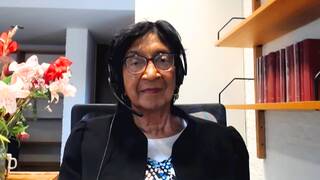

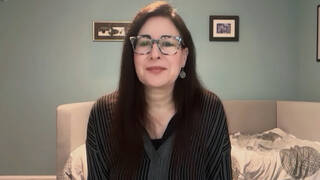





Renowned anti-death penalty activist Sister Helen Prejean reacts to the Justice Department announcement that it will use firing squads and single-drug lethal injections to kill condemned federal prisoners, as it seeks to ramp up and expedite capital punishment.
Transcript
AMY GOODMAN: This is Democracy Now!, democracynow.org, The War and Peace Report. I’m Amy Goodman, as we bring you Part 2 of our conversation with Sister Helen Prejean.
Death by firing squad. In its efforts to ramp up and expedite federal executions, the Justice Department announced Friday it will add firing squads, electrocution, gas asphyxiation to its arsenal of methods to execute federal prisoners on death row.
We’re continuing our conversation with Sister Helen Prejean, one of the world’s most well-known anti-death penalty activists, perhaps second only to Pope Leo when it comes to well-known opposition to the death penalty. Sister Helen Prejean is the author of the best-selling book, Dead Man Walking: An Eyewitness Account of the Death Penalty, which was just published in a graphic edition by Random House.
As we continue this conversation, Sister Helen Prejean, I wanted to ask you about the conference you’re at, at DePaul in Chicago. I mean, Chicago is where Pope Leo is from. The message that you played of Pope Leo opposing the death penalty came out almost concurrent with the Trump administration announcement expanding the methods to carry out federal executions. President Biden had put a moratorium on federal executions. Can you talk about the significance of this?
SISTER HELEN PREJEAN: Right. Yeah, well, the pope’s — that we had invited him to send a message to this to celebrate the 15th anniversary of Illinois abolishing the death penalty. And Governor Pat Quinn was there. That was the occasion. And we issued the invitation to him, and he responded readily.
Now, this has been in work for weeks. It just happened to coincide that right as he gave this message, this video message to us, Friday, here you had the Trump administration announcing that they’re going to use every form possible to kill people so that they can expedite executions. They just happened to coincide, but they were not related directly to each other, except to say that Pope Leo is coming out very strongly that the paradigm of using the death penalty to kill the killers to try to control violence is the microcosm of Gaza and Iran. You designate an enemy, you dehumanize them, and you kill them.
And so, the pope is speaking out. He’s one of the prominent voices now in the world. But that’s the church. It took 1,500 years of dialogue to reach a position that is in alignment with the Universal Declaration of Human Rights, which means you can never make an exception and ever entrust over to governments that right to decide that they can kill some of their citizens for their crimes.
AMY GOODMAN: This isn’t the first time that the pope has dramatically diverged from the Trump administration. Defense Secretary Pete Hegseth recently prayed for military commanders to unleash, quote-unquote, “overwhelming violence” against enemies. Hegseth, who has long embraced Christian nationalism, has repeatedly invoked Jesus Christ in recent weeks during official remarks about the war in Iran. In his Palm Sunday address in Vatican City, Pope Leo called the war in Iran “atrocious” and said leaders who start wars have, quote-unquote, “hands full of blood.” How is the pope taking on not just Trump, but his version of Christian nationalism? And respond to what Pope Leo has said.
SISTER HELEN PREJEAN: Well, Pope Leo is doing what Pope Francis did and what the pope before him did. It’s announcing the true gospel of Jesus is nonviolence. The true gospel of Jesus is you dialogue respectfully with people. You don’t automatically deem them an enemy and kill them.
And I’ve noticed this about the death penalty, that people wanted to quote religious reasons that, therefore, God is justifying what we’re doing, and so selectively quoting the Bible. But it’s really reached a new zenith now with Trump and Hegseth. I mean, that statement of “Let us go to — this is a holy war, and let us do it in the name of Jesus Christ. Everyone kneel and pray,” a holy war like the Crusades.
And the pope took it on. So, the pope is not afraid to take things on. And as he said recently, “I’m not in a political arguing match with a politician as if I’m a politician. I’m simply continuing to announce and proclaim the gospel of Jesus, which is always going to be about nonviolence and respect of other persons and never war.” And so, he speaks out consistently about it.
AMY GOODMAN: Last April in South Carolina, autopsy records revealed corrections officers botched the execution of Mikal Mahdi, who was killed by firing squad last year after being sentenced to death in 2006. Mahdi’s three executioners missed his heart, hitting his abdomen and causing him, quote, “excruciating conscious pain and suffering for about 30 to 60 seconds,” unquote. He was pronounced dead nearly four minutes after the officers fired. Mikal Mahdi’s lawyers said he selected the firing squad method over lethal injection and the electric chair because he believed it would be “the lesser of three evils,” quote-unquote. Sister Helen Prejean, your response?
SISTER HELEN PREJEAN: There’s no humane way to kill a human being. Look at all the methods they have. But it’s human beings, who are prone to error, that are behind all of these, whether you’re shooting somebody, if you’re lethally injecting people with drugs. I mean, they’ve done autopsies on the lungs of 200 people that have been lethally injected, and have found this kind of porous, fluidy, floaty thing in their lungs, which means they were gasping for breath when they were being killed. But often they paralyze them so that you can’t see them struggling. There is no humane way to kill a conscious, imaginative human being. And so, we see all these errors. And you just see the effort more and more to make it like medicine or a medical procedure that we’re just putting somebody to sleep.
But we see Trump departing from that. Heck no, forget about all this lethal injection and the problems of getting the drugs. Let’s shoot them. Let’s electrocute them to death. And let’s gas them. And let’s shorten the process so they can’t have these appeals. And let’s kill them all and kill them quickly. Look at the mentality that’s present in this.
AMY GOODMAN: I want to quote from Reuters. “The U.S. is one of very few Western nations that still uses the death penalty, although public support for capital punishment has gradually declined among Americans. According to long-running Gallup surveys, 52 percent said they supported it for murder last October, the lowest in more than [half a century], while 44 percent said they opposed it.” If you can respond to this changing view, the increased opposition to the death penalty? And what do you think it would take to end it in the United States legally?
SISTER HELEN PREJEAN: Yeah, like, when Dead Man Walking came out, '93, 80% of the American public said they supported the death penalty. What changes it is people having a chance to reflect and understand how the death penalty works, how selective it is, how racist it is, how it's only poor people chosen. And we have been following, I have been following the mandate from Thurgood Marshall, who said, early on, a lot of Americans say they believe in the death penalty, but educate them on it, bring them close.
And that’s what’s been happening in the country. Like, take my state, Louisiana, we hadn’t had an execution for 17 years, until we got this Republican governor, Jeff Landry, who claimed he’s going to clean out death row and execute everybody, with that mentality of “we’re going to kill them all” kind of thing. But the people have changed. Even juries in Texas, the state that has the most executions, are reluctant to give the death penalty, and often they don’t. It’s not a deep-seated thing in our people to want to kill people and to put the government in charge.
So, the whole key, Amy, the more we educate people on it and get to them. This graphic edition of Dead Man Walking, we’ve been getting it out to young people across the countries and to universities. It’s reflection, understanding how it works. And then most people say, “Oh, I don’t want the death penalty.” Look how many town hall meetings are held where people bring up all their problems, and somebody says, “Oh, and we need the death penalty.” It’s so selective, and it’s so costly, and it takes so much time. The average waiting time from a death sentence at a trial to an execution is 17 years. And to claim that this is — we’re doing this for the victims’ families is such a moral outrage even to say it, so their grief is public all this time when they’re waiting, and then supposedly they get to sit on the front row. They’re going to leave that execution, and the person who was killed, the chair is still going to be empty where they sat.
But it’s education, education, education of the people. And I actually have hope. I can see the difference that’s happening in the country, despite these pockets of death that we have in the Deep South states that were former slave states. But education is really the answer, and it’s the way our democracy works. People thought — and there was a lot of support for slavery. There was a long time people didn’t support the vote of women. But we educate people, and things change.
AMY GOODMAN: Sister Helen Prejean, for people, particularly young people, who don’t know how you got involved with this issue, I mean, the story became extremely famous when your book, Dead Man Walking, became a film. Susan Sarandon played you. She won an Oscar for her performance. Talk about how you came to oppose the death penalty.
SISTER HELEN PREJEAN: Grew up as a young Catholic kid where the teaching of the church for a long time was that the state had the right to execute. It was always to protect society. But then I awakened to justice issues in my own city, in New Orleans. And it’s when I moved into the neighborhood with African American people, who, Amy, when I grew up in the Jim Crow days, I only knew African American people as servants. It was — everything was completely segregated. But then I moved into this neighborhood, and I just saw the difference. It was like a different country, different rules, the way people were treated.
And then, one day, I got an invitation: Would I write a letter to a death row inmate? And I did. His name was Patrick Sonnier. He’s the first story in Dead Man Walking. I thought I was only going to be writing letters. I had no idea they really were going to kill him. We hadn’t had an execution in 20 years. So, in some ways, I feel like I fell down a laundry chute into this whole thing. But when I witnessed that execution and saw a man who had been fully alive taken and deliberately killed, that changed my life, because I’m a witness. And very few people, I know, will ever witness what it means for the state to kill people. It’s like a semi-secret ritual. And that plunged me then into public debate about the death penalty. Because I’m a witness, I tell the story.
So, when the film of Dead Man Walking was made in '95, and then the Oscars and four nominations in ’96, 1.3 billion people in the world were watching the Oscars that night, and Dead Man Walking then entered into the vernacular, And the debate, public debate, then really began in earnest. So, you can see the difference, from the book coming out in ’93 and then the recent Gallup poll, that people are changing about the death penalty. So I'm happy to see that. And we’ll be engaged with this as long as God gives me breath.
AMY GOODMAN: Sister Helen Prejean, one of the world’s most well-known anti-death penalty activists, the author of the best-selling book, Dead Man Walking: An Eyewitness Account of the Death Penalty. It has just come out in a graphic edition. To see Part 1 of our conversation, go to democracynow.org. I’m Amy Goodman. Thanks so much for joining us.




 Top
Top
Media Options