








 Watch Full Show

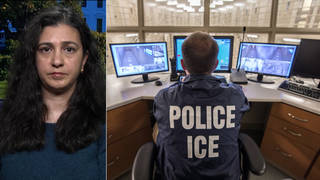
Democracy Now! is joined by Ryan Schwank, an ICE whistleblower who has been speaking out about how the agency drastically slashed its training standards for new officers. Schwank worked as an ICE lawyer and legal instructor in Georgia until he resigned last month.
Schwank says he received secretive orders to teach ICE trainees to violate the Constitution by entering homes without a judicial warrant.
He also speaks about how violent arrest tactics by ICE agents, like those seen in Minneapolis, should only be employed in certain circumstances: “Those things should only be done as an act of necessity, when it’s the choice between the public’s safety and the use of force on the individual.”
Related Story
 StoryApr 21, 2026Deaths in ICE Custody Skyrocket: 2026 Toll Reaches 17, on Average One a Week
Transcript
AMY GOODMAN: This is Democracy Now!, democracynow.org. I’m Amy Goodman, with Nermeen Shaikh.
NERMEEN SHAIKH: As President Trump deploys ICE agents to airports across the country, we’re joined by a whistleblower who’s been speaking out about how ICE has drastically slashed its training standards for new officers. Ryan Schwank worked as an ICE lawyer and legal instructor in Georgia up until last month, when he resigned. In late February, Schwank testified before Congress.
RYAN SCHWANK: On my first day, I received secretive orders to teach new cadets to violate the Constitution by entering homes without a judicial warrant. For the last five months, I watched ICE dismantle the training program, cutting 240 hours of vital classes from a 584-hour program, classes that teach the Constitution, our legal system, firearms training, the use of force, lawful arrests, proper detention and the limits of officers’ authority.
For example, they ceased all of the legal instructions regarding use of force. This means that cadets are not taught what it means to be objectively reasonable, the very standard which the law requires them to meet when deciding whether or not to use deadly force. Our jobs as instructors are to teach them so well that they can make split-second decisions about what they can and cannot do in life-or-death situations.
Yet, in the name of churning out an endless stream of officers, DHS leadership has dismantled the academic and practical tests that we need to know if cadets can safely and lawfully perform their job — all to satisfy an administration demanding they train thousands of new officers before the end of the year. DHS told the public that new cadets receive all the training they need to perform their duties, that no critical material or standards have been cut. This is a lie.
AMY GOODMAN: That was Ryan Schwank, former ICE lawyer, legal instructor, testifying before the House Oversight Committee. He resigned last month from the agency and joins us now.
Ryan, thank you so much for being with us. There is so much you said in your testimony. But I wanted to go to saying you were told not to write down any of the instructions because they were unconstitutional, so you would keep a record of what you were teaching to the ICE cadets. Explain exactly, and why you finally quit.
RYAN SCHWANK: Hi. Thank you for having me.
So, to answer your question, I quit because it’s not possible, with the way the academy is being run right now, to ensure that the people graduating from it are able to lawfully perform their duties in a safe way and in a way that supports the constitutional requirements for law enforcement in the United States.
And when I said that they told me not to write anything down, when you teach at the Federal Law Enforcement Academy, and, really, if you do any kind of instruction in law enforcement, you try to keep close records of exactly what was taught, the material given to the students, how the process or procedure was explained to them, the step-by-step approach, because you want to be able to go back later and say, OK, this did or did not work, and if there’s a question about the quality of training or question about the nature of the training of the cadet or the graduate of the program, to say, “Here’s what we taught them. Here’s what was taught to this particular class.”
And the instructions we got were to teach this memo that was issued by the director, Todd Lyons, back in May of 2025 that authorized officers to enter homes without a judicial warrant, but not to mark down anywhere in our records that we had changed what the material says, because the training material for the cadets says that you cannot do this. It says that the types of warrants they were trying to use, administrative warrants, do not possess what’s called search authority, which, under Fourth Amendment constitutional law, you have to have search authority to enter into private space. And so, we were teaching the cadets officially that they could not enter a home using an administrative warrant, while secretly teaching them that they could.
NERMEEN SHAIKH: And, Ryan, if you could explain — you said in your congressional testimony that cadets were not taught to be objectively reasonable. If you could explain what that means, and then say what were cadets taught to do, for example, in airports?
RYAN SCHWANK: OK, so, I’m going to break that into two parts. Let’s talk about the objective reasonableness. Objective reasonableness comes from a Supreme Court case, Graham v. Connor, from around 1989. That is the case where the Supreme Court looked at how do we decide whether or not police officers can have liability for use of force against an individual. And the court came back and said that the way we measure that is the Fourth Amendment protection against seizures is exercised when police stop you or seize you through the use of force. If someone shoots you, takes a baton to you, uses some form of force on you to stop your movement, that’s a Fourth Amendment seizure.
And so, the court said what you essentially have to do is you have to look at: Would another officer, in the shoes of the officer in question, the officer who used force — would another officer, knowing the same piece of information, the same set of facts, make the same decision or come to an objectively similar decision? And that’s the basic underlying premise behind all use-of-force law in the United States, is that Graham v. Connor decision. It’s the foundation on which everything is built. And there’s later decisions that modify that, that expound on it, but this is the fundamental piece, this idea that if you’re a police officer and you use force, you can be liable for excessive force if what you did is what another officer, who is being objectively reasonable — that is, being calm, being rational, being sane with their decision-making — would not have done, would have looked at and said, “Oh, yeah, no, that’s not the right way to do things. That’s not — that’s not appropriate or acceptable,” right? And to some level, when we talk about objective reasonableness, what we’re really talking about is: What is a jury going to interpret that to be?
And now, moving from that to your question about airport security, I cannot tell you what the cadets are taught about airport security, because it is not part of the training program. Flat out, the officers for ICE are trained and taught how to be law enforcement officers conducting arrests based on civil warrants, and how to be detention officers operating detention facilities for people who are going through removal proceedings, or how to manage, essentially, parole processes for individuals who are out of custody while in removal proceedings. There’s nothing in their training that ties directly back to their work in airports. So, I can’t tell you what they were trained to do with that, because it’s not part of their training. Or, another way to say this is they don’t have any.
AMY GOODMAN: So, Ryan Schwank, how do you teach them, when they’re seeing on TV people being ripped out of their cars, people being beaten, people being shot to death? How does that jibe with what they’re taught in their training, and who ICE now attracts?
RYAN SCHWANK: Thank you. That’s a good question. So, let’s start with something that’s kind of the unspoken aspect of all law enforcement, not just in the United States, but globally. Law enforcement operate as avatars of the justice system of whatever country they’re assigned to, and they exercise the state’s monopoly on power. So, when you talk about someone being hurt, someone being injured or even killed by law enforcement, those are not innately outside of the realm of possibility when law enforcement is acting, right? Law enforcement officers theoretically could conduct any of those actions, that have to be lawful and appropriate. The question is not: Can they do that? The question is: When do they do that? When is it an appropriate step or an action? And in an ideal training environment, what you want to do is you want to train them to understand that those things should only be done as an act of necessity, when it’s the choice between the public’s safety and the use of force on the individual, or when it’s necessary to effect an arrest and it’s the least coercive form of force possible, as a rule of thumb.
AMY GOODMAN: We just have 30 seconds, Ryan.
RYAN SCHWANK: Sorry. I’ll be much faster, then. And then, the way they’re taught at the academy is they’re taught practical applications of force, but because there’s no legal attachment to that, it kind of exists in the ether. They’re told, “You can use your baton. You can use your pepper spray. You can use your firearm. But you should be reasonable about doing it,” without ever actually explaining to them what that meant.
AMY GOODMAN: We want to thank you very much for being with us, Ryan Schwank, former ICE lawyer, legal instructor, who resigned last month and became a whistleblower. He just recently testified before Congress.
Coming up, the U.N. special rapporteur on the occupied Palestinian territory. Her new report is titled “Torture and Genocide.” Back in 30 seconds.
[break]
AMY GOODMAN: “Peaceable Kingdom,” performed by Patti Smith, alongside her daughter Jesse Paris Smith and Tony Shanahan at Democracy Now!'s 30th anniversary event. To see her performing the whole song, go to democracynow.org. It's about Rachel Corrie, the American who stood in front of a Palestinian’s home in Rafah three days before the U.S. invaded Iraq, and she was crushed to death by a Israeli military bulldozer when she tried to protect the home from demolition.




 Top
Top
Media Options