










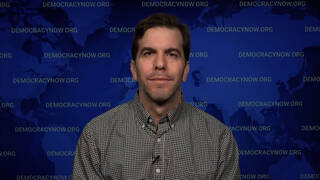





Watch Part 2 of our interview with David Uberti, reporter for The Wall Street Journal, about President Trump’s “war on wind” farms. Despite well-established demand for new power, Trump recently paused leases for all large offshore wind farms under construction, which has “thrown the renewable energy industry into turmoil,” Uberti says. He has covered how the U.S. is forfeiting the clean energy race to China after Trump scrapped projects funded by the Inflation Reduction Act. Trump’s “animus for offshore wind has a personal link, as well,” notes Uberti: He once tried unsuccessfully to stop windmills off the coast of one of his golf courses.
Uberti also discuses his piece “What Happened When Small-Town America Became Data Center, U.S.A.” and his coverage of the role AI may play in the modern economy. Uberti expects in 2026, this will move from being “an emerging political issue” among the left to one that is more mainstream.
More from this Interview
- Part 1: Chevron Stocks Surge After Trump Vows to “Take Back” Venezuela’s Oil After U.S. Attack
- Part 2: Trump Family Businesses Rake in $4 Billion After His Reelection with Focus on AI, Crypto & Nuclear
- Part 3: WSJ’s David Uberti on Trump’s War on Wind & How AI Data Centers May Be Key 2026 Political Issue
Transcript
AMY GOODMAN: This is Democracy Now!, democracynow.org, The War and Peace Report. I’m Amy Goodman.
In mid-December, the Trump administration announced it’s pausing leases for all large offshore wind farms under construction, citing national security risks. Ted Kelly, lead counsel for clean energy at the Environmental Defense Fund, said in response, “For nearly a year, the Trump administration has recklessly obstructed the build-out of clean, affordable power for millions of Americans, just as the country’s need for electricity is surging,” he said.
The Trump administration’s order impacts five projects being built in the Atlantic Ocean, including a Virginia offshore wind farm that was set to be completed by the end of this year. Virginia has the largest concentration of data centers in the world, leading to soaring energy costs.
We’re continuing our conversation with Wall Street Journal reporter David Uberti, who has been closely following this story. If you can talk about, on the one hand, President Trump stopping renewable energy wind farms off the coast, and, on the other hand, investing — his family investing in nuclear fusion companies?
DAVID UBERTI: No one disputes that AI data centers require a huge amount of power. The question is how you go about producing that power. There’s some evidence and some arguments to be made that if you actually manage that correctly, it won’t affect energy prices in a big way. That said, taking existing power projects offline or sort of scrambling the pipeline for additional power projects in the future, the argument from renewable energy folks is that this will put upward pressure on prices. You have this well-established demand coming for new power, and these projects that are essentially ready to go, if not currently in construction right now, are basically being scrapped or put on pause.
AMY GOODMAN: And this lack of interest in oil, that President Trump is now pushing even more as he says he is running Venezuela.
DAVID UBERTI: Yeah, I mean, if you talk to big hyperscalers who work in this place, the Microsofts, the Alphabets of the world, they are interested in getting power fast and cheaply. In some circumstances, that might be natural gas. But in many circumstances, that could be renewable energy, that could be solar power, that could be wind power, whatever the case may be. What’s happening now is, in some circumstances, those choices are being constricted, depending on where those companies are operating.
AMY GOODMAN: You wrote a piece in September, “The U.S. Is Forfeiting the Clean-Energy Race to China.” Explain.
DAVID UBERTI: There was an idea during the Biden administration that Beijing had essentially taken control of these massive and increasingly important supply chains for things like solar panels, things for the — like the turbines and nacelles that go into wind farms, and that because of that, they were able to exert a large amount of power over especially developing countries around the world, as well as Europe, in ways that the U.S. had done previously with oil. The Biden administration’s plan was to basically invigorate the domestic industry to both produce cleaner energy, but also manufacture all of the things that you need to produce that energy. That was the Inflation Reduction Act.
Of course, President Trump has more or less scrapped all of that, which has thrown the renewable energy industry into turmoil over the last year or so. There’s still a ton of solar development, in particular, battery advancements happening in the United States, as well. But a lot of the existing projects that were happening last year, and especially those manufacturing projects that would create jobs and theoretically produce the material and the parts needed to actually build out this energy, this energy domestically, a lot of those manufacturing projects no longer exist.
AMY GOODMAN: You wrote a piece, “Trump’s War on Wind Has This Construction Crew Stuck 15 Miles Out at Sea.”
DAVID UBERTI: Right. So, there’s been fits and starts of the Trump administration’s push against offshore wind. You mentioned the stated securities concerns, which the industry totally disputes. The piece you mentioned was over the summer, and the one word that came to mind when reporting it was “Kafkaesque.”
The Trump administration more or less halted projects that were taking place off the coast of New York, where we are. And I spoke to a guy who was actually on one of the vessels out there, and he said, “Look, we’re kind of just sitting out here twiddling our thumbs.” So, what you have is these construction crews on very expensive boats working on a very expensive project that are not able to build it going forward. So, I spoke to a guy there, a young guy. He said, “We’re basically playing video games and working out four times a day.”
And it’s funny on one level, but also immensely sad on others, mostly for the workers, who have no idea of what the future holds for this industry, that they oftentimes had to get additional training for and really staked a lot of their livelihoods around in terms of scheduling when they get to see their kids, going on and offshore for months and months and months at a time. That’s the sort of chaos that has played out within the renewable energy sector, particularly for offshore wind, which the Trump administration has taken aim at with a specific amount of force over the last year.
AMY GOODMAN: And why? Why this enormous hostility? Is it just President Trump’s devotion to oil? You know, obviously, one of his mantras during his campaign was “drill, baby, drill.”
DAVID UBERTI: He has brought back “drill, baby, drill” into popular lexicon, of course. It’s important to say that there is a lot of local opposition to some of these projects, on the grounds of “it will ruin my view off of the coastline, it will be difficult for my boat to navigate these things. Potentially, these turbines could disintegrate into the water, which could pose some environmental problems.
That said, Trump’s animus for offshore wind has a personal connotation, as well, and it stretches back more than a decade, at least, to when there was an offshore wind project off of one of his golf courses abroad, which he tried, unsuccessfully, to stop. So he is in that camp of people who oppose these things because it — you know, I think he said, “It ruins your neighborhood. It brings down your property values,” in addition to sort of the oil-focused energy policy of the administration, generally speaking.
AMY GOODMAN: I want to go to your piece right around election time, “What Happened When Small-Town America Became Data Center, U.S.A.” Talk about Umatilla, Oregon.
DAVID UBERTI: Umatilla, Oregon, is a small, small town in northeast Oregon, about three hours east of Portland. It’s roughly 8,000 people. Not a lot has been going on in Umatilla economically for the past decade or so. There’s a state prison there that houses about 2,000 people, incarcerated people. And besides that, for lack of a better term, it’s sort of a pass-through town for truckers who are going to Portland.
Over the last several years, Amazon, specifically Amazon Web Services, has turned Umatilla and the surrounding area into a massive hub for its data centers. It’s sort of strategically positioned between population centers in Portland, San Francisco and Seattle, with fiber-optic cable leading back to Umatilla. So, there’s something like more than a dozen, if not 18 or so, data center sites in Umatilla.
And now, what this has done, it has basically turned the surrounding area into a company town. There’s a lot of people working in construction. There’s an increasing number of people who are actually working at the data centers themselves, though that’s a smaller number of people. And despite the fact that these data centers have encountered a lot of opposition in different parts of the country, where there’s concerns about power, concerns about land use, etc., the people in Umatilla are very positive on what has happened there, in large part because there was not a lot happening in the local economy previously. There’s been a massive injection of capital into Umatilla, which has created jobs. If you’re a homeowner, it has boosted your home value. And it’s created a lot of other offshoot businesses for people in town. I talked to a real estate agent, for example, who basically previously worked in a Walmart distribution center and has, over the last couple of years, become one of the most successful real estate agents in town. It’s been huge for people like her.
AMY GOODMAN: And then I think about the Ponca Tribe in Oklahoma taking on data centers; Justin Pearson, the state legislator in Tennessee, who led a movement in Memphis, because they felt that the energy sources for mass data center were compromising their communities, particularly communities of color. And then you think about President Trump issuing this executive order saying you cannot regulate, at a local level, at a state level, data centers, but that also goes to the energy for them.
DAVID UBERTI: Right. I mean, I think you raise a good point here. I mean, the main thing a data center needs are land, water and power. And how each of those play out on any individual circumstances really relies on the local community. What are the climate issues surrounding the local community? Is it a hot area? Is it a cold area? Are there abundant water resources nearby? Does the state or the surrounding region have a lot of power plants that are ready or are being able to be built? These things are inherently local issues. And so, you see these companies, the Big Tech giants, they’re increasingly trying to boost their outreach to some of these places, sometimes unsuccessfully. Some communities want data centers. They want the economic development. Other communities have huge concerns about the power needs or other questions they have around data centers. So, yeah, I think you do see this tension of the sort of give and take between local regulation and sort of the local community imperatives that you might see on a city or state level, versus what the U.S. technology and national security strategy might be.
AMY GOODMAN: And the billionaire brotherhood of the tech moguls who support President Trump, not wanting to deal with community after community, and then the Trump family themselves, when it comes to nuclear fusion powering AI data centers, President Trump then stopping renewable energy sources, for example, off the coast of Virginia, which has more data centers than anywhere in the country.
DAVID UBERTI: Yeah, it’s interesting. After I wrote that piece about Oregon, I spoke with Richard Blumenthal, the senator, who is among a group of senators who have basically said, “Hey, we need to take a close look at this, and we don’t really like the way the administration is carrying this out,” for all the concerns that you’ve just mentioned.
If I were to look in my crystal ball for 2026 and 2028, I would bet that this is an emerging political issue, especially on the political left. It’s not only what do we want the data center industry to look like, where are these things built, etc. It’s what role do we want AI to play in the modern economy, and whether that will create jobs in certain industries or maybe wipe entire industries off the map entirely. I think especially among Bernie Sanders and some of the more left-wing elements of the Democratic Party, they take an increasingly strong line against this. And I wouldn’t be surprised that that becomes a more mainstream position in the months and years ahead.
AMY GOODMAN: David Uberti, reporter for The Wall Street Journal. To see Part 1 of our conversation, go to democracynow.org. I’m Amy Goodman. Thanks so much for joining us.





 Top
Top
Media Options