











 Watch Full Show

The share prices of U.S. oil companies surged following the Trump administration’s attack on Venezuela and abduction of its president, Nicolás Maduro. In public statements, Trump has been clear about his desire to reassert U.S. corporate control over Venezuela’s nationalized oil industry. Now with Trump’s show of force over Venezuela’s political sovereignty, many investors see the potential for a similar overpowering of the socialist country’s economic independence. However, notes financial reporter David Uberti, it won’t be so easy for Wall Street to make a profit. In addition to upgrading Venezuela’s “decrepit” oil-producing infrastructure, “they have to push for more appetite for oil around the world.”
More from this Interview
- Part 1: Chevron Stocks Surge After Trump Vows to “Take Back” Venezuela’s Oil After U.S. Attack
- Part 2: Trump Family Businesses Rake in $4 Billion After His Reelection with Focus on AI, Crypto & Nuclear
- Part 3: WSJ’s David Uberti on Trump’s War on Wind & How AI Data Centers May Be Key 2026 Political Issue
Transcript
AMY GOODMAN: This is Democracy Now!, democracynow.org. I’m Amy Goodman.
We turn now to look at how the U.S. attack on Venezuela has impacted Wall Street. On Monday, the Dow Jones Industrial Average rose nearly 600 points to a new all-time high. Shares in the oil giant Chevron jumped 5%.
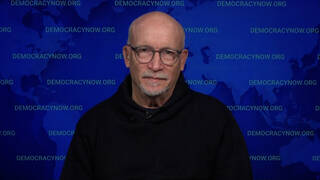
We’re joined now by Wall Street Journal reporter David Uberti.
Thanks so much for being with us.
DAVID UBERTI: Thanks.
AMY GOODMAN: Why don’t we start off there? Talk about the significance of Chevron in Venezuela and President Trump saying he didn’t consult Congress, but he did talk to corporate executives before and after the U.S. attack on Venezuela and the abduction of the president.
DAVID UBERTI: Right. Well, U.S. oil companies had a long history in Venezuela over the course of decades — ExxonMobil, ConocoPhillips, Chevron. A number of them left Venezuela in the mid-2000s after the government nationalized many assets in that sector. But Chevron has been the sole player to continue navigating the sort of political and economic environment in Venezuela since then, more recently operating on a license agreement with the U.S. government to basically get around U.S. sanctions. Now, investors on Wall Street believe, because of that imprint within Venezuela right now, Chevron is potentially best positioned to capitalize on any new opportunities to come within Venezuela.
That said, it’s an extremely long road to any of that happening. In addition to the geology that’s at question with Venezuela, they have very large oil reserves. There’s also the question of decrepit infrastructure in the country, which will take billions of dollars of investment and years of time, as well as the other above-ground factors at play, which mean political and legal institutions in the country that have withered over the course of time and that the Trump administration has really called into question going forward, too.
AMY GOODMAN: And can you talk about Paul Singer, the billionaire supporter of President Trump, who bought Citgo, I think at $5.9 billion? Now it’s worth $18 billion?
DAVID UBERTI: Well, there’s been investors across the map who had invested in various Venezuelan assets over the course of time, essentially playing the long game in the hope that something like this might happen and provide an opening for them to cash out those assets. Singer has invested in Citgo, which is the PDVSA, the state-run oil company in Venezuela. They own a downstream refining business and marketing business, as well. It’s been in for-sale proceedings for some time, and that might move forward in the months and years ahead.
AMY GOODMAN: You note the world doesn’t have much of an appetite for more oil, and some oil companies, like Chevron, are not sure about investing more in Venezuela. But in order to profit from this, since President Trump says the U.S. is controlling the oil supply in Venezuela, they have to push for more appetite for oil around the world.
DAVID UBERTI: The most important piece of information in the oil market is the price of oil. And yesterday, U.S. oil prices were something like $58 per barrel. Now, U.S. oil companies can make a profit at that prices. That said, Venezuelan oil trades at a discount for a bunch of nuanced reasons. But $58 a barrel is not sending a signal to companies in the U.S. and elsewhere, “Hey, why don’t you spend billions of dollars to tap into unproven, decrepit reserves and infrastructure in a country that’s unstable?”
So you saw there was an NBC interview last night that President Trump gave where he essentially suggested the U.S. might actually subsidize some of these oil companies going back into Venezuela. The word he used, I believe, was “reimbursement.” That seems like a very difficult political move to make. But that said, I think oil companies might need some sort of incentive, in addition to the political and legal stability they’re looking out for, to make those big decisions.
AMY GOODMAN: Former Chevron executive Ali Moshiri is raising $2 billion for Venezuelan oil projects, telling the Financial Times, quote, “I’ve had a dozen calls over the past 24 hours from potential investors. Interest in Venezuela has gone from zero to 99 per cent.” Has your reporting shown this?
DAVID UBERTI: There will always be speculators who are ready to pull the trigger on big bets in very unproven environments. I’d be curious to check in with that investor in a year or two years’ time to see if he’s actually raised that money, and see if they’re ready to actually pull the trigger on an investment decision, given whatever the political situation is in Venezuela.
AMY GOODMAN: And I’d be curious to know how the Trump family plans to profit, but which that takes us to your overall look at the Trump family, your reporting on the Trumps’ family finances.





 Top
Top
Media Options