





 Watch Full Show

Guests
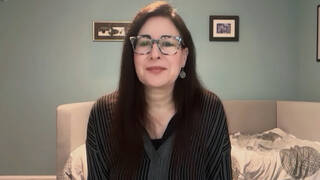
- Lylla Younesinvestigative journalist and writer based in Beirut, contributor to Drop Site News.
The Israeli military issued new evacuation orders in southern Lebanon on Wednesday, warning residents of 12 towns and villages, including some north of the Litani River — beyond its current zone of occupation — to leave their homes. Those warnings were followed by reports of airstrikes in the south.
Israel and Hezbollah agreed to a fragile temporary ceasefire in mid-April that has since been extended, but fighting has continued at a lesser scale. More than 1 million Lebanese, nearly one-fifth of Lebanon’s population, have been displaced.
“So this is dozens of villages that now no one can technically access. They’re calling it a 'forward defensive zone,'” says Lylla Younes, an investigative journalist based in Beirut. “There’s nothing defensive about it. It’s an offensive operation, and they’re using the word 'cleanse' to describe what they’re doing there. They’re just bulldozing homes.”
Related Story
 StoryJun 17, 2026Has Trump Had Enough of Netanyahu? Israel Defies U.S., Vows to Continue War in Lebanon
Transcript
AMY GOODMAN: This is Democracy Now!, democracynow.org, The War and Peace Report. I’m Amy Goodman.
The Israeli military has issued new evacuation orders in southern Lebanon, warning residents of 12 towns and villages, including some north of the Litani River, to leave their homes. Those warnings were followed by reports of airstrikes in the south.
In mid-April, Israel and Hezbollah agreed to a fragile temporary ceasefire that’s since been extended, but fighting continues at a lesser scale. Israel maintains an occupation of southern Lebanon. More than a million people are displaced, about a fifth of the Lebanese population. According to the Lebanese Health Ministry, more than 2,600 people have been killed since March 2nd. Israel reports two civilians and 17 soldiers have been killed by Hezbollah.
In U.S.-Iran negotiations, Tehran has repeatedly said Lebanon must be included in any deal to end the wider war, a condition the U.S. so far rejects.
For more, we’re joined today in studio, usually in Beirut, by independent investigative journalist Lylla Younes. She has family in the south of Lebanon, but joining us here today in New York.
Thank you so much for being with us. Can you talk about the level of destruction in Lebanon right now, the number of people displaced, what people in the United States should understand, and around the world?
LYLLA YOUNES: Lebanon is a very small country with densely populated urban areas, and so the 1.2 million people that were displaced after March 2nd have created very, very, very difficult conditions across Lebanon. Most of them have been unable to return home.
I think what Americans should understand is that there have been not one, but two exoduses from southern Lebanon. The first, of course, happened after March 2nd, when Israel issued its sweeping displacement orders for the region. And then, when the ceasefire was announced between Lebanon and Israel, people went back to their homes to check on their homes, to see if they were still there. Many of them — I remember that day that I saw the highway to the south was backed up, even past Beirut, mattresses on top of cars, people trying to return home, and very quickly realizing that this was not a ceasefire at all, that the bombing was continuing. And we can talk about the death toll since this so-called ceasefire went into effect, but, essentially, a second exodus then occurred out of southern Lebanon, and now people are back in shelters, back in tents on the streets of Beirut and back, you know, in sort of rentals that they’re kind of pooling funds to be able to afford.
AMY GOODMAN: According to Lebanon’s Health Ministry, Israeli strikes on southern Lebanon killed 17 people on Monday alone, in one of the deadliest days since the ceasefire began.
LYLLA YOUNES: Sixty people killed over the weekend, then those 17 on Monday. Just today in Zelaya in the western Beqaa Valley, the mayor’s home was bombed. He was killed alongside four of his relatives, including women and children. I mean, this is the sort of thing that we’re seeing every single day.
And I think it’s important for people to remember that when the ceasefire between Iran and the U.S. and Israel was announced, the fire stopped falling on Iran, right? But when Iran attempted to or announced that Lebanon would be included in the ceasefire, Israel issued an emphatic “no” by bombing over a hundred locations across Lebanon within 10 minutes and killing more than 350 people.
So, this is really the conditions that we’re seeing right now in Lebanon, is escalating attacks across the south. And the destruction, it’s hard to describe. I mean, we’re talking about entire villages that have been reduced to moonscapes, essentially. People, as Drop Site News recently reported, are pooling funds to buy satellite imagery so that they can check and see whether or not their homes are still there, because they’re not able to reach them. Some of the last people, you know, on the border — you spoke earlier about Amal Khalil, the journalist who was assassinated by Israel —
AMY GOODMAN: She was based in southern Lebanon. She’s from southern Lebanon, is that right?
LYLLA YOUNES: She’s from southern Lebanon, so she wasn’t based, obviously, where she was. She was actually near my village, near the village of Bint Jbeil, where Israel was carrying out demolition operations. And she must have wanted to write about and report on those operations, when she was, effectively, you know, stalked to her destination and killed.
And another thing I think that we’re seeing, another pattern that’s repeating, is the Red Cross being barred from reaching victims of Israeli violence. So, they were barred from reaching her. And you heard that she survived the initial strike and then died from her wounds because she couldn’t be reached. It’s an unbelievable story, but we’re seeing the same thing repeat.
AMY GOODMAN: With the prime minister or president demanding medics be allowed to go in to help her. Of course, then, hours later, it was too late.
LYLLA YOUNES: We all know that in emergency response work, every second counts and can be the difference between life and death. And so, with similar reports emerging, one of a Syrian family struck and left basically to die near Deir Siryan, another family in Majdal Selem, this is something that we’re seeing now repeat over and over, is Red Cross being barred from rescuing the people, civilians, that are being struck.
AMY GOODMAN: How is the situation in Lebanon comparable to what Israel has been doing in Gaza? Just last week, the Israeli Defense Minister Israel Katz said, quote, “The fate of southern Lebanon will be the same as that of Gaza.” Earlier this year, a senior Israeli official told Axios, quote, “We are going to do what we did in Gaza.” Can you explain what the “yellow line” is that Israel has established?
LYLLA YOUNES: So, the yellow line began — right? — in Gaza, after the ceasefire that was announced there. Sixty percent of the Gaza Strip now is enveloped in this so-called yellow line. Residents of these areas, that have been ethnically cleansed there, when they try to access them, have been shot and killed.
The same thing is effectively happening in southern Lebanon. There’s now been a new yellow line declared. It is six kilometers, approximately, into — 10 kilometers, sorry, six miles, into Lebanese territory. So this is dozens of villages that now no one can technically access. They’re calling it a, quote, “forward defensive zone,” but I shouldn’t have to tell you that there’s nothing defensive about it. It’s an offensive operation, and they’re using the word “cleanse” to describe what they’re doing there. They’re just, you know, bulldozing homes. We just saw over the weekend a mosque destroyed, a school destroyed.
And when the Israeli military destroyed a 100-[year]-old community center in the town of Dweir in the south, Press TV correspondent — I want to read you a quote that he wrote after that. He said — his name is Hadi Hoteit, and he said, “We can barely process the amount of terror against our people. The collective memory of a century has been erased.” And I think that that, you know, really sounds a lot like what we’ve seen in Gaza.
AMY GOODMAN: If you can talk about this round of talks, first time that Israel is having with Lebanon in Washington, D.C.? In a recent address, the Hezbollah leader, Naim Qassem, said, quote, “Direct negotiations are a free concession without results, serving the interests of Netanyahu who seeks a symbolic image of victory, and serving Trump ahead of the midterm elections.” Also talk about where Hezbollah fits into this picture, and how people who are not Hezbollah in Lebanon feel.
LYLLA YOUNES: It’s quite a complicated picture, Amy. I think it’s important for people to remember that Israel actually did occupy southern Lebanon for 18 years. Liberation was in 2000. And after that, Israel was declared an enemy state by Lebanon. So, you know, people in Lebanon, you’re not actually — by law, you’re not allowed to speak to Israelis. They are, in official Lebanese media, referred to as the enemy. And so, direct talks are quite a big deal for Lebanon. It hasn’t happened in three decades, at least in a public — in a public form.
And so, you know, to remind you what I said earlier, which was that when the ceasefire was declared in Iran, the bombs stopped falling on Iran, but, you know, Lebanon is negotiating under fire and from an extremely weak position. You know, we don’t have a Strait of Hormuz that we can kind of dangle as a bargaining chip. So, the government is attempting to kind of signal to the Americans that, listen, we’re committed to disarming Hezbollah. We are — you know, these direct talks are kind of a way to signal that, this willingness to kind of change three decades of kind of indirect talks with Israel. However, with Hezbollah not being at the table and announcing that, “Hey, because we’re not at the table, you know, and because these talks are direct, we will not be consenting to anything that comes out of them,” with dozens of people being killed every single day in the south, it’s hard to see these talks as anything but sort of like a background political theater, while a, you know, war rages in the south of Lebanon and in the Beqaa Valley.
AMY GOODMAN: Lylla Younes, I want to thank you for being with us, investigative journalist and writer based in Beirut, speaking to us, though, here in New York. Lylla is a contributor to Drop Site News.
Coming up, Backtalker: An American Memoir. We’ll speak with the acclaimed constitutional law scholar Kimberlé Crenshaw, known for her work on critical race theory and intersectionality. Where does this country stand today? Stay with us.
[break]
AMY GOODMAN: “Me Voy,” “I’m Leaving,” performed by Julieta Venegas in our Democracy Now! studio. To see the whole interview with Julieta and her music in our studio, go to democracy now.org, in English and in Spanish.




 Top
Top
Media Options