













 Watch Full Show

Colombian mercenaries accused of committing war crimes in Sudan were trained on military bases in the United Arab Emirates, according to a new report from Human Rights Watch. The group’s investigation outlines how, since 2024, the Abu Dhabi-based security company Global Security Services Group hired hundreds of Colombian private military contractors, who were then deployed to Sudan to fight alongside the Rapid Support Forces. Human Rights Watch found evidence that the private military contractors were in El Fasher in October 2025, when the RSF seized the key city and committed widespread massacres and rape. The report adds to evidence of the UAE’s involvement in the war in Sudan, despite the government’s repeated denials.
“UAE’s apparent support to the RSF is part of a broader pattern whereby the UAE has been intervening in neighboring conflicts for over a decade … to project its political and economic influence abroad,” says Human Rights Watch researcher Joey Shea. “The UAE still has not received any accountability and has not yet been called out by name by the international community. And in the context of Sudan, we’re still relying on these ambiguous and weak statements calling out 'external actors' fueling the war, rather than naming names and calling out the UAE.”
Related Story
 StoryDec 18, 2025“No Military Solution”: Is Peace Possible in Sudan as “Proxy War” Expands?
Transcript
AMY GOODMAN: This is Democracy Now!, democracynow.org, The War and Peace Report. I’m Amy Goodman, with Nermeen Shaikh.
NERMEEN SHAIKH: We turn now to Sudan. A new report by Human Rights Watch has found Colombian mercenaries accused of committing war crimes in Sudan were trained in military bases in the United Arab Emirates. The report outlines, since 2024, the Abu Dhabi-based security company Global Security Services Group hired hundreds of Colombian private military contractors, who were then deployed to Sudan to fight alongside the Rapid Support Forces. Human Rights Watch found evidence that the private military contractors were in El Fasher in October 2025, when the RSF seized the key city and committed widespread massacres and rape. The report adds to evidence of the UAE’s involvement in the war in Sudan, despite repeated denials.
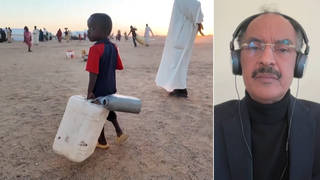
AMY GOODMAN: For more, we’re joined now in London by Joey Shea, senior UAE researcher at Human Rights Watch, author of the new report, “From Bogotá to El Fasher.”
So, Joey, if you can lay this out? And how did you find the Colombians to go on the record about being deployed to Sudan to assist the RSF? And if you can put this in a bigger political context for those who aren’t following this carefully, the significance of what the RSF is doing in Sudan?
JOEY SHEA: Absolutely. And thanks, Amy, for having me.
Our investigation documented how this Abu Dhabi-based security company, Global Security Services Group, has apparently hired hundreds of these Colombian fighters, before they were deployed to fight alongside, arm in arm with, the Rapid Support Forces, an armed group accused of war crimes and crimes against humanity in Sudan. Now, since the beginning of the war in Sudan three years ago, there has been a steady drip of reporting, mounting evidence pointing to the fact that the UAE has been militarily supporting the Rapid Support Forces. The New York Times, U.N. experts, human rights organizations like ours have repeatedly reported on UAE military support to the RSF. And yet the international community has remained silent. To this day, not a single EU member state, the EU, the U.S., the U.K., has publicly called out the UAE’s role in helping to fund, support and militarily support the Rapid Support Forces.
Now, when it comes to our investigation, we were able to conduct firsthand interviews with some of the Colombian contractors who were deployed to Sudan. Now, this research was incredibly difficult. It took quite a bit of time to convince these contractors to speak with me. And this research was also corroborated by a deep open-source investigation. Thankfully for us, Colombian contractors are not very hygienic with their social media presence, so we were able to get a lot of information from their own TikTok accounts and other social media that they posted publicly, and geolocate them in these sensitive UAE military sites, before they were then deployed to Sudan. And I think what is most important about our report is that these contractors transited through sensitive UAE military sites, military bases in the UAE, where they received training by Emirati nationals before they were deployed to Sudan.
NERMEEN SHAIKH: So, Joey, could you talk about this Colombia-based recruitment agency, A4SI, what the origins of this company are, and what role they’ve played in sending Colombian mercenaries to Sudan to support the RSF? This organization, this agency, was sanctioned by the U.S. Treasury in December 2025.
JOEY SHEA: So, A4SI is the Colombia-based recruitment company that was responsible for recruiting the retired Colombian personnel before they were hired, apparently hired, by Global Security Services Group, the UAE-based company that we believe hired the contractors and which has very strong ties to UAE authorities, including senior members of the UAE ruling family. And as you said, A4SI was sanctioned by the U.S. Treasury Department in December of last year. And yet, GSSG, Global Security Services Group, which we believe has apparently hired these contractors, paid them, has not been sanctioned, nor its CEO, a man named Mohamed Hamdan al-Zaabi.
And in our report, we are calling for the U.S. Treasury Department, the EU, allies of the UAE to investigate GSSG and investigate its CEO, Mohamed Hamdan al-Zaabi, with a view to imposing sanctions, because at the core of this operation, we believe, are UAE authorities. And it’s sort of like if you’re going to sanction A4SI without sanctioning GSSG, you’re cutting off one arm of the octopus without getting to the heart of the operation.
AMY GOODMAN: Joey, what does UAE have to gain by this intensification of conflict in Sudan? UAE, a close U.S. ally.
JOEY SHEA: Yeah, so, this — UAE’s apparent support to the RSF is part of a broader pattern whereby the UAE has been intervening in neighboring conflicts for over a decade. Human Rights Watch has consistently documented how the UAE has intervened, as far back as Yemen in 2014, 2015, and then in Libya in the war between 2019 and 2020, and now in Sudan. And we really see how the UAE uses these neighboring conflicts to project its political and economic influence abroad. And again, Human Rights Watch has documented scores of human rights violations that are linked with UAE’s intervention. In Yemen — in both Yemen and Libya, we documented scores of indiscriminate and disproportionate airstrikes on civilians and civilian objects. And particularly in southern Yemen, we also documented how the UAE financed, trained and supported abusive local forces, which detained civilians in terribly violent counterterrorism operations.
So, it’s not just about Sudan. And with each of these, you know, very violent interventions, the UAE still has not received any accountability and has not yet been called out by name by the international community. And in the context of Sudan, we’re still relying on these ambiguous and weak statements calling out external actors fueling the war, rather than naming names and calling out the UAE.
NERMEEN SHAIKH: And finally, Joey, before we conclude, why Colombia? And are there other states that the UAE — fighters from other states that the UAE has been recruiting?
JOEY SHEA: There may be other fighters of other nationalities that UAE-linked entities have recruited. We weren’t really able to verify those accounts. But the relationship between UAE authorities and Colombian retired personnel goes back to 2011, when Mohammed bin Zayed, the current UAE president, started to build an 800-person battalion, a foreign legion comprised entirely of Colombian military personnel. Well, at this time, this foreign legion was legal. The recruitment effort was public. But that was sort of the start of this relationship between UAE authorities and Colombian retired personnel.
Colombia provides a very fertile recruitment ground, after years of internal armed conflict. There’s also, you know, retired personnel who are incredibly well trained. Also, they’re trained on U.S. equipment, of which the UAE’s military is also trained, so there’s lots of interoperability between the two forces there. And we also saw Colombian fighters pop up, supported by the UAE, in Yemen, as well, starting in 2015. So, this relationship goes back more than a decade.
AMY GOODMAN: I want to thank you so much for being with us, Joey Shea, senior UAE researcher at Human Rights Watch. We’ll link to your report, “From Bogotá to El Fasher.”
Coming up, the Justice Department has announced it’s investigating the writer E. Jean Carroll, who’s won two civil lawsuits against President Trump, over sexual abuse and defamation. Back in 20 seconds.
[break]
AMY GOODMAN: “Femmes du Monde,” “Women of the World,” by Amadou & Mariam in our Democracy Now! studio.




 Top
Top
Media Options