






Conversation between Amy and Martín Espada. Espada was a regular contributer to NPR, but one of his poems about Mumia Abu-Jamal was not played due to its political sympathies. Espada reads his poem, and we hear a recording of Mumia Abu-Jamal speaking from prison.
Related Story
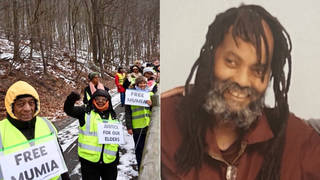
 StoryDec 09, 2025Save Mumia’s Eyesight: Supporters March to Prison to Demand Medical Care for Him & Aging Prisoners
Transcript
AMY GOODMAN: And you’re listening to Democracy Now! Today on Democracy Now!, we’re going to turn our attention to disturbing allegations of censorship, one of the country’s most critically acclaimed poets, by National Public Radio. Martín Espada, called “the Latino poet of his generation,” has published poetry in The New York Times Book Review, Harper’s, The Nation and Ploughshares. His fifth book of poetry, Imagine the Angels of Bread, won the American Book Award and was a finalist for the National Book Critics Circle Award. A few weeks ago, you could have heard a poem that he did that was asked for by National Public Radio. But why don’t we let Martín Espada tell the story? Because in the end, you couldn’t hear it. They decided not to air it. Martín Espada joins us. He’s a professor now at the University of Massachusetts. He joins us from an Amherst radio station. Why don’t you tell us what happened over these past few weeks?
MARTÍN ESPADA: OK. First of all, it might help to understand that I have had an ongoing relationship with National Public Radio, in particular All Things Considered. In the past, All Things Considered would regularly broadcast my poems in conjunction with news stories, and one producer even commissioned a New Year’s poem from me. In fact, that was “Imagine the Angels of Bread,” which later became the title poem of the book you referred to that just won the American Book Award.
In any event, as a result of that relationship, I got a call this past April, early in the month, from the staff at All Things Considered, and I was commissioned to write a poem, as before with the New Year’s poem. This time, I was commissioned to write a poem for National Poetry Month. And the general idea was that the poem should be like a news story with a journalistic perspective, as if I were a correspondent. And in fact, I do have radio experience with Back Porch Radio, WORT in Madison.
Well, in particular, they suggested I could write a poem in response to a news story in a city I visited during the month. And that made sense, because, being National Poetry Month, I was traveling everywhere. At one point, in fact, someone from All Things Considered called to obtain my travel itinerary, so that perhaps they could think of an assignment relevant to a particular city. Now, they couldn’t think of any such assignment, but the idea had already found home in my brain, and the wheels had started to turn. And so I was thinking about writing a poem when I visited Philadelphia. And in fact, I believe I had even mentioned to them that I would be visiting Philadelphia, but there was no connection made at the time.
In any case, I read in the Philadelphia Weekly of April 16th that there were new developments in the case of Mumia Abu-Jamal. And in fact, I’m sure that most of your listeners know who Mumia is, the African American journalist and activist convicted in the 1981 slaying of police officer Daniel Faulkner in Philadelphia under extremely dubious circumstances. And, of course, he is now on death row awaiting execution. What I read in the Philadelphia Weekly about Mumia was the following, that, essentially, Cynthia White, who had been the star witness for the prosecution at his original trial, had testified on Mumia’s behalf at his last hearing and then subsequently disappeared. And this is an important story. Now, what happened next was that Leonard Weinglass, the attorney for Mumia, decided to go out and find yet another witness, another prostitute who could testify on behalf of Mumia at his next hearing, who was present that evening. In any case, this was the basis or the nucleus of the poem.
Well, I also visited the tomb of Walt Whitman in nearby Camden, right across the bridge. And so, Walt Whitman found his way into the poem, particularly Whitman’s tomb, which became a place of refuge for what I call the fugitive slave, for Cynthia White, and then Mumia, should the worst come to pass. This was based directly on a verse of Whitman’s from “Song of Myself,” where he gives refuge to a fugitive slave.
Well, I faxed the poem to All Things Considered on April the 21st. On April the 24th, I still hadn’t received a response, so I called from Chicago, where I was traveling, and I was told by the staff at All Things Considered that they would not air the poem. And they were quite explicit. They would not air the poem because of its subject matter, Mumia, and its political sympathies. And I wanted to be clear, I wanted to be sure, so I made a statement. I said, ”NPR is refusing to air this poem because of its political content. Do you agree?” And the reply I received was “yes,” one-word reply. I was reminded of the history of NPR and Mumia, which, of course, is a reference to their refusal to air his radio commentaries after first agreeing to do so. And that is now, as we know, the subject of a First Amendment lawsuit filed by Mumia Abu-Jamal. But there was — there were a few other reasons offered. It was explained to me that this was “not the way NPR wants to return to this subject,” and that’s a quote. And I was stumped. I talked for about 20 minutes to two different people, a producer and assistant producer, and then I pondered what to do with the poem.
Well, that same weekend, I met Marilyn Jamal, who’s Mumia’s former wife, the mother of his children, and I gave her the poem. And I watched her read it, and I watched her struggle against tears. And then she said, “I promised myself that I wouldn’t cry anymore.” Suddenly, this had a human dimension for me that it had lacked previously. And I concluded that I had to tell the story about the censorship of the poem at All Things Considered.
So, in subsequent weeks, what happened was that certain journalists contacted All Things Considered, and they got a somewhat different story from what I had heard on the telephone and on April 24th. There was now a public position on the situation. The public position was this, as expressed by their executive producer, Ellen Weiss, that the problem with this poem was the legal status of — well, let me rephrase that. The problem with the poem was that Mumia Abu-Jamal had a lawsuit against NPR, and that lawsuit was pending, and that as long as the lawsuit was pending, NPR would not air any commentaries or op-ed pieces about Mumia Abu-Jamal. This was policy. This was — this was a legal justification for the act of censorship that I had encountered.
Now, strangely, the two people who made the decision not to air the poem and informed me of that decision never mentioned such a policy in a telephone conversation of 20 minutes. And yet, some weeks later, this was the official position. As one producer told Dennis Bernstein of KPFA, quote, “It’s a legal thing.” And the poem had now become defined as a commentary and not a work of art, because that definition would justify censorship under their policy of not airing any commentaries as long as this lawsuit was pending.
Now, I should point out that I am not only a poet, but I’m also a lawyer. And this legal justification, to me, was quite amusing, because it’s no justification at all. In fact, we’ve all heard about the principle of not speaking on matters which are being litigated. We all know something about that, even if it’s only from television, that you’re not supposed to talk about something that’s being litigated. But the reason for silence in the face of pending litigation doesn’t apply here. The reason that corporations like NPR say “no comment” is because they don’t want the statements to be used against them in court. Now, as a poet or independent person, I’m not a corporate spokesman. I can’t bind the corporation. Nothing I say can be used against them in court. And the rationale doesn’t apply to a poet reading a poem. It makes no sense at all. And furthermore, the subject of the lawsuit and the subject of the poem are totally different. The censored poem is not about Mumia’s commentaries or his First Amendment rights. And Mumia’s lawsuit does not concern his criminal case or his possible execution. That’s what the poem is about.
And a friend of mine, an attorney named Bill Newman, raised a rather ominous question. He asked, “If Mumia were to dismiss his lawsuit, would they air this poem?” Because that’s where this goes logically, if you follow their logic. So, ultimately, if this indeed is NPR’s policy — and remember, this is not what was told to me at all when I was told the poem would not be aired — if this is NPR’s policy, even ex post facto, it’s punitive. It’s a means of perpetuating Mumia’s silence by silencing those who would speak for him.
And a number of people have asked me this question. They said, “Well, look, you know you knew their history with Mumia Abu-Jamal. You knew about the censored commentaries. You knew about the First Amendment lawsuit. You knew that this was bound to be sensitive. Why did you write this poem?” And I think that’s a good question. It requires an answer. And my answer is simply this. First of all, how could I not write this poem once it came to me? How could I censor my imagination and make myself complicit in this enforced silence of Mumia Abu-Jamal? Ultimately, however, on a practical basis, I thought better of the people at All Things Considered. I gave them the proverbial benefit of the doubt. And I even speculated, given NPR’s refusal to air Mumia’s commentaries, that a sense of fairness or a respect for opposing viewpoints would compel All Things Considered to air the poem. And airing the poem, in fact, would also address the concerns of those listeners who felt that NPR did not do the right thing for Mumia the first time around. And I guess I was wrong about that. So, that’s the best way I could summarize this. Now, there are more details, which I’m sure will come out in the course of our conversation, but that’s basically what happened.
AMY GOODMAN: Well, perhaps the best way to go right now would be to actually hear that poem, that poem that National Public Radio would not allow its listeners to hear. You’re listening to Martín Espada, Martín Espada who has written many books of poetry, his latest, Imagine the Angels of Bread. The poem.
MARTÍN ESPADA: This poem is called “Another Nameless Prostitute Says the Man Is Innocent.”
— for Mumia Abu-Jamal, Philadelphia, PA/Camden, NJ, April, 1997
The board-blinded windows knew what happened;
the pavement sleepers of Philadelphia, groaning
in their ghost-infested sleep, knew what happened;
every black man blessed
with the gashed eyebrow of nightsticks
knew what happened;
even Walt Whitman knew what happened,
poet a century dead, keeping vigil
from the tomb on the other side of the bridge.
More than fifteen years ago,
the cataract stare of the cruiser’s headlights,
the impossible angle of the bullet,
the tributaries of lakes and blood,
Officer Faulkner dead, suspect Mumia shot in the chest,
the nameless witnesses who saw a gunman
running away, his heart and feet thudding.
The nameless prostitutes know,
hunched at the curb, their bare legs chilled.
Their faces squinted to see that night,
rouged with fading bruises.
Now another nameless prostitute has appeared
says the newspaper.
Perhaps she stiffens eyes open in a fresh bed of soil,
or floats in the warm gulf stream of her addiction,
or hides from the fanged whispers of the police
in the tomb of Walt Whitman,
where the granite door is open
and fugitive slaves may rest.
Mumia: the Panther beret, the thinking dreadlocks,
dissident words that swarmed the microphone like a hive,
sharing meals with people named Africa,
calling out their names even after the police bombardment
that charred their black bodies.
So the governor has signed the death warrant.
The executioner’s needle would flush the poison
down in to Mumia’s writing hand
so the fingers curl like a burned spider;
his calm questioning mouth would grow numb,
and everywhere radios sputter to silence, in his memory.
Beyond the courthouse, a multitude of witnesses chants, prays,
shouts for his prison to collapse, a shack in a hurricane.
Mumia, if the last nameless prostitute
becomes an unraveling turban of steam,
if the judge’s robes become clouds of ink
swirling like octopus deception,
if the shroud becomes your Amish quilt,
if your dreadlocks are snipped during autopsy,
then drift above the ruined RCA factory
that once birthed radios
to the tomb of Walt Whitman,
where the granite door is open
and fugitive slaves may rest.
AMY GOODMAN: Martín Espada, reading the poem that National Public Radio dared not air. We’ll be back with him in just 60 seconds. But before, actually, we do that, it’ll be a bit more than 60 seconds, because we want to turn to Mumia Abu-Jamal himself and the commentary that the Prison Radio Project recorded just months ago, after which the Pennsylvania authorities cracked down and said no prisoner could be video-, audiotaped or photographed. But we did get these audio commentaries, and this is Mumia Abu-Jamal.
MUMIA ABU-JAMAL: My name is Mumia Abu-Jamal. I’m a journalist, a husband, a father, a grandfather and an African American. I live in the fastest-growing public housing tract in America. I’ve been a resident on Pennsylvania’s death row for more than 15 years.
American mass media is a marvel of technology. It is whiz bang, sparkle glitter, and satellite wizardry. It is a master plan of methods to communicate, and a pauper’s worth of substance. With such technology, how are people so woefully misinformed? The average American neither knows nor cares about the vast world beyond the nation’s border. The average American student knows little math, no history, and very little geography, and nor does he or she want to know. Americans have computers in school, dozens of TV stations and the most aggressive news media on Earth. Does that mean they’re better informed? Hardly.
On November 2nd, 1995, the United Nations General Assembly voted overwhelmingly — 117 to 3 — to condemn the United States for its continuing blockade of Cuba. The international community called the United States blockade “a flagrant act of aggression” and “a blatant violation of international law.” That the U.N. vote was reported at all in American media is amazing, for such news is more often than not passed over entirely by the American press. But where was information about the blockade itself, the effects suffered by the Cuban people, in-depth comments from United Nations delegates and leaders from around the world? For a more substantive report, one had to listen to the BBC World News service, for the rest of the world takes note of events the U.S. prefers to ignore.
American media is a business, and it has a mission, not to inform Americans but to entertain them. Every media enterprise in America reports the drivel that Marcia Clark and Chris Darden are secret lovebirds, but the vote of a global assembly condemning U.S. actions received only scant coverage at best. Why?
The media is a source of titillation more than information. The mission of the media is to please, to comfort, and primarily to sell. When TV was developed, it was promised that every American would learn about the world in his living room. When computers were developed, wasn’t it said that they would be invaluable learning tools and that children would learn more, faster? National scholastic tests show otherwise, as kids master computers as toys and learn splendid hand-to-eye coordination, but little else.
The media paints false pictures of the nation and the world, pictures designed to serve corporate masters and to make America look good. This “feel good” media approach serves the American delusion of white supremacy, but it does not inform. When The New York Times echoes the National Star, what can the word “media” mean?
How could media be surprised at Minister Farrakhan’s enormous influence among Blacks unless the media wasn’t doing its job? How could they look at a million and count less than half that number?
The major media, like its racist projections, is to be rejected, not consumed. For your very patronage gives it life.
From death row, this is Mumia Abu-Jamal.
AMY GOODMAN: Mumia Abu-Jamal on Pacifica Radio’s Democracy Now! We’ll be back in a minute.



 Top
Top
Media Options