










 Watch Full Show

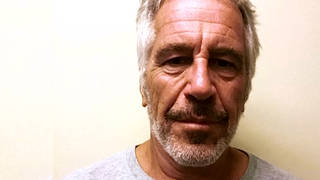
As the Trump administration is expected to release investigative files related to Jeffrey Epstein later this week, a recent New York Times investigation delves into one of the biggest mysteries about the deceased sexual predator: how the college dropout with no financial training rose through the world of finance and amassed his wealth, which enabled his abuse and insulated him from scrutiny for decades.
David Enrich, deputy investigations editor at The New York Times and lead author of the report, headlined “Scams, Schemes, Ruthless Cons: The Untold Story of How Jeffrey Epstein Got Rich,” says Epstein’s early success in business was due to a series of lucky breaks, lies and scams that nevertheless convinced sophisticated investors and business titans to give him their money.
Related Story
 StoryAug 12, 2019Jeffrey Epstein Is Dead, But Victims Call for Probes of His Sex Trafficking Ring to Continue
Transcript
AMY GOODMAN: This is Democracy Now!, democracynow.org. I’m Amy Goodman, with Juan González.
Friday is the deadline for the Department of Justice to release its investigative files into the dead financier and serial sex trafficker Jeffrey Epstein. The deadline was set with the passage of the Epstein Transparency Act last month. One of the questions that’s remained largely unanswered until now is: How did Jeffrey Epstein become so extravagantly wealthy, wealth that both enabled his crimes and shielded him from scrutiny and accountability for so many years?
Well, a new investigation by The New York Times uncovered details about Epstein’s rise, previously unreported, and provides an answer. The investigation is headlined “Scams, Schemes, Ruthless Cons: The Untold Story of How Jeffrey Epstein Got Rich.” This is a video clip featuring some of the reporters. It begins with business reporter Jessica Silver-Greenberg.
JESSICA SILVER-GREENBERG: How did Jeffrey Epstein have the financial backing to abuse what turns out to be hundreds of young women and girls?
DAVID ENRICH: The hundreds of millions of dollars that Epstein amassed, the palatial estates and aircraft.
JESSICA SILVER-GREENBERG: Connections to some of the wealthiest, most established people all over the world. There’s been a tremendous number of conspiracy theories and myths.
DAVID ENRICH: From he was running a huge blackmail operation to he was affiliated with spy agencies.
JESSICA SILVER-GREENBERG: Through months of reporting and digging through documents.
DAVID ENRICH: People’s diaries, letters, old photo albums.
JESSICA SILVER-GREENBERG: The answer is: He stole it.
AMY GOODMAN: “He stole it.” The New York Times investigation begins with Epstein in his early twenties, a college dropout, teaching math at the prestigious Dalton High School here in New York. He’s introduced by a student’s father to Ace Greenberg, the future chief executive of Bear Stearns, an introduction that changed Epstein’s life.
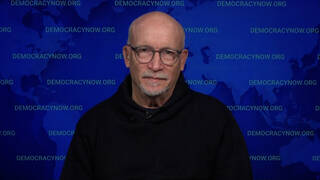
For more, we’re joined by New York Times deputy investigations editor David Enrich, who co-wrote the new piece.
We thank you so much for being with us, joining us from Dobbs Ferry. Can you name names? Lay out Jeffrey Epstein’s rise, the critical importance of the people he connected with, and the lies, the thievery, all that you lay out, after, what, months, years of this investigation.
DAVID ENRICH: Yeah, we’ve spent a long time on this one. And it really starts at Bear Stearns, where Epstein is introduced to a guy named Ace Greenberg, who was a top executive at the investment firm. And Greenberg and another of his colleagues, Jimmy Cayne, who’s also a top executive there, took Epstein under their wings and made him their protégé.
And Epstein proceeded to go on kind of this spree of wrongdoing at Bear Stearns, everything from abusing his expense account, lying on his résumé, giving a girlfriend early access to kind of hot investment deals. And time and time again, Epstein’s protectors at the bank went to bat for him and basically got him out of trouble. And this basically — this was the start of a lifelong pattern for Epstein, where he would push the envelope, cross ethical, moral, sometimes legal lines, and basically escape with impunity because of his really astounding ability to charm people in positions of power and to use his leverage over people in positions of power.
And one of the things we heard about Bear Stearns was that he was — and this was a time in the late '70s and early ’80s where there was a lot of drugs and sex going on within the firm itself, and Epstein, it sounds like, was providing some of the top executives with drugs and with access to women. And so, you know, he had leverage, and he was not afraid to use the leverage. And again, we see this over and over and over again in the ensuing decades of Epstein's life and career.
JUAN GONZÁLEZ: And, David, one of the — one of the key figures that he cultivated was the Harvard law professor Alan Dershowitz. Could you talk about how they got together and the importance of Dershowitz in his rise?
DAVID ENRICH: Yeah, and Dershowitz is interesting, because he is both — he goes on to become Epstein’s kind of leading defender and leading protector, but Epstein connects with him through — by doing this thing that he does all the time, which is he leverages one connection to form another to form another.
And so, in the case of Dershowitz, Epstein, in the early '90s, had become close with a woman named Lynn Forester, who was this successful telecom executive who was very close to Bill Clinton and the Clinton White House. Epstein befriends her. She is friends with Dershowitz, and Forester asks Epstein if — or, I'm sorry, asks Dershowitz if Epstein can come over and visit him. So, Epstein and Dershowitz get together on Martha’s Vineyard, and Epstein convinces Dershowitz to fly out to Ohio with Epstein for a birthday party for Les Wexner, who is the billionaire retail tycoon who owns brands like Victoria’s Secret. And this is the start of a yearslong and very fruitful relationship for both Epstein and Dershowitz.
And Dershowitz gets a lot of notoriety and, I think, from his perspective, probably fame from his representation of Epstein. And Epstein, for his part, gets this access to a world-class lawyer, who engineers a sweetheart deal for him in around 2007 that gets him, basically, out of trouble when he was facing a sex trafficking and money laundering investigation in Florida. And Dershowitz, I mean, to this day, is one of Epstein’s leading public defenders. And so, it was an investment that Epstein made in this man in a very kind of prescient way early on. And that entailed not just introducing him to people, but also getting him access to invest in very exclusive hedge funds, and, when those investments didn’t work out, getting Dershowitz bailed out of those investments.
So, Epstein was just absolutely masterful at leveraging one connection to benefit another. And, you know, it’s often been said that Epstein is this math genius and this super sophisticated financier. What we found in our reporting is much simpler, which is that he may have been those things, but the evidence shows that what made a difference for him in the long run was his ability to charm and entrance and leverage powerful people off of one another.
AMY GOODMAN: And if you can talk about the connections, as we’re about to see the documents released, if we are, Friday, December 19th, the connections to Trump, to Robert Maxwell, the father of Ghislaine Maxwell, to Ghislaine Maxwell herself, serving a 20-year sentence for —
DAVID ENRICH: Yeah.
AMY GOODMAN: — sex trafficking? Go ahead, David.
DAVID ENRICH: Well, and we don’t know what’s going to be in these files, if indeed there are files released by Friday. And I think it is much more likely — I don’t think it’s very likely that we’re going to see a lot of stuff that kind of plumbs through Epstein’s ancient history, the way we did in this article. That’s part of the reason we wanted to do this reporting, was to provide — kind of shine a light on a phase in his life that has not undergone quite as much scrutiny as his later years.
And I think what we’re likely to see in these files is quite a bit about him in the 2000s, essentially, and in the 2010s. And that happens to be a period where he certainly overlapped with Donald Trump for a period, he overlapped with Bill Clinton for a period, and that there are a lot of powerful, important figures kind of darting in and out of his life. And, obviously, there is an enormous amount of interest, rightly so, in what these files show, if anything, about how Epstein’s sex trafficking operation ensnared some of these kind of boldfaced names.
The truth is — and I’m not trying to be coy or evade the question — we just really have no idea what is in these files and what is going to actually be released in a way that is legible. And I think there is an expectation or a concern that these might be very, very heavily redacted, if they get released at all. And hopefully I’m wrong about that, because I think the whole world is clamoring for some transparency here. And just as someone who’s been covering this for like six years, six-plus years now, with my colleagues at the Times, we are really eager to see what’s in these files.
AMY GOODMAN: And finally, what surprised you most as you investigated him for all of these years? We just have 30 seconds.
DAVID ENRICH: I think what surprised me the most was just how pedestrian some of his scams were. This is not someone who was hatching this, like, extremely elaborate plot to con sophisticated people through all these, like, bells and whistles. He was just grabbing people’s money and running with it. And for all of the attention that’s been paid to the possibility of Epstein being part of spy services or running this really sophisticated blackmail operation, the truth that we found — and there may be more to it, but what we found — was much more run-of-the-mill and kind of low-level than that.
AMY GOODMAN: David Enrich, we want to thank you for being with us, deputy investigations editor for The New York Times. We’ll link to your new investigation, “Scams, Schemes, Ruthless Cons: The Untold Story of How Jeffrey Epstein Got Rich.”
Happy birthday to Jeff Stauch! And happy belated birthday to Renée Feltz! I’m Amy Goodman, with Juan González. Thanks for joining us.




 Top
Top
Media Options