






 Watch Full Show

President Trump has ordered what he called a “total and complete blockade” of sanctioned oil tankers entering and leaving Venezuela, as the United States escalates pressure on the government of President Nicolás Maduro. The move comes amid a major U.S. military buildup in the region and days after U.S. forces seized an oil tanker carrying Venezuelan oil. Since September, the U.S. military has carried out at least 25 airstrikes on alleged drug-smuggling boats in the Caribbean and eastern Pacific near Venezuela, killing at least 95 people.
The administration’s actions against Venezuela signal “the total renunciation of liberal internationalism” and further abandonment of “a world governed by common laws,” says Pulitzer Prize-winning historian and Yale University professor Greg Grandin. This comes as Latin America is on a “knife’s edge between the left and the right,” with the Trump administration eager to boost its authoritarian allies across the region, says Grandin.
Related Story
 StoryNov 25, 2025Will the U.S. Attack Venezuela? Trump’s Anti-Maduro Campaign Seen as Part of a Broader Regional Plan
Transcript
AMY GOODMAN: President Trump has ordered a “total and complete blockade” of sanctioned oil tankers entering and leaving Venezuela, as the U.S. ramps up pressure on the government of Nicolás Maduro. The blockade comes amidst a major U.S. military buildup in the region and days after the U.S. seized an oil tanker filled with Venezuelan oil.
In a post on Truth Social, Trump wrote, quote, “Venezuela is completely surrounded by the largest Armada ever assembled in the History of South America. It will only get bigger, and the shock to them will be like nothing they have ever seen before,” unquote.
Since September, the U.S. military has also carried out at least 25 airstrikes on alleged drug boats, without offering evidence, in the Caribbean and eastern Pacific near Venezuela, killing at least 95 people.
On Tuesday, Vanity Fair published excerpts of bombshell interviews with Trump’s Chief of Staff Susie Wiles, in which she suggested the aim of the boat strikes is to topple Maduro. Wiles said, quote, “[Trump] wants to keep on blowing boats up until Maduro cries uncle. And people way smarter than me on that say that he will,” unquote.
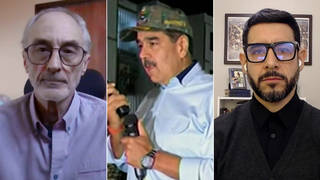
On Tuesday, President Maduro denounced the U.S. actions.
PRESIDENT NICOLÁS MADURO: [translated] We tell the people of the United States our truth, and it is very clear: Imperialism and the Nazi-fascist right wing want to colonize Venezuela to take our wealth — oil, gas, gold, iron, aluminum and other minerals. We have sworn to defend our homeland. And in Venezuela, peace will always prevail, along with stability and shared happiness for our people.
To the people of the United States, we say again and again, one and a thousand times: [in English] No blood for oil! No war for oil!
[translated] The claims about drug trafficking are fake news, a lie, an excuse. Since they cannot accuse us of weapons of mass destruction, chemical weapons or nuclear missiles, they invent another pretext to create another Afghanistan, another Libya. And with moral authority and with God’s blessing, I say: [in English] No more Vietnam! No more Afghanistan! No more Libya! No more Iraq! No more war eternal! No! No! No! Enough!
[translated] We know we are morally and spiritually in the right.
AMY GOODMAN: We’re joined now by the Pulitzer Prize-winning historian, Yale University professor Greg Grandin. His latest book, America, América: A New History of the New World. He has a recent piece in The New York Times headlined “Trump’s Dated Strategy Is Putting Us on a Path to World War III.”
Welcome back to Democracy Now!, Professor Grandin. Can you start off by responding to what’s happening right now? We are doing this broadcast before President Trump makes his address to the nation tonight, unclear what that’s about. But talk about the latest developments with Venezuela.
GREG GRANDIN: Well, it is an unprecedented military buildup. It’s probably bigger than what the Spanish Empire sent to retake Spain in the 1820s in terms of sheer destruction — destructive force. And the classification of fentanyl as a weapon of mass destruction, and all sorts of presidential announcements that — you know, trying to lay a legal justification for this. And, of course, as this is going on, they’re still blowing up speedboats in the Caribbean and in the Pacific. And as you mentioned, Susan Wiles, the secretary — the chief of staff of Trump, said that this had nothing to do with narcoterrorism, that Trump actually doesn’t really care about narco drugs coming into the country; this is really just setting up and hoping to induce a regime change in Venezuela.
And Venezuela is really just the first, the first step. Marco Rubio, the secretary of state, from Florida, from South Florida, whose family itself is not uninvolved in drug trafficking, sees it in very ideological terms. He’s, you know, Cuban. And for whatever reason, they see Venezuela as the first step of finally bringing down the Cuban Revolution and bringing Cuba back into the orbit of the United States. And then, from there, of course, it’s Nicaragua. And we just saw this election in Chile, which I know you’re going to talk about later with Ariel Dorfman. But Latin America really is on a kind of knife’s edge between the left and the right. We see, in Argentina, Javier Milei and what the United States is willing to do to keep him in power, billions and billions of dollars, not just — not just through the Treasury Department, but also through the IMF, to prop up the peso. Honduras, there’s all sorts of machinations going on there in terms of the election that the U.S. was involved in.
And so, that really leaves Latin America divided, almost unprecedentedly divided. In the past, Latin America tended to be coherent and tended to be all dictatorships or all kind of center-left presidents. And now we have a continent that’s split angularly down the middle. And the image is quite stark. You have Brazil, and you have Mexico, and those are the two bulwarks of Latin America. And ultimately, if you’re going to get Latin America under control and back under the U.S.’s umbrella, you have to confront those two countries. Ultimately, that is the end goal.
And this is in the larger context of a dramatic reversal of U.S. foreign policy, the total renunciation of liberal internationalism. Now, liberal internationalism as an ideal, there was a big gap between in practice and as it actually functioned. But the idea was that the United States would superintend a world governed by common laws. The Trump administration announced in its National Security Strategy document, which it put out last week or a couple weeks ago, that the bipartisan consensus that came out of the Cold War has failed. And it had been essentially announced, implicitly, that what it sees as replacing it is a Monroe Doctrine for the entire world, that the way the United States acted with impunity to seize, to kill and to sanction, it could do anywhere.
AMY GOODMAN: Which brings us to what Secretary of Defense Pete Hegseth just said at the Reagan Defense Forum. He said, quote, “The Monroe Doctrine is in effect.”
DEFENSE SECRETARY PETE HEGSETH: After years of neglect, the United States will restore U.S. military dominance in the Western Hemisphere. We will use it to protect our homeland and access to key terrain throughout the region. We will also deny adversaries’ ability to position forces or other threatening capabilities in our hemisphere. Past administrations perpetuated the belief that the Monroe Doctrine had expired. They were wrong. The Monroe Doctrine is in effect, and it is stronger than ever under the Trump corollary, a commonsense restoration of our power and prerogatives in this hemisphere consistent with U.S. interests.
JUAN GONZÁLEZ: That was Defense Secretary Hegseth. I wanted to ask you, though, Greg — Latin America is not the same region that it was a hundred years ago or that it was 50 years ago. And when you mentioned this split in the region, I’m not so sure I agree with you on that. Brazil, Mexico and Colombia are the three largest nations in Latin America. They have half the population of the entire region, and all three of those countries are being led still by progressive, left-wing-oriented presidents. None of them are going to back a U.S. invasion, not to mention some of the smaller countries like Cuba or Nicaragua. And so, we’re in a situation where the United States is trying to impose a past that no longer exists. I’m wondering what you think, even if the intervention were to occur, and it seems likely that’s going to happen just in time to eclipse any news of the release of the Epstein files. The ability of the United States to impose its chosen leader on Venezuela is going to be severely restricted, not only by the international condemnation, but also by the fact that the Venezuelan military has been politicized directly, over years now, as a result of the Chávez revolution, so they’re not likely just to lay down their arms and allow the U.S. to come in. I’m wondering your thoughts.
GREG GRANDIN: Yeah, I agree with you completely. And that’s what I meant, that the region was split, and that in Mexico and Brazil, if you don’t — if they’re not — if they’re not isolated, then there is no kind of broader U.S. hegemony over the region, and certainly Colombia also, although there’s elections coming up in Colombia, and that country is going to be in play. But I think Mexico and Brazil are secure for now.
But, yes, and speaking about Venezuela, it’s unclear what the actual action is going to be. I mean, just stopping — just the sanction and blockade on the oil tankers are going to put enormous pressure on Venezuela to — you know, in terms of food, in terms of being able to import food and feed its people, and what that — and what kind of disaster that’s going to be. The sanctions are already incredibly punishing. There was bipartisan consensus going back decades, even to Obama. We might see some massive show of force, some targeted strikes. But you’re absolutely right, Venezuela is not Libya. It’s not going to collapse. I think there is — I think there is a kind of embedded structure, that, on the one hand, there is a radicalized sector of the population; on the other hand, there are — you know, there are people invested in a kind of militarized corruption that does structure some of the ways the country is governed. And Maduro could or could not go, but that doesn’t necessarily mean the United States is going to have its way and just be able to install a puppet like it did in Chile in ’73 or Guatemala in ’54, any number of coups in the past.
It’s a dangerous game. I was sitting out in the waiting room today, just now, a second ago, and CNN talked about a second near-crash between a private jet and some U.S. military force. I mean, they’re really — they’re really pushing it to the max. You know, of course, these murders on the high seas. Now we have the admission from the administration that this is just — you know, this has nothing to do with drugs; it has everything to do with Maduro. You know, these are innocent people. You know, it’s like — he’s like the Red Queen in Alice. You know, you execute, then you have the trial, and then you have the conviction, and then you have the trial. You know, he does everything backwards. We’re living in like an Alice in Wonderland foreign policy in Latin America.
But Latin America is confused, you know? There’s tension within Latin America. Petro said that he wouldn’t shake President-elect Kast’s hand, this is a Nazi. And he was immediately rebuked by Boric, you know, a center-leftist. So there’s also a lot of tension within Latin America about how to respond to the United States. That kind of — that kind of unity that existed coming out of the 2000s, Chávez, when Chávez was president, and Lula was the president of Brazil, and you had Kirchner in Argentina, and you had Bachelet in Chile, and, you know, it was a very — it was a very rhetorically strong and dominant form of social democracy that really commanded the rhetorical field. I think what we’re seeing here is a lot of — a lot of confusion about how to deal with Trump, just like the rest of the world. You know, it is, in some ways, the madman doctrine of diplomacy, except the madman doctrine was supposed to be a performance, an act, but we actually have a madman in the White House, in some ways.
JUAN GONZÁLEZ: Well, but this whole — the issue is, clearly, the key aspect of this in Venezuela, that distinguishes Venezuela from all the other governments in the region that Trump may not like, is these vast oil reserves.
GREG GRANDIN: Yeah.
JUAN GONZÁLEZ: On the one hand, could you talk about the importance of these oil reserves, and also the fact that the American people, by and large, all the polls indicate they have no interest in the United States launching a war against Venezuela, because Venezuela has not posed any threat to the United States?
GREG GRANDIN: Yeah, and that’s interesting. And so, I think that’s one of the reasons why it’s taking Trump so long to know — to figure out what to do. He may be a madman, but he’s not completely irrational. He does calculate. And there is obviously no bloodthirst within the rank and file of the Trump administration for a ground war in Venezuela, and certainly not within the country as a whole, and so he’s responding to that. Then there’s the calculus of, well, distraction, the Epstein files. Will this distract, or will people make the connection that we’re doing it to distract? You know, there’s a lot of independent — we’ve heard about how the Republican ecosphere, information sphere, is kind of fracturing and coming apart and eating each other.
Venezuela does have oil, but, you know, there’s lots of ways of getting Venezuela’s oil. I mean, Maduro has basically offered it up. Chevron, as we speak, is pumping oil and sending it to Port Arthur in Texas to be processed. And there’s lots of ways to make — get control. So, a war with Venezuela over oil is an ideological war, and it’s led by the Marco Rubio faction, the war party within the Trump administration, that sees Latin America in very ideological terms, in which Venezuela is the step — is the first step to contain a left, a left that, yes, is still strong and still, you know, has quite a purchase. I mean, even in Chile — right? — 42% of the population voted for a communist woman, in one of the most socially conservative countries in Latin America. That’s not nothing. I mean, it’s a shame we got the Nazi, but, you know, 42% of the country voted for Jeannette Jara, who is, you know, a communist woman. That speaks, I think, to the strength of — the ongoing strength of the left.
But there isn’t a coherent strategy of how to deal with the United States. I mean, any country going to come to Venezuela’s aid to try to get the oil out? I don’t think Colombia can risk that. You know, there are ways in which you can imagine Colombia trying to get Venezuela’s oil out of there, but do they want to provoke the United States to that degree? It’s a little unclear. So, I think everything’s up in the air and on the table at this moment. Anything can happen. And I guess we’ll — things will be clarified by the speech, or not.
AMY GOODMAN: Well, Greg Grandin, we want to thank you for being with us, Yale University history professor, Pulitzer Prize-winning author. His latest book, America, América: A New History of the New World. And we’ll link to your piece in The New York Times headlined “Trump’s Dated Strategy Is Putting Us on a Path to World War III.” We’ll link to you at democracynow.org.
Coming up, Chile has elected its most right-wing president since Augusto Pinochet. We’ll go to Santiago to speak with the renowned Chilean writer Ariel Dorfman. This is Democracy Now! We’ll also, later in the broadcast, look at the untold story of how Jeffrey Epstein got rich. Back in 30 seconds.
[break]
AMY GOODMAN: “Una Canción,” “A Song,” by the Cuban musician Silvio Rodríguez, performing at New York’s Central Park years ago.




 Top
Top
Media Options