












 Watch Full Show

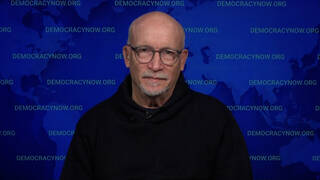
As tech companies scramble to build massive new data centers to power artificial intelligence, marginalized communities are bearing the brunt of the environmental harms. In Memphis, Tennessee, Elon Musk’s xAI operates over two dozen methane gas-burning turbines without legal permits to power its data centers, Colossus 1 and Colossus 2, polluting the nation’s largest majority-Black city with toxic emissions. The NAACP is suing xAI for violating the Clean Air Act. “We are, unfortunately, a cautionary tale about what will and possibly can happen if you don’t have the right rules and guardrails in place,” says KeShaun Pearson, the executive director of Memphis Community Against Pollution. Pearson says pollution from xAI’s energy generation is already “at a level even higher than our Memphis International Airport.” Meanwhile, the company has created far fewer jobs than it initially promised. “This has been terrible for our region, and it’s terrible for our future, because our community is going to continue to suffer. Our children have the highest rate of ER visits for respiratory illnesses and issues in the state of Tennessee, and it’s only going to continue to get worse.”
Related Story
 StoryOct 15, 2026The Midterm Battle over Data Centers: Memphis House Candidate Justin Pearson Fights Elon Musk’s xAI
Transcript
AMY GOODMAN: This is Democracy Now!, democracynow.org, The War and Peace Report. I’m Amy Goodman.
On this Earth Day, we’re continuing our look at community resistance to the construction of AI data centers. We go now from the state of Maine, which just passed a statewide moratorium on the construction of new data centers, to the city of Memphis, Tennessee. Last week, the NAACP sued Elon Musk’s xAI, accusing the artificial intelligence company of polluting Black neighborhoods with toxic emissions from its makeshift power plant fueling its data centers in Memphis. The lawsuit alleges xAI is violating the Clean Air Act by operating over two dozen methane gas-burning turbines without legal permits. The massive xAI data centers are known as Colossus and Colossus II.
We go now to Memphis, where we’re joined by KeShaun Pearson, executive director of Memphis Community Against Pollution.
KeShaun, thanks so much for joining us again. We talked to you almost exactly a year ago. Can you talk about what is Colossus and Colossus II? Talk about the power these data centers require and what kind of regulation there is.
KESHAUN PEARSON: Thank you, Amy, for having me back. It’s good to be back.
And we are, unfortunately, in an even worse position than we were a year ago. At this point, we now have two facilities, Colossus I and Colossus II, that are being powered by illegal and unlawful methane gas turbines. These turbines generate enough power to power over half a million homes. This is unprecedented, the amount of pollution that we’re being exposed to, nitrogen dioxide, formaldehyde, chemicals that we know cause cancer. And so, in this moment, we have to do something similar to what Maine is doing, and we are demanding a moratorium of some sort come to fruition. But here in Memphis, we are, unfortunately, a cautionary tale about what will and possibly can happen if you don’t have the right rules and guardrails in place.
AMY GOODMAN: Last year, Elon Musk explained why he decided to build Colossus in Memphis.
ELON MUSK: Well, we needed a building. We can’t build a building, so we must use an existing building. So we looked for — basically, for factories that had been — that had been abandoned, but the factory was in good shape, like a company had gone bankrupt or something. So, we found an Electrolux factory in Memphis. That’s why it’s in Memphis, home of Elvis and also one of the oldest — I think it was the capital of ancient Egypt.
AMY GOODMAN: So, that’s Elon Musk. KeShaun Pearson, you’re the director of Memphis Community Against Pollution. That’s MCAP. It’s the NAACP that’s suing xAI, accusing the company of polluting Black neighborhoods. The facility, next to historically Black neighborhoods, runs on two dozen methane gas-powered turbine generators, which you have said emit significant amounts of nitrogen oxide and other toxic chemicals. Talk about what Elon Musk has said and why you think that this is particularly hurting Black communities.
KESHAUN PEARSON: What Elon Musk said is basically smoke and mirrors, because what we know is that southwest Memphis continues to be targeted. Memphis Community Against Pollution has stood up against multiple corporations and billion-dollar organizations who have sought to see our community as the path of least resistance, where they could push forward these environmentally unjust and these environmentally racist projects. These projects specifically focus on a neighborhood, on a community and on a region where you see an increased poverty level and you also see an increased amount of Black families. Just like all over the South, you see a concentration of AI data centers in communities that are largely Black or marginalized. This is nothing new.
This is Elon Musk presenting an option for Memphis which we know is untrue. Elon Musk was invited to Memphis. Unfortunately, our city mayor joined with Ted Townsend of our Greater Memphis Chamber, and these folks wooed the terrible decision that we continue to see operate like a cancer in our region.
xAI has not promoted or really led to the jobs that they said they would. They have not been in communication with the community in any significant way. But what they have done is continue to pollute our air, to do it unlawfully and illegally, and not include even our government officials.
We are in a place now where we are literally worse off than we have ever been. xAI continues to pollute at a level even higher than our Memphis International Airport. This has been terrible for our region, and it’s terrible for our future, because our community is going to continue to suffer. Our children have the highest rate of ER visits for respiratory illnesses and issues in the state of Tennessee. And it’s only going to continue to get worse.
AMY GOODMAN: Elon Musk claims he chose the former Electrolux building in Memphis because he wanted to expedite his AI applications using an abandoned building instead of a new one. What was Electrolux previously? And how did Musk’s company, xAI, go about purchasing the building?
KESHAUN PEARSON: Yeah, so, Electrolux was a company who came into Memphis doing something very similar to what we’re seeing xAI do. They offer hyperbolic promises and ended up a colossus failure. And Electrolux was a company, machine company, and they got breaks from our Shelby County Health Department, from our Shelby County government and our city of Memphis government. They actually received the building at a discount and got payments in lieu of taxes or a pilot program to help them finance it. And then they left. They got the money, and then they left, leaving this facility open. And xAI purchased the facility and started their environmentally unjust project. And so we are seeing this cyclical activity. And it’s in the same area. We cannot bifurcate the fact that southwest Memphis has continued to be the site and target of a lot of these extractive corporations in an extractive ecosystem.
One last thing I do want to add is that in 1968, Dr. Martin Luther King came, and he marched with sanitation workers in the city of Memphis. That was fighting for environmental justice, and that is the fight that we are continuing. It is no mistake that environmentally unjust projects continue to put pressure on the city of Memphis and continue to extrapolate what we know is our right to health, healthy environment and clean air. And so, with this project, we will continue to fight back, and we will continue to work alongside the NAACP, the Southern Environmental Law Center and Earthjustice, as well as our partners in coalition in South Haven, the Safe and Sound Coalition. Our families are suffering. Our region is suffering. We can’t continue to fall for smoke and mirrors. We have to do something that protects us, and we have to do it now.
AMY GOODMAN: KeShaun Pearson, I want to thank you for being with us, the executive director of Memphis Community Against Pollution.





 Top
Top
Media Options