






 Watch Full Show

Guests
- Kimberlé Crenshawprofessor of law at UCLA and Columbia University, co-founder and executive director of the African American Policy Forum.
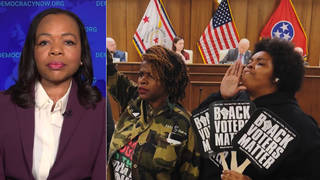
Leading scholar in the field of critical race theory Kimberlé Crenshaw coined the term “intersectionality,” which she has described as a “lens through which you can see where power comes and collides, where it interlocks and intersects.” Crenshaw, a professor of law at UCLA and Columbia University and executive director of the African American Policy Forum, has just published a new book, Backtalker: An American Memoir.
“Backtalker is a frame that I use to encourage people to talk back against claims that the world as we have experienced it is the way it can only be, that there is no reason to continue to advocate for change,” says Crenshaw. She also discusses the Supreme Court’s recent gutting of the Voting Rights Act and the sociopolitical environment that allowed for Clarence Thomas to be appointed to the Supreme Court despite Anita Hill’s claims of sexual harassment against him.
Related Story
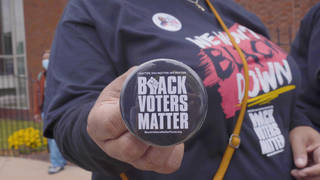
 StoryOct 21, 2022“Democracy Demands We Participate”: Black Voters Mobilize for Midterms Amid GOP-Led Voter Suppression
Transcript
AMY GOODMAN: This is Democracy Now! I’m Amy Goodman.
We end today’s show with the acclaimed legal scholar Kimberlé Crenshaw, professor of law at UCLA and Columbia University, executive director of the African American Policy Forum. She coined the term “intersectionality” in 1989, which she’s described as a “lens through which you can see where power comes and collides, where it interlocks and intersects.” Kimberlé Crenshaw went on to write, “It’s not simply that there’s a race problem here, a gender problem here, and a class or LGBTQ problem there. Many times that framework erases what happens to people who are subject to all of these things.”
Kimberlé Crenshaw is also a leading scholar in the field of critical race theory. For years, President Trump has led a campaign against CRT as part of a broader attack on how history is taught and told in the country.
Well, Kimberlé Williams Crenshaw has just published a new book. It’s titled Backtalker: An American Memoir. In the book, she writes, quote, “When the federal government silences the past, it destroys the foundation upon which civil rights and equality are grounded.”
Professor Crenshaw, it’s such an honor to have you here. Backtalker, what does that mean?
KIMBERLÉ CRENSHAW: Oh, “backtalker” is a frame that I use to encourage people to talk back against claims that the world as we have experienced it is the way it can only be, that there is no reason to continue to advocate for change, that what we have is pretty much all we deserve. I am thinking about backtalking as the kind of resistance that we need to the logics that tell us that the world is pretty much OK the way it is, and we know it isn’t.
AMY GOODMAN: So, put that, backtalk, against the Voting Rights Act and what has happened with it, and for people who don’t understand what exactly has happened. And if you can also talk about the Supreme Court finding that Louisiana’s current congressional map is unconstitutional, which followed Governor Landry suspending the state’s primaries for the U.S. House of Representatives?
KIMBERLÉ CRENSHAW: Absolutely. Well, the Voting Rights Act was the crown jewel of the civil rights movement, in part because it said, “Look, it doesn’t matter the specific thing that you’re doing to undermine the voting strength of traditionally excluded populations. The Voting Rights Act protects against intentional or effective disenfranchisement of protected groups.”
Well, what this Supreme Court has now said is that if you take race into account in trying to address racism in the voting rights system, that you are the one that is guilty of creating a racialized system. So, what they’re effectively saying is that if you draw a district in order to protect an incumbent, that’s OK; if you draw a district in order to maximize minority voting strength, that’s not OK.
Now, let’s be clear about one thing: Incumbency is often the product of racial power. Incumbency, particularly in Louisiana, is made and reinforced by packing, cracking, stacking African American voters. What they’re basically saying is you have to take the baseline as is, even though that’s the product of race discrimination. If you try to — if you try to remedy the racial discrimination that’s built into incumbency, that’s when you’re being racist, that’s the problem. So, it’s turning reality completely on its head, and destroying the Voting Rights Act while they’re doing so.
AMY GOODMAN: So, you are known around the world for your work on intersectionality, on critical race theory. But let’s hear for a moment the personal story behind the public intellectual. Talk about how you came to be Kimberlé Williams Crenshaw, your background.
KIMBERLÉ CRENSHAW: Well, I wrote this book as a tribute to my parents, who were, as we call them, race men and women of the 20th century. What that meant is that they were vigilant in pushing back against the barriers, the illegitimate ways in which Black people were told that they didn’t belong in this country. My mother integrated her local swimming pool when she was 3 years old. So, they were keen to make it clear that we understood the history upon which we stood, the places and spaces of racial discrimination, but also that we were prepared to walk into institutions that were being opened at that very time.
You know, a lot of people think that this period of discrimination and segregation was ancient history, a long time ago. It was during my lifetime. I was born into a society in which I was not free. I was born before the Voting Rights Act, the Civil Rights Act of '64 and ’65. So, when my parents raised us, they raised us to be aware that the context that we were in might often be shaped by illegitimate racial barriers, but also raised us to be prepared to talk back to them. That's what we had to do at the dinner table. That’s how they shaped me. So, much of the book is trying to trace the arc of the civil rights movement and locate my parents’ nurturing to allow me to be able to understand and talk back against racial power when I saw it.
AMY GOODMAN: And where did you grow up?
KIMBERLÉ CRENSHAW: I grew up in Canton, Ohio, an industrial town in the Midwest, on its way from the South to Chicago and Detroit. A lot of Black folks escaping the South ended up staying in Canton, Ohio, and being part of the industrial core there.
AMY GOODMAN: Talk about what exactly intersectionality is and critical race theory, and what it means today under President Trump —
KIMBERLÉ CRENSHAW: Yeah.
AMY GOODMAN: — the vicious attack, and how that was really the underpinning of DEI.
KIMBERLÉ CRENSHAW: Yeah, well, intersectionality just refers to the idea that disadvantage, discrimination, marginalization often is based on more than one axis of inequality. Those often overlap. They reinforce each other.
So, I began to write in this arena when I was trying to understand how Black women, who sometimes sued employers because they were subject to gender discrimination and race discrimination — many times Black jobs were for men, and women’s jobs were for white women, which meant that there was precious little space for African American women. But courts couldn’t really understand that. They were saying, you know, “How can you claim race discrimination? Because we hire Black people” — they just happen to be men. “How can you claim gender discrimination? We hire women” — they just happen to be white. And I couldn’t understand what the courts couldn’t understand.
So I was looking for a metaphor, a way that would allow judges to understand that discrimination isn’t just along one axis or another, but just like intersections, they might criss-cross each other. So, intersectionality was really a remedial framework for judges, that are supposed to be very smart, but they weren’t that smart at all when it came to understanding what Black women were experiencing.
AMY GOODMAN: Can you talk about Clarence Thomas and the tensions around his confirmation as justice of the Supreme Court? You write a lot about this.
KIMBERLÉ CRENSHAW: Yeah. So, when Clarence Thomas was nominated for — to take over the seat that Thurgood Marshall had occupied, the great civil rights giant, my initial thought was, “This isn’t going to work. Everybody knows there’s a difference between Clarence Thomas and Thurgood Marshall.” And to my surprise and disillusionment, a lot of people didn’t understand the difference between the two.
Eventually, there became a moment when it was known that there was someone, a former employee, who had told someone that she’d been sexually harassed by him. That person turned out to be Anita Hill. Turned out I knew Anita. There weren’t a whole lot of Black women law professors. So I contacted her. I offered support. Before I knew it, I was on my way to Washington, D.C., to support her.
But the shocking thing that happened was when Clarence Thomas denounced the entire inquiry as a “high-tech lynching.” And what that did was it provided a metaphor for him to speak to the history of anti-Blackness, to place himself in the middle of that narrative, and to draw a support of large numbers of African Americans to his side. And she had nothing equivalent that she could say.
AMY GOODMAN: I wanted to turn to then-senator, Senate Judiciary Committee Chair Joe Biden —
KIMBERLÉ CRENSHAW: Joe Biden, yes.
AMY GOODMAN: — questioning Anita Hill back in 1991.
SEN. JOE BIDEN: Can you tell the committee what was the most embarrassing of all the incidences that you have alleged?
ANITA HILL: I think the one that was the most embarrassing was his discussion of pornography involving these women with large breasts and engaged in a variety of sex with different people or animals. That was the thing that embarrassed me the most and made me feel the most humiliated.
AMY GOODMAN: Law professor Anita Hill testifying at the confirmation hearing of Clarence Thomas. Professor Crenshaw, the lessons you draw from what happened there and what it means for today?
KIMBERLÉ CRENSHAW: You know, Amy, I want to take you to the moment that Clarence Thomas was finally confirmed. My co-founder of AAPF, Luke Harris, and I were sitting on the stairs of the Supreme Court. At that moment, I said, “This is going to change the rest of our lives.” Luke said, “All because they refuse to believe a Black woman.”
I called this a massive intersectional failure. A coalition of civil rights groups, feminist groups, they successfully blocked Bork. Clarence Thomas was basically an acolyte of Bork. There wasn’t really much daylight between them. What was different was Clarence Thomas was able to wrap himself in a sympathetic framework as someone who was being unfairly treated by the testimony and Anita Hill, partly because the history of Black women, the experiences that they’ve had with sexual harassment, really since we arrived here, and the fact that Black women were some of the first plaintiffs in sexual harassment cases, that just wasn’t part of the common knowledge. So, she was framed as someone who was complaining about something that Black women don’t complain about. There was an op-ed in The New York Times that said that what Clarence Thomas had done to Anita was just basically “down-home courting.” So there was a cultural defense that was being made to block the significance of her testimony.
So, what we often say now is when we look at some of the consequences of that failure, some of the long-term results of that, we’ve lost campaign finance reform on a 5-4 vote. We lost Section 5 of the Voting Rights Act, 5-4 votes. We look at all the 5-4 votes that were made possible by that failure to believe Anita Hill, and we have to recognize that this intersectional failure not only impacts Black women, not only impacts communities of color, it undermined the security and the democracy of the entire nation.
AMY GOODMAN: Before we go, if you could define CRT, critical race theory? Also talk about what gives you hope today.
KIMBERLÉ CRENSHAW: Well, critical race theory is basically the study of the way that racial disempowerment and other forms of exclusion are not principally the product of individual people making decisions to exclude people because they hate them for the color of their skin. Critical race theory looks at the ways that institutions, once they’ve been structured in contexts where people of color had not been part of it, that exclusion can continue even if there isn’t explicit policies and practices that say Black people, Brown people, Asian people can’t come in. It’s embedded in our systems.
I often liken it to asbestos. We used to build institutions with asbestos, right? And we know it’s toxic. It would be crazy to say that we can protect ourselves from asbestos-related diseases by stop talking about asbestos, stop looking at it, stop teaching people how to find it. That would make no sense whatsoever. Critical race theory says the same thing about race and racial exclusion.
AMY GOODMAN: And what gives you hope?
KIMBERLÉ CRENSHAW: What gives me hope is the fact that when I was born, Amy, there was no reason to really have faith that this American republic would actually reform itself, would create opportunities, yet there was the recognition that the one thing that was clear is, if we didn’t fight it, if we didn’t prepare ourselves for these opportunities, they would never come. I’m hopeful, because that same energy, that same recognition, I think, is growing all over the United States today. We have to be willing to speak against power, to backtalk against all those who tell us it’s impossible, because we know it’s not impossible. It’s happened before. It can happen again.
AMY GOODMAN: So, you say backtalking is —
KIMBERLÉ CRENSHAW: Backtalking.
AMY GOODMAN: — the answer to backsliding.
KIMBERLÉ CRENSHAW: Backtalking is the answer to authoritarian backsliding.
AMY GOODMAN: Kimberlé Williams Crenshaw, professor of law at UCLA and Columbia University. Her new book, Backtalker: An American Memoir. She’s also the co-founder and executive director of the African American Policy Forum, the AAPF.
That does it for today’s show. I’ll be in Minneapolis on Thursday night and Friday morning for screenings of the new documentary about Democracy Now!, Steal This Story, Please! I’ll be at the Main in Minneapolis. Then in Chicago, on Friday night, Saturday afternoon and Saturday evening at the Music Box movie theater, joined by Juan González and the film’s directors, Tia Lessin and Carl Deal. Then on to Milwaukee at noon on Sunday at the Oriental, a massive theater in Milwaukee. You can check our website at democracynow.org for all details. That does it for our show. I’m Amy Goodman. This is another edition of Democracy Now!



 Top
Top
Media Options