










 Watch Full Show

Topics
Guests
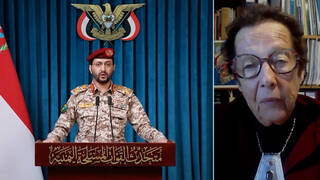
- Yasmine FaroukGulf and Arabian Peninsula project director at the International Crisis Group.
As Iran destroyed energy facilities and infrastructure in all six of its Persian Gulf neighbors and blocks their shipments of oil through the Strait of Hormuz, the Gulf states — Saudi Arabia, Kuwait, Bahrain, Qatar, Oman and the United Arab Emirates — are reevaluating their strategic alliances with the United States. We speak to Yasmine Farouk, the Gulf and Arabian Peninsula project director at the International Crisis Group, about where else the Arab Gulf is looking toward in Asia and Europe to diversify its defense relationships, and what exactly the war has put at risk in the region. “Let’s remember the ceasefire came at a moment when energy infrastructures, desalination, power plants, nuclear plants could have been in the crossfire. So what is at stake here is an uncontrolled escalation that everyone, everyone wants to stop.”
Related Story
 StoryJul 16, 2026A “Forever War” in Iran? Ali Vaez on Escalating War, U.S. “Diplomatic Malpractice”
Transcript
AMY GOODMAN: This is Democracy Now!, democracynow.org, The War and Peace Report. I’m Amy Goodman.
We end today’s show looking at how the Gulf states are reacting to the U.S.-Iran ceasefire. As negotiations are set to take place in Islamabad, Pakistan, Gulf states are expressing growing alarm that Iran will be allowed to maintain or even expand its control over the Strait of Hormuz. On Wednesday, the United Arab Emirates said it’s seeking further clarification regarding Iran’s commitment to the, quote, “complete and unconditional reopening of the Strait of Hormuz,” unquote. UAE officials have also said they want Iran to be held accountable for damages and to pay reparations for attacks on the UAE’s energy facilities and infrastructure. During the war, Iran attacked all six Arab Gulf states: Saudi Arabia, Kuwait, Bahrain, Qatar, Oman and the United Arab Emirates. Several attacks were reported on Wednesday even after the ceasefire was announced.
We’re joined now by Yasmine Farouk. She works at the International Crisis Group, where she serves as project director for the Gulf and Arabian Peninsula.
Why don’t you take us through the Gulf states and how they each individually have responded and as a group?
YASMINE FAROUK: Good afternoon. Thank you for having me.
Well, individually, you’ve seen, mostly by Saudi Arabia, Qatar, but also Kuwait, welcoming statements that welcome the ceasefire. But we have seen a welcome of the ceasefire that is conditioned on a long-term solution to their problems and the security threats that Iran represents to them, that it has shown during this war, and, as you just mentioned in your introduction, really singling out the opening of the Strait of Hormuz as being one of the conditions that are not — that they are not going to let go in the negotiations or whatever outcome comes from this war. The GCC also, which is the body that represents the six of them, also have welcomed the ceasefire, although the statement was very short, which shows that there isn’t really total or identical views on this ceasefire, how it was achieved, and on the direction after.
Oman, of course, was a country that welcomed the ceasefire, but this is coherent and consistent with its position that only when the war became very intense and we were getting into a phase where the war was going to get out of control. But since it began, Oman has kept a distance, and it was very consistent to be one of the first countries to work on this ceasefire.
Now, the countries that stand out are actually the UAE and Bahrain. As you just mentioned, the UAE statement was very detailed. It’s a page-long statement, and it did not welcome the ceasefire. It said that it is following the ceasefire. And it fleshed out all the details that it expects from any negotiations that are coming after the ceasefire.
AMY GOODMAN: During this five-week period, Gulf states have been seeking to diversify security partnerships, from European radar systems to anti-drone cooperation with Ukraine, you know, have learned to deal or have increased their expertise in dealing with Russia’s drone strikes, which many of those drones came from Iran. How significant is it that these countries, that once saw the U.S. as a security and military guarantor, are now seeking alternative options?
YASMINE FAROUK: So, first of all, this diversification has started since before. This is not the first time Iran targets those Gulf countries. Let’s remember that the biggest attacks that have already pushed the Gulf countries to question how reliable and how satisfactory is the U.S. defense umbrella happened in 2019 and a couple of years afterwards, when — of course, Iran denies its involvement in the 2019 attacks on Saudi Arabia, and then on the Houthi attack on Abu Dhabi, in which Iranian technology, of course, has been used.
We have to also notice that in this reach-out to countries in Asia, but also in Europe, to supply either batteries or even fighter jets with pilots in order to surveil the air but also respond and intercept Iranian projectiles, have been done so far within the camp of U.S. allies. We have U.S. systems and British systems and European systems and Israeli systems in the Gulf. And so, the Gulf diversification is still largely limited to U.S. allies. And reaching out to Ukraine is really what stands out in here.
Of course, the Gulf countries had higher expectations in terms of military support from their European allies, but I see that the European involvement in this war and in the defense of their partners is already a first step that should be noted and, I think, will continue. We have read news today also that the Gulf countries are going to use some Chinese drones technology, that already exists in Saudi Arabia and the UAE, in defense. So, this diversification, that had started before, will continue. But for the foreseeable future, the U.S. will be the backbone of defense in the GCC countries, and there is existing cooperation with Israel that, of course, also I see continuing.
AMY GOODMAN: On Tuesday, China and Russia vetoed a Bahrain-sponsored U.N. resolution that had strong U.S. and Gulf support. Can you talk about the significance of the veto, Yasmine, and what it means for the Gulf states to have their security determined by countries, again, that are not the United States?
YASMINE FAROUK: So, even a country like France and other European countries had issues with the first drafts of this resolution, because it opened the door to the use of force to reopen the Strait of Hormuz, which is something that even the Europeans didn’t want to be on board on. The U.K., France, that took initiatives to reopen regarding the Strait of Hormuz, were very clear that whatever action that will be taken is going to be taken after the war ends. Now, Bahrain has worked with the Security Council, and the UAE dispatched its own minister of state to the Security Council to also help with that.
And the video at the end only came from Russia and China. I want to say that it was only half a surprise, if you want. China has not been up to the Gulf expectations in this crisis, in the sense that there was hope that, you know, given the Beijing process with Iran, between Iran and Saudi Arabia, and given the OPEC+ agreement with Russia and their position in the war on Ukraine, there were expectations that Russia and China’s roles in this war are going to be different.
So, I think that this will also have an impact on the long-term relationship, particularly between a country like the UAE and Russia. As you know, Abu Dhabi was a main venue for the negotiation between the U.S. and Russia, but also Ukraine and Russia. So, it was a surprise, but it was only half a surprise, given the role of those countries and their ties to Iran, including during this war.
AMY GOODMAN: We just have 30 seconds, Yasmine Farouk, but if you can just talk about what’s at stake at this moment?
YASMINE FAROUK: Well, first of all, as you said, one, the Strait of Hormuz, we have seen — we have heard and seen, actually, very concerning remarks from President Trump saying that cooperation with Iran on a toll booth is something that is beautiful. This is something that will not be acceptable by the GCC countries. Also, if this war restarts, let’s remember the ceasefire came at a moment when energy infrastructures, desalination, power plants, but nuclear plants could have been in the crossfire. So what is at stake here is an uncontrolled escalation that everyone, everyone wants to stop.
AMY GOODMAN: Yasmine Farouk is the Gulf and Arabian Peninsula project director at the International Crisis Group, speaking to us from the Gulf.
That does it for our show. Juan González is speaking today at 1:00 at the CUNY Grad Center in New York. We’ll be tonight at the IFC Center for the theatrical release of the new film about Democracy Now!, Steal This Story, Please! It will be going through the weekend. We’ll be doing Q&As with the directors throughout next week. I’m Amy Goodman. This is another edition of Democracy Now!, democracynow.org.





 Top
Top
Media Options