










 Watch Full Show

Guests
- Patrick CorriganNorthern Ireland director of Amnesty International UK.
- Sinéad MarmionImmigration lawyer based in Belfast.
Democracy Now! host Amy Goodman is in Belfast, where several days of racist riots have targeted immigrants and ethnic minorities with violence, threats and property destruction. It is the third consecutive summer of organized mob violence against immigrants in Northern Ireland, with roots in the extant paramilitary structures that remain there after decades of sectarian warfare. Our broadcast from the Northern Ireland capital features guests Sinéad Marmion, an immigration lawyer, and Patrick Corrigan, the Northern Ireland director of Amnesty International UK. Both were among the tens of thousands who attended a recent rally in Belfast condemning racism and standing in solidarity with immigrants. “The vast majority of people in Belfast, as across Northern Ireland, are antiracist and very welcoming to the people who have come here to make their lives from around the world,” says Corrigan. “We wanted to send, most importantly, a message to them, to say, 'You are welcome. This is your city. This is your home, just as much as it is ours.'”
As mob violence drives residents from their homes and leaves many fearing for their lives, “it’s the community that has picked up the pieces. It’s women in the community, it’s migrant women in the community, that have organized and mobilized the response. And our authorities have been left wanting,” says Marmion. “We have political parties that are stoking the flames and encouraging what they call a 'legitimate concern on immigration,' … and the conversation, resultingly, is always toxic.”
Related Story
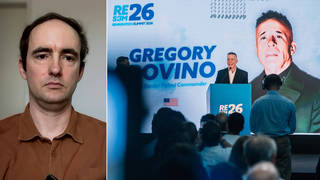
 StoryJun 04, 2026Far-Right Leaders, Including Ex-CBP Chief Greg Bovino, Convene in Portugal for “Remigration Summit”
Transcript
AMY GOODMAN: This is Democracy Now!, democracynow.org, The War and Peace Report. I’m Amy Goodman. We’re broadcasting from Northern Visions TV, community television here in Belfast. We’re here in Belfast for the Docs Ireland film festival. The film about Democracy Now!, Steal This Story, Please!, will be premiering first at the film festival on Tuesday night at Queen’s cinema. We look forward to seeing folks there. I’ll be there with the director Tia Lessin.
Here in Belfast, Northern Ireland, tens of thousands of people gathered Saturday outside Belfast City Hall for a rally organized by United Against Racism. The solidarity protest, which was supported by local trade unions, followed several days of violence in Northern Ireland in which masked rioters set fire to houses and cars, targeting immigrants and ethnic minorities. In one incident, four masked men reportedly chased a nurse into the Ulster Hospital. In another, two Ugandan health workers were barricaded in their home for four hours as neighboring properties burned and rioters threw stones at their windows. Emergency services told them it was too dangerous to try and leave. Their pastor eventually managed to negotiate their exit. This is Belfast resident Greg Sachno, who attended the “Together Against Hate” demonstration.
GREG SACHNO: It’s wrong, it’s racism, and it’s not what this city is. So, everybody here today is united in support of our migrant and new arrivals. We’re here showing solidarity. This is what this city is about. And I say to those racists: You’re not welcome. This isn’t your city. This belongs to everybody.
AMY GOODMAN: The disorder began a week ago after an asylum seeker from Sudan was charged with attempted murder in a stabbing attack. As video of the attack circulated online, calls for protests against immigration followed. The family of the victim, Stephen Ogilvie, who lost his eye in the attack, urged against violence. They wrote in a statement, quote, “We are aware of the tensions and talk of the protests following this incident. We want to make it absolutely clear that overnight unrest is not welcome. … We do not want this terrible tragedy to be used to divide people or fuel hostility,” they wrote.
Less than 24 hours after the attack, hundreds of people joined protests, some becoming violent. Police in Belfast deployed water cannons to quell the anti-immigrant rioters. At least 23 people were arrested, 12 police officers injured. Hilary Benn, the U.K.-Northern Ireland secretary, condemned the violence as “racist thuggery,” speaking on Sky News.
HILARY BENN: Well, if you are targeting people on the basis of their color of their skin, how else can you describe them? This is — that is racist thuggery. There’s no question about it at all, because we are a society where, as Martin Luther King famously said, we should judge people by the content of their character and not by the color of their skin. And these, these are people who have come to Northern Ireland, settled. Someone was forced out of their home. They’ve been living here for 20 years. And they’re working in the health service. They’re working in industry. They are colleagues and friends of people who were born and brought up in Northern Ireland. And there is no place for this whatsoever.
AMY GOODMAN: Hilary Benn is Northern Ireland’s secretary of state. He’s an MP, a member of the British Parliament. He’s also the son of the late MP, for over 50 years, Tony Benn, the famous antiwar Labour MP.
When the anti-immigrant violence broke out, Belfast resident Ruchira Rangaprasad put out a call on social media offering to provide food to people too scared to leave their homes, and also requested volunteers help make the deliveries.
RUCHIRA RANGAPRASAD: I think I’m personally scared to step out of my house. I don’t want to be out. I don’t want to, because especially, like, there was like a hit list being passed around with, like, addresses and all of that. And a lot of those hit list roads are very close to me. And there are so many — like, literally, basically, every single area in Belfast is somehow on that hit list, so, like, people are scared to step out of their home. And food is like a basic need. And especially like a nutritious, home-cooked food is so, so important, especially during this time. So, that’s why I thought, “OK, let me, like, cook can help feed people.” …
I’ve been in Northern Ireland about three years now. Actually, if anything, I feel like from this experience, from yesterday and today, I have a lot more respect for Northern Ireland, and I love Northern Ireland and Belfast a lot more, because in one day 30-plus people showed up, all strangers, just being like, “I will help.” And there’s literally war out there. There’s petrol bombs being thrown out there. And they don’t care, and they’re like, “We will help, and we will give this food. And, you know, we got you.” And that spirit, I have never seen in any other city. So, I actually love Belfast.
AMY GOODMAN: For more, I’m joined in studio here in Belfast, Northern Ireland, by two guests. Sinéad Marmion is an immigration lawyer based in Belfast. Patrick Corrigan is the Northern Ireland director of Amnesty International UK.
We welcome you both to Democracy Now! It’s great to be with you in studio here at Northern Vision. Patrick, let’s begin with you. You both were at the mass protest this weekend, that protest for immigration and against what Hilary Benn called the “racist thuggery.” You were speaking, Patrick, to a lot of the community activists on the ground right here in front of Belfast City Hall. It was really interesting, because I flew in from Sheffield, the film festival there. As we left, there was an anti-immigrant protest of what? Sixty or 70 people, but a lot of people responding. And as I flew in, tens of thousands of people saying, “No, this is a different Belfast.”
PATRICK CORRIGAN: That’s right. It was such an important, I think, ray of light after a very grim week for Belfast, and to be able to stand with my neighbors, fellow citizens of Belfast, in their thousands, to send a message to those racist thugs that they do not represent the true spirit of Belfast. And the vast majority of people in Belfast, as across Northern Ireland, are antiracist and very welcoming to the people who have come here to make their lives from around the world, who work in our health and care sectors and many other walks of life. And we wanted to send, most importantly, I think, a message to them, say, “You are welcome. This is your city. This is your home, just as much as it is ours,” but also to call out the politicians and the state authorities who had left people vulnerable and under attack during the days before.
AMY GOODMAN: Talk about who were the people, masked young men, particularly, who were burning houses and cars. Talk about how this started.
PATRICK CORRIGAN: You know, this is the third consecutive summer of racist, organized mob violence we have seen in Belfast and beyond in Northern Ireland. So it didn’t happen in a vacuum. And increasingly, it is coordinated, both online and offline. There is an overlap within loyalist paramilitary circles. A lot of the violence happened in areas in Belfast that they effectively control, and that nobody would be able to take over the streets and commit that sort of level of violence without their say-so. And the people — some of the people who are out on the streets masked and mobbed up were teenagers, and I think they’ve been exploited, manipulated. Others were grown men, some of whom have a long history of violence in this city. And I think on top of that, then, we have a wider ecosystem of online anti-immigration and pro-racism being promoted and being used — those online spaces being used to organize people, as well as actively promote misinformation.
And I think that terrible incident that happened at the start of the week was immediately seized on and exploited by people in order to engender hate and, ultimately, to result in violence, which we had, sadly, been predicting was coming. We had been warning the authorities. And sadly, when it happened, they were found wanting, and too often it was left to community activists, many of whom I was speaking to on Saturday at the antiracism rally, who had gone into people’s homes, people’s homes who were under attack, people’s homes who were being firebombed, and rescuing them out the back door, putting them into their own cars, bringing them to emergency accommodation, which had been organized on positive community WhatsApp groups overnight. And it’s those people who I think are the real heroes of the moment, of these last few days, as well as the tens of thousands who took to the streets of Belfast to say, “This is the real Belfast.”
AMY GOODMAN: Can you talk about Elon Musk? What does he have to do with these protests?
PATRICK CORRIGAN: Well, it was he, alongside some of these other online spaces. These social media owners have been allowing their platforms to be used not only to promote misinformation, disinformation, but also to be used as an organizing space for the racists. The call went out on social media for people to come out ready to fight, ready to get arrested, to wear all in black, to put on masks, to turn off their mobile phone cameras, warnings for people to turn off their doorbell cams so that police wouldn’t be able to identify people through video afterwards.
So, not only did Elon Musk, however, allow his social media platform to be used in that way, he joined in, and he was resharing far-right content, as well. We have our own fair share of homegrown racists in this place. The last thing that we needed was people like Elon Musk and others joining the pro — you know, the pro-protest parties.
AMY GOODMAN: Sinéad Marmion, you certainly saw this happening. You’re an immigration lawyer. You’re dealing with a lot of immigrants right now who are terrified. Many are recruited to come here to Belfast, by, for example, UNISON, the massive, what, union. Fifty thousand union members are here to be healthcare workers, to work in hospitals, home care. And yet you have Elon Musk amplifying. Talk about whose voices he was amplifying.
SINÉAD MARMION: Absolutely. You’re right to say that our health service relies on foreign labor that is actively sought. And Elon Musk has been portraying that — you know, he’s targeted our lord mayor, for example, who’s just been office a week, and saying that she’s a betrayer of our people.
AMY GOODMAN: She’s 30 years old, right?
SINÉAD MARMION: She is, yeah. And he —
AMY GOODMAN: What did he say?
SINÉAD MARMION: He said she was a betrayer of our people, of her people, so an extremely evocative statement, and provocative, and it has undoubtedly led to the mobilization, as Patrick has said, of those racist thugs of the community groups that have been historically existent here, ready to attack people in their homes. And I’ve seen clients, I’ve heard from clients who were put out of their houses, were burnt out of their houses, clients with young kids who are terrified.
And as Patrick says, it’s the community that has picked up the pieces. It’s women in the community, it’s migrant women in the community, that have organized and mobilized the response. And our authorities have been left wanting, as Patrick has said, as well. So, it is an extremely volatile situation, but it’s not the Belfast that we know and love, having worked with communities and worked with lots of people who call Belfast their home.
AMY GOODMAN: Can you talk about some calls that you have gotten?
SINÉAD MARMION: Yes. I received a call over the weekend from a client of mine from Syria, who has a young daughter, and her daughter was sending me messages saying that her mum was too sad to come to the phone. She and her mum had slept in the kitchen of the house at the back of the property, because they were too afraid to be seen. They have been left again without any help from the authorities, and we’re looking to try and assist somehow with her and her child. I have another client who was burned out of her house, and she has a — she has a young child, as well. And she’s now staying in emergency accommodation. So, it has been affecting people that have called Belfast their home for numbers of years, who are legally and lawfully here and have now been targeted in, essentially, what is racial profiling.
AMY GOODMAN: The Belfast Islamic Centre halted evening prayers last week due to the racist violence. This is Kashif Akram, who’s a member of the center’s executive committee.
KASHIF AKRAM: It’s heartbreaking. It really is. At the same time, you know, Belfast is full of a lot of decent people. We’ve had a lot of support from the local community. And the people who are spreading the hate at the moment, they’re a minority. They’re very few. But definitely, it’s sent shocks throughout the whole community. A lot of, you know, ethnic minority people at the moment are living in fear. We’re getting a lot of calls at the moment. You know, the levels of distress are very, very high. …
I’ve lived in Northern Ireland, born and bred here, 44 years. This is the worst I’ve seen it. Does it change my kind of perception, or does it make me fearful of living here? Definitely not. I see hope. I see hope. And hope is not something we just sit and kind of pray or think about. It’s created by action. And we’re seeing that. We’re seeing a lot of local support. We’re seeing people come together. Communities are sick and tired of the sort of intimidation, which has been happening in Belfast over the years.
AMY GOODMAN: That’s Kashif Akram of the Belfast Islamic Centre. Patrick, you know him well.
PATRICK CORRIGAN: Yes. And unfortunately, the Islamic Centre has been the target of repeated attacks over recent years, including last year, an attempted firebomb attack into the building itself. The Muslim community in Belfast and across Northern Ireland has been under a very serious threat. There has been a particular anti-Muslim, anti-Islam dimension to these racist attacks. We have seen murals and banners and placards going up across Belfast and elsewhere, not just in the last week, but over the last several years, that are specifically targeting Muslims for this sort of race hate. So, they are particularly vulnerable at the moment, and so our heart goes out to them.
But they have also been on the receiving end of huge public community support. And again, to reiterate the message of the antiracism protest, that’s the real spirit of Belfast, and that’s the views of most people who live here, not the vociferous and sometimes violent minority that we saw on our streets last week, as well.
AMY GOODMAN: And, Sinéad Marmion, if you could talk about the Sudanese women who are gathering to do mutual aid?
SINÉAD MARMION: Yes, it’s been fantastic. There’s an organization called the Anaka Collective in Belfast.
AMY GOODMAN: Anaka.
SINÉAD MARMION: Yes. And it’s run by women. It’s a women’s collective, and, indeed, two Sudanese women, as well. So, they have organized pretty much immediately, immediate support across other community organizations, across certain political parties, as well, have assisted. I say “certain,” not all. And we’ve seen a rehoming, I think, of 200 people in the past week, food deliveries, people getting lifts to appointments. And it’s an unbelievable community effort, which is the real — the real spirit of Belfast.
But it does come against the backdrop from our government of hostile environment policies that have been created over the past number of years that demonizes immigration. It focuses on negatives, you know, negative immigration. It hasn’t put any positive policies in place for integration. We have no racial equality strategy here in Northern Ireland. We have no anti-poverty strategy. None of that has been moved to assist people who are coming to Belfast to call it their home. And it’s against the backdrop of where we have political parties that are stoking the flames and encouraging what they call a “legitimate concern on immigration” in circumstances where that is not well founded, and the conversation, resultingly, is always toxic.
AMY GOODMAN: Patrick, as we begin to wrap up, can you put this in a global context, what we’re seeing here in Belfast, which is not, of course, isolated? And by the way, the anti — the pro-immigration protests that took place here this weekend took place in Derry, took place, really, in so many places in solidarity with immigrants. But what about this right-wing push that really features anti-immigrant racism?
PATRICK CORRIGAN: So, we know we’re not alone in Northern Ireland in facing these problems of racists, and sometimes violent racists, with a backdrop of anti-immigration, anti-migrant political rhetoric sometimes coming from leaders of countries. We’ve seen that across Europe. We’ve seen it, obviously, in the U.S.
Sometimes people are coming to build their lives here because they’re fleeing some of the wars that you talked about at the top of the program. Otherwise, they’re coming for economic reasons, to build new lives, just as Irish people have done into the U.S. and elsewhere for many, many generations. But I think what we have seen globally is sort of a far-right stoking of people’s fears, exploiting people’s fears around societies that are changing, shifting a little bit.
And I think what we need is real political leadership. The words of condemnation we got from Hilary Benn and from Keir Starmer this week, they’re welcome, but they’re not really very useful to people who are being burned out of their homes and who are worried about what the rest of this summer holds. And I think that we need political leaders to step up to the mark, rather than joining in the inflammatory rhetoric that ultimately leads to inflammable materials being put into people’s homes, followed by flames. And I think that, you know, the Keir Starmers, the Hilary Benns and our own political leaders have a lot to answer for in terms of the lack of leadership they have given. Condemnation statements are easy after the event. A bit of sympathy for people, easy after the event. What did you do before? How did you heed the warnings from the summer of violence we had last year, the summer of violence we had the year before? I’m afraid the answer is nothing. And into that vacuum has stepped community activists trying to do the right thing to rescue their neighbors. But we need political leadership now. We need it in this country, but we need it globally.
AMY GOODMAN: Patrick Corrigan, Northern Ireland director of Amnesty International UK, and Sinéad Marmion, immigration lawyer based here in Belfast.
Coming up, the Justice Department approves the $111 billion merger of Paramount and Warner Bros. Discovery. We’ll speak to Craig Aron of Free Press. Stay with us.
[break]
AMY GOODMAN: “King’s Daughters Home for Incurables” by The Corner Laughers.




 Top
Top
Media Options